
 Arka Pratama
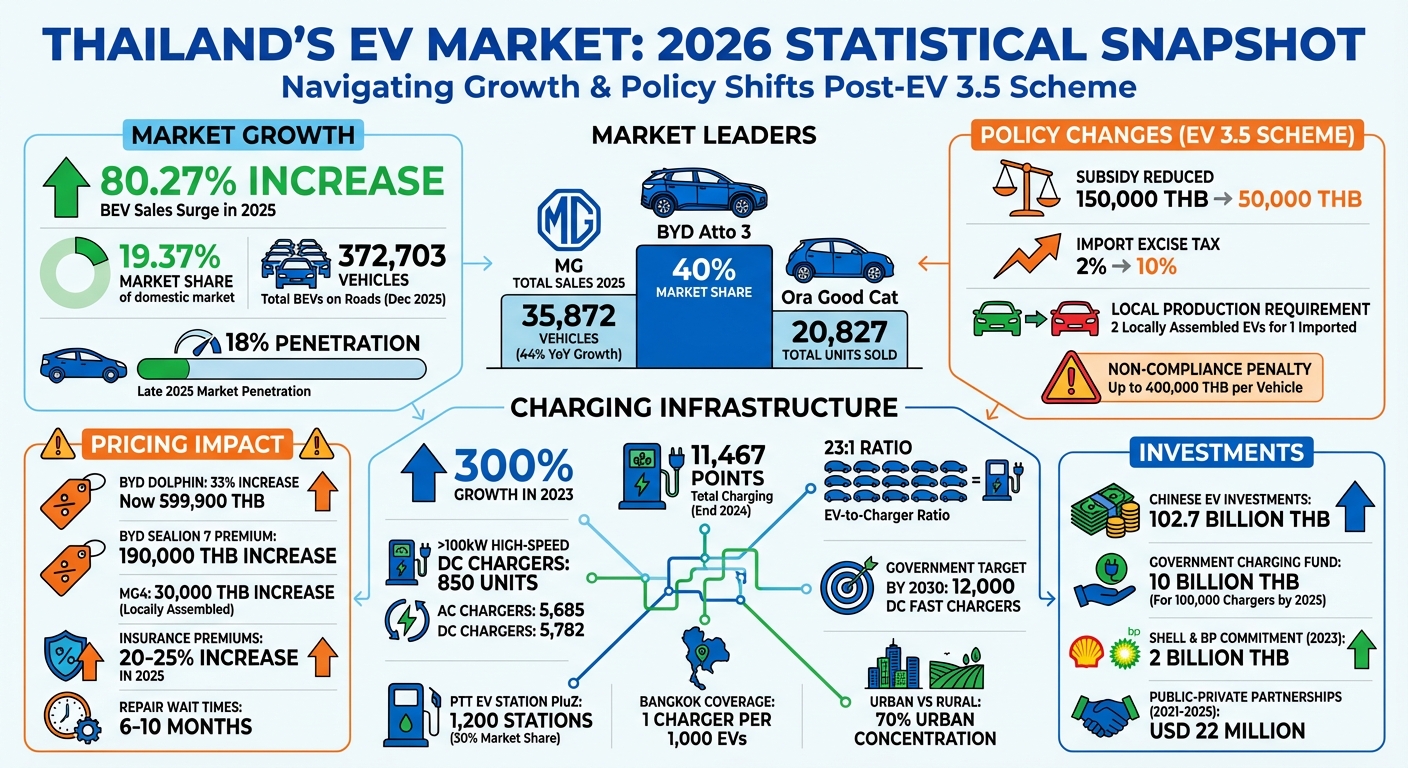
Thailand’s electric vehicle (EV) market in 2026 is reshaping itself with a shift from price competition to a focus on reliability and service. Sales of battery electric vehicles (BEVs) surged by 80.27% in 2025, capturing 19.37% of the domestic market. Key drivers include heavy investments by Chinese automakers like BYD and MG, local production growth, and expanded charging infrastructure. However, policy changes under the EV 3.5 scheme have reduced subsidies and increased taxes on imports, leading to price hikes across the board.
Key Highlights:
- BYD Atto 3 leads the market with 40% share, offering affordability, reliability, and strong after-sales service.
- MG4 Electric excels in the mid-range segment with competitive pricing and local assembly.
- Charging infrastructure expanded by 300% in 2023, with over 4,500 public chargers supporting EV adoption.
- New government policies require manufacturers to produce two locally assembled EVs for every imported one, increasing production challenges.
- Imported EVs face higher taxes, with excise duty rising from 2% to 10%, creating a pricing gap with locally produced models.
In 2026, buyers prioritize long-term support, spare parts availability, and service networks over initial cost. This marks a transition from a "Price War" to a "Trust War", as automakers adapt to stricter regulations and evolving consumer expectations.
Thailand EV Market 2026: Key Statistics and Growth Metrics
2026 รถ EV ขึ้นราคาทั้งตลาด ยอดขายจะร่วงหรือไม่ ? | ลุงใจดี…มีเรื่องเล่า EP109
Top-Selling EV Models in Thailand 2026
Thailand’s EV market in 2026 is shaped by models that balance affordability, performance, and brand trust. These vehicles cater to a wide range of preferences, from budget-friendly city cars to high-end performance sedans, meeting the growing demand for dependable and value-driven options.
BYD Atto 3: Market Leader
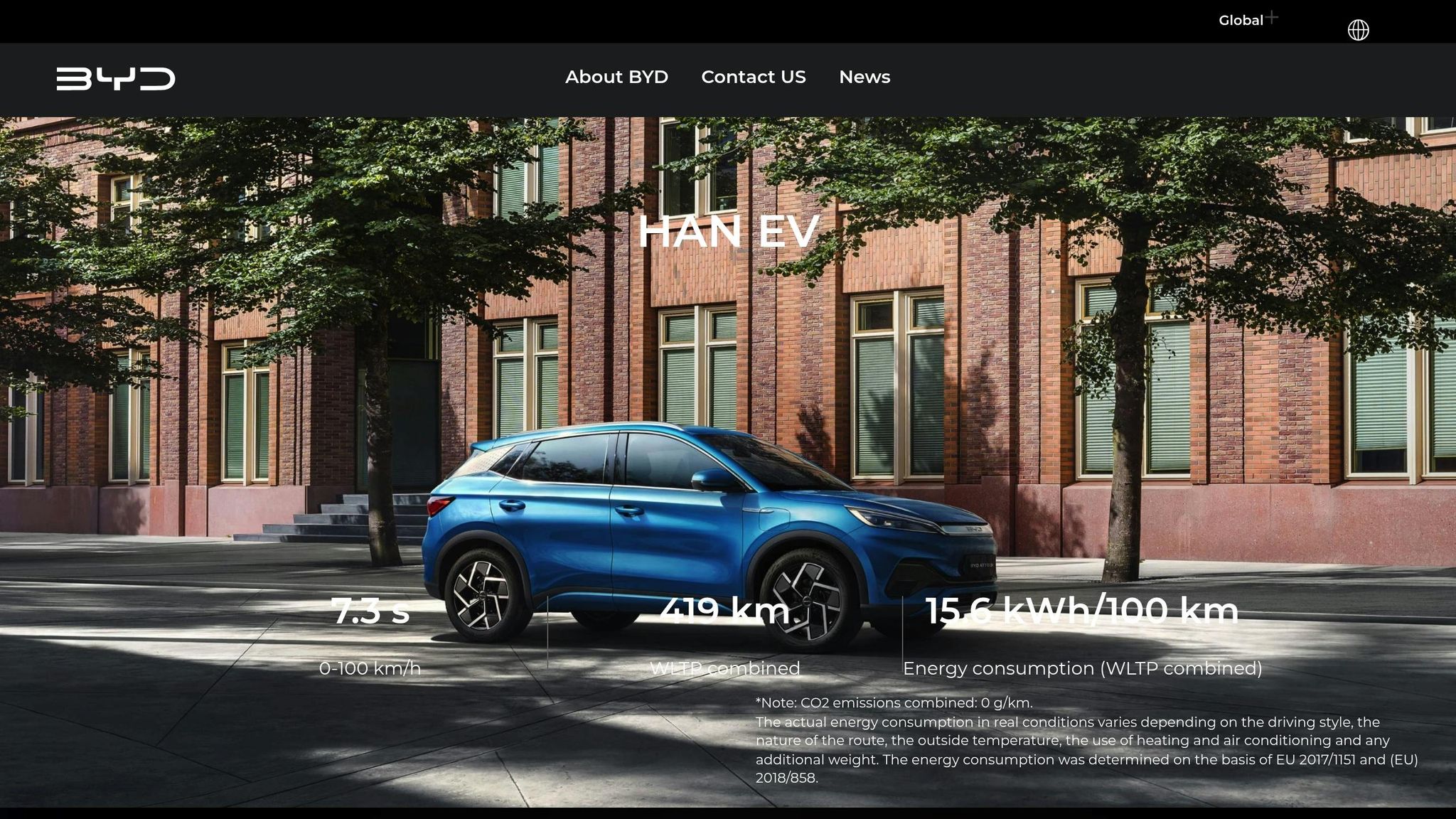
BYD has captured nearly 40% of Thailand’s EV market share by early 2026, with the Atto 3 leading the charge. Since local production began in July 2024, the Atto 3 has benefited from the 50,000 THB government subsidy under the EV3.5 scheme. In contrast, many imported models face a 10% excise tax and miss out on these incentives.
The Atto 3 is well-suited for Thailand’s needs, offering a 201 hp motor, battery options of 49.92 kWh (Standard) and 60.48 kWh (Extended), and a range of 410 km to 480 km per charge. Key features include a 360-degree camera system, ADAS safety features, voice control, and Apple CarPlay. Pricing in 2026 starts at 799,900 THB for the Premium variant (50.25 kWh) and 849,900 THB for the Extended version (60.48 kWh).
"The fear of owning an ‘Orphan Car’ – a vehicle with no parent company to service it – has become the #1 barrier to purchase. Buyers are no longer just looking at the sticker price; they are auditing the company’s balance sheet." – Iconic Research
BYD’s reputation for reliability and its established service network make it a "safe bet" for consumers, especially as some competitors exit the market due to financial challenges. To further reassure buyers, BYD offers a lifetime battery warranty package covering the high-voltage battery, drive motor, and power distribution unit, available for around 5,000 THB during promotions.
This dominance sets a high bar for competitors like the MG4 Electric.
MG4 Electric: Growing Market Share
The MG4 Electric has carved out a strong position in Thailand’s mid-range EV segment, thanks to its Rear-Wheel Drive (RWD) configuration, a standout feature at its price point. MG Thailand reported 35,872 vehicle sales in 2025, marking a 44% year-on-year growth.
Locally assembled, the MG4 is priced between 549,900 THB and 649,900 THB in 2026. It offers variants like the Premium Long Range (280 miles) and Premium Extended Range (338 miles), while the MG4 XPower delivers 435 horsepower and all-wheel drive. Charging is quick, with a 10% to 80% top-up taking roughly 30 minutes.
MG Thailand also provides an "EV Lifetime Warranty", covering the high-voltage battery, drive motor, and motor control unit with no mileage or ownership restrictions.
"MG recorded total domestic and export sales of 35,872 vehicles in 2025, up 44% year-on-year, underlining the brand’s strength in Thailand." – Da ShenShen, Managing Director, SAIC Motor-CP
While the MG4 thrives in the mid-range market, other models like the Ora Good Cat have made their mark in different segments.
Ora Good Cat: Popular Choice
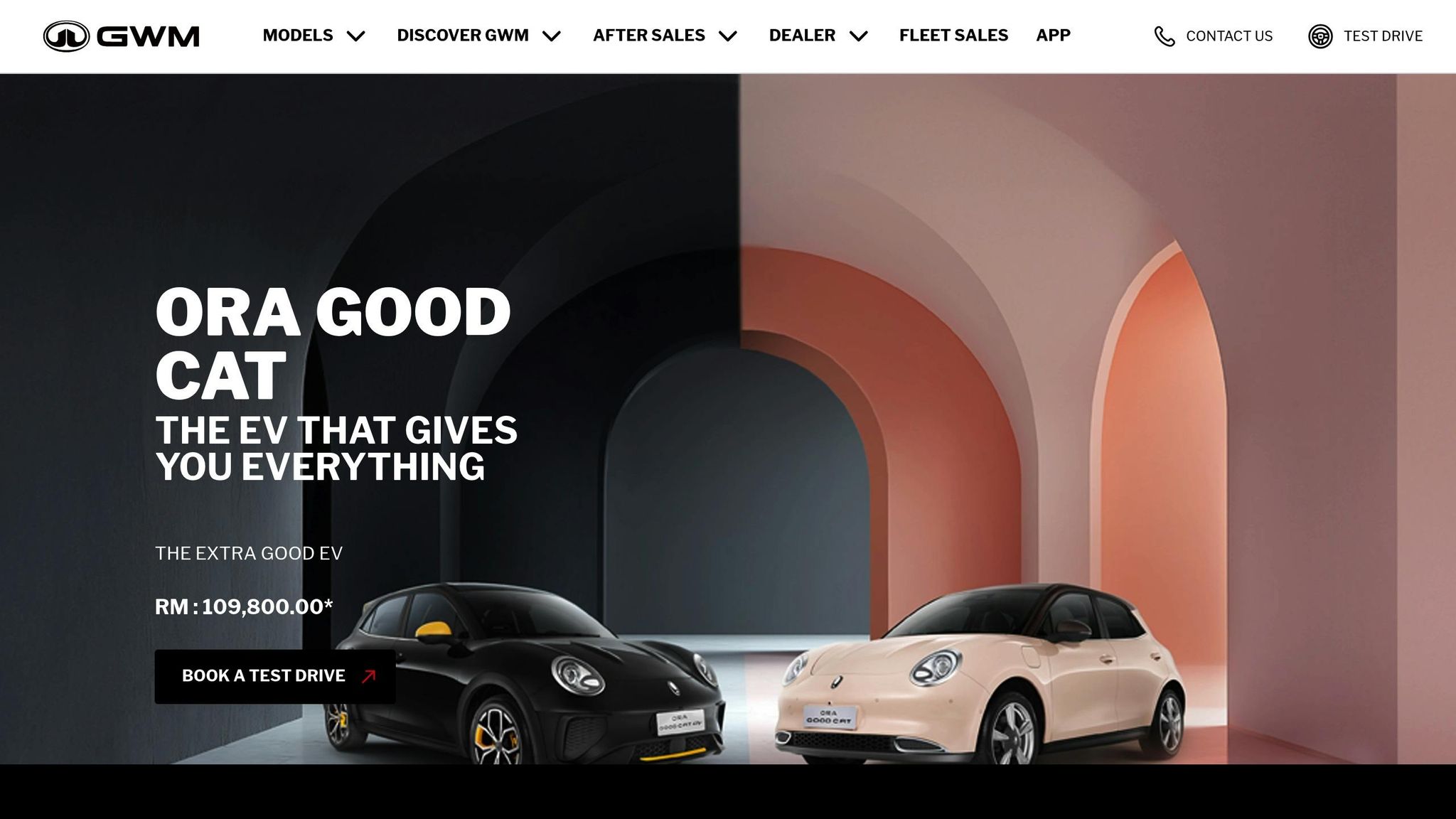
The Ora Good Cat left a lasting impression before production ended in early 2026 to make way for the ORA 5 SUV. Despite its discontinuation, it remains a familiar sight on Thai roads, with total sales of 20,827 units, making it the top-selling EV in Thailand in 2022.
The Good Cat’s appeal lies in its "Retro-Futuristic" design, highlighted by rounded cat-eye LED headlamps. It was also the first EV manufactured at 100% capacity in Thailand at GWM’s Rayong factory, reinforcing consumer trust in locally produced vehicles. With a 480 km range (NEDC), powered by a 57.70 kWh Lithium Iron Phosphate battery, its pricing ranged from 799,000 THB (Pro variant) to 1,099,000 THB (GT variant).
Safety is another strong suit, with 5-star ratings from both EURO NCAP and ANCAP in 2022. Compact dimensions (4,235 mm in length) make it ideal for urban driving, while higher trims come with features like a 360-degree camera, intelligent parking, and a 17.25-inch integrated display.
Price Competition Among EV Manufacturers
Thailand’s EV market in 2026 has moved away from aggressive discounting, embracing a more deliberate pricing approach. The shift from the EV3.0 scheme to the stricter EV3.5 policy has reshaped the competitive landscape, with price increases now becoming a standard trend.
Effects of Reduced Government Subsidies
The new EV3.5 scheme significantly reduced government subsidies, dropping from 150,000 THB to just 50,000 THB, and these subsidies now apply only to locally assembled vehicles. Meanwhile, imported models face a sharp excise tax hike from 2% to 10%. These changes triggered notable price hikes in early 2026.
In January 2026, Rêver Automotive, BYD’s distributor, raised prices across its lineup. The BYD Sealion 7 Premium saw an increase of 190,000 THB, reaching 1,264,900 THB, while the BYD M6 went up by 160,000 THB. The BYD Dolphin experienced a dramatic 33% price increase, now starting at 599,900 THB.
"Chinese EV makers including BYD and SAIC’s MG have raised prices in Thailand after subsidies of up to THB 150,000 per vehicle were phased out."
– Nikkei Asia
The pricing gap between locally assembled and imported models has widened. For instance, on 12 January 2026, MG Sales increased the price of the locally assembled MG4 by 30,000 THB to 549,900 THB, while the imported MG IM6 jumped by 100,000 THB. To cushion the blow, MG introduced an "EV Lifetime Warranty", offering unlimited mileage coverage for the high-voltage battery and drive motor.
These price adjustments reflect a broader strategy shift. After the intense discounting frenzy to clear inventory before the 150,000 THB subsidy expired on 31 December 2025, automakers in 2026 are prioritising profit margins and value-added incentives over price wars.
Local Production Requirements and Pricing
The EV3.5 scheme has introduced stricter local production mandates. Manufacturers must now produce two locally assembled vehicles for every imported one, a significant increase from the previous 1:1 ratio. Non-compliance comes with hefty penalties of up to 400,000 THB per vehicle. Additionally, the policy limits the imported battery cell content to 10% of an EV’s factory price, down from 15%, although exported EVs count as 1.5 units towards domestic production targets.
Industry experts have referred to this as a "Production Trap", as subsidy eligibility is now tied to meeting domestic production quotas. Some analysts predict that manufacturers might resort to strategic self-purchases – buying their own vehicles – to meet these targets.
These regulatory challenges have further intensified competition, particularly for Chinese manufacturers, who are facing stricter local sourcing and production requirements.
Competition from Chinese EV Manufacturers
Chinese automakers continue to dominate Thailand’s EV market, with BYD alone accounting for nearly 40% of EV sales by early 2026. This dominance is partly driven by overcapacity in China and the redirection of production due to Western trade restrictions. Chinese EV investments in Thailand have exceeded 102.7 billion THB (approximately PKR 946 billion).
By late 2025, EVs made up about 18% of Thailand’s total automotive market share, and the competition has evolved into what analysts are calling a "Trust War". Consumers are increasingly wary of "orphan cars" – brands that may exit the market – following incidents like Neta Auto’s parent company defaulting on 200 million THB in debts owed to Thai dealers.
"You cannot win a Trust War with a Price War strategy. To survive 2026, you must stop selling cars and start selling certainty."
– Iconic Research Thailand
Other challenges include rising EV insurance premiums, which increased by 20–25% in 2025 due to higher loss ratios, and repair delays, with collision damage wait times stretching 6–10 months, according to the Thailand Consumer Council. These issues have shifted the focus from upfront pricing to long-term reliability, service networks, and parts availability.
Japanese automakers have responded by leveraging their extensive service networks and promoting hybrid models to maintain their market leadership. Meanwhile, Chinese brands continue to dominate the pure EV segment, supported by advanced technology and strategic investments in local production.
sbb-itb-5f05a6f
Charging Infrastructure Development in Thailand
By the end of 2024, Thailand’s charging network had grown to include 11,467 points, split almost evenly between 5,685 AC chargers and 5,782 DC chargers. By December 2025, the country had 372,703 battery electric vehicles (BEVs) on the roads, resulting in an EV-to-charger ratio of 23:1. Despite this ratio, 93% of EV drivers in Thailand found charging more convenient in the latter half of 2025. This progress has laid the groundwork for a faster rollout of DC fast chargers across the nation.
DC Fast Charger Network Expansion
In early 2026, Spark EV Co., Ltd. took a significant step by rolling out 250 DC fast-charging sites equipped with Autel Energy‘s DH480 ultra-fast chargers, which feature AI diagnostics. This is part of their larger goal to establish 1,000 charging sites nationwide.
PTT Oil and Retail Business expanded its EV Station PluZ network to 1,200 stations by the third quarter of 2024, securing a 30% market share. They aim to reach 7,000 charging points by 2030. Similarly, the Electricity Generating Authority of Thailand (EGAT) increased its "EleX by EGAT" network from 211 to 321 outlets by late 2024 and introduced a queue management app to streamline the user experience.
By 2024, Thailand had approximately 850 high-speed DC chargers capable of delivering over 100kW. The government has set an ambitious target of 12,000 DC fast chargers by 2030. The country’s 50:50 split between AC and DC chargers is well above the global average of 39% DC chargers, highlighting Thailand’s focus on supporting long-distance travel and commercial fleets.
Urban and Rural Coverage Gaps
Bangkok leads the way with 1,800 chargers, equating to 1 charger per 1,000 EVs. However, 70% of the charging network is concentrated in urban areas, leaving rural regions with less than 20% of urban coverage levels.
"Thailand’s charge-point sufficiency compares favourably with neighbouring countries, but its geographical spread could improve."
– Timothy Wong, Principal at Roland Berger
The Provincial Electricity Authority (PEA) is working to close this gap through its PEA VOLTA network, which holds a 13% market share. Leveraging its extensive provincial grid, PEA has been deploying chargers in less urbanised areas. To address grid limitations in rural regions, 200 solar-integrated charging units have been installed, a practical solution for areas where the existing infrastructure struggles to handle the load from high-power DC chargers.
Government and Private Sector Funding
Bridging these regional disparities requires a mix of public and private investments.
The Thai government has allocated 10 billion THB (≈PKR 92.2 billion) to fund the installation of 100,000 chargers by 2025. Between 2021 and 2025, public–private partnerships raised USD 22 million (≈PKR 6.1 billion) to support the EV charging ecosystem. Additionally, the Board of Investment (BOI) offers a five-year tax exemption for charging stations with 40 or more chargers, including at least 10 DC chargers. Low-priority electricity tariffs have also been extended until 2025 to encourage growth.
Private companies have stepped in with substantial investments. In 2023, Shell and BP committed 2 billion THB (≈PKR 18.4 billion) to EV charging in Thailand. Energy Absolute’s "EA Anywhere" network now holds a 16% market share, while Spark EV and other operators have adopted revenue-sharing and co-investment models to reduce upfront costs for landowners. Collectively, PTT Group, Energy Absolute, and PEA Volta control nearly 60% of the public charging market.
EV24.asia‘s Role in Thailand EV Imports
As Thailand’s electric vehicle (EV) market evolves, a shift from a "Price War" to a "Trust War" is expected by 2026. Buyers are no longer just looking at the initial price tag – they now value long-term reliability, availability of spare parts, and efficient service more than ever. EV24.asia steps in to meet these changing priorities by offering a carefully curated selection of EVs with transparent pricing and comprehensive import support. This approach helps Thai consumers navigate the increasingly complex policies shaping the EV market.
Available Models Across Price Ranges
EV24.asia caters to a wide range of buyers by offering electric vehicles across different price points – entry-level, mid-range, and premium. Their selection includes popular brands like Tesla, BYD, Volkswagen, and XPeng, ensuring there’s something for every budget and lifestyle.
Import and Registration Support
The shift from the EV 3.0 to the EV 3.5 incentive scheme in early 2026 has made the EV import process more challenging. For instance, excise tax on imported Completely Built-Up (CBU) vehicles has increased from 2% to 10%. EV24.asia simplifies this process by handling customs clearance, vehicle registration, and shipping logistics, whether through RoRo or container shipping. The platform also played a key role in helping buyers meet the extended EV 3.0 registration deadline in January 2026.
Advantages for Thai Buyers
EV24.asia goes beyond just streamlining imports – it builds buyer confidence by offering complete cost transparency. With the removal of the 150,000 THB (≈PKR 41,550) government subsidy and higher excise taxes in 2026, imported EVs now come with added financial challenges. However, EV24.asia addresses these hurdles by clearly detailing all costs, offering flexible payment options, and providing ongoing customer support. By breaking down total landed costs, including taxes and fees, the platform empowers buyers to make well-informed decisions, even in a regulatory environment that’s becoming increasingly complex. This clarity and support are especially valuable in a time of reduced subsidies and rising import taxes.
Conclusion
Thailand’s electric vehicle market is undergoing a major transformation in 2026, shifting focus from price-based competition to what experts are calling a "Trust War." By late 2025, EV market penetration reached 18%, with models like the BYD Atto 3 and MG4 Electric standing out due to competitive pricing and local production. Recent policy changes have reshaped the landscape, reducing subsidies while enforcing stricter local production requirements. These shifts are pushing manufacturers to rethink their pricing strategies.
Imported EV models now face significantly higher taxes, creating a noticeable divide between locally assembled and imported vehicles. Locally produced models have seen modest price increases, while imported options have experienced far steeper hikes.
"2025–2027 will be the ‘Elimination Round’ of the EV industry".
Charging infrastructure has also seen rapid growth, with the number of public chargers increasing by 300% in 2023 and the PTT OR network expanding to 1,200 stations by Q3 2024. The government aims to hit 20,000 public chargers by 2025, though gaps between urban and rural areas remain. High-speed DC chargers capable of over 100 kW now total 850 units, enhancing long-distance travel capabilities. Investments in charging infrastructure have strengthened the market’s support network, making it more reliable than ever.
EV24.asia has emerged as a key player in helping Thai consumers navigate these changes. By offering transparent pricing for brands like Tesla, BYD, Volkswagen, and XPeng, and handling the complexities of the import process, the platform meets the growing demand for reliability and clarity. With insurance premiums rising by 20–25% and spare parts wait times stretching to 6–10 months, buyers are prioritising comprehensive support over just securing the lowest price tag. These developments point to a more mature and dependable EV market in Thailand as 2026 unfolds.
FAQs
Is it cheaper to buy a locally assembled EV in Thailand in 2026?
Yes, locally assembled electric vehicles (EVs) in Thailand are expected to be more affordable in 2026. This is largely due to government subsidies and lower import taxes, which help reduce costs. On the other hand, the prices of imported EVs have gone up because subsidies and support for them have been reduced. As a result, locally assembled EVs offer a more budget-friendly choice for buyers.
How can I avoid ending up with an “orphan car” in Thailand?
To steer clear of buying an “orphan car” in Thailand, it’s essential to dig deep into the vehicle’s history. Start by checking ownership and registration details, and make sure all the necessary documents and service records are in order. This becomes even more critical with the competitive EV market and its shifting prices. Doing your homework upfront can save you from future headaches and ensures your vehicle remains dependable with proper support over time.
Will fast charging be practical outside Bangkok by 2026?
Thailand is gearing up to make fast charging practical beyond Bangkok by 2026. The country has already installed more than 850 high-speed DC chargers nationwide, with 1,800 chargers located in Bangkok alone. Together, these chargers provide a total capacity of 500 MW, capable of supporting 200,000 electric vehicles (EVs). This progress reflects a strong push to expand EV infrastructure, making it easier for drivers to adopt electric vehicles across the nation, not just in the capital.