
 Arka Pratama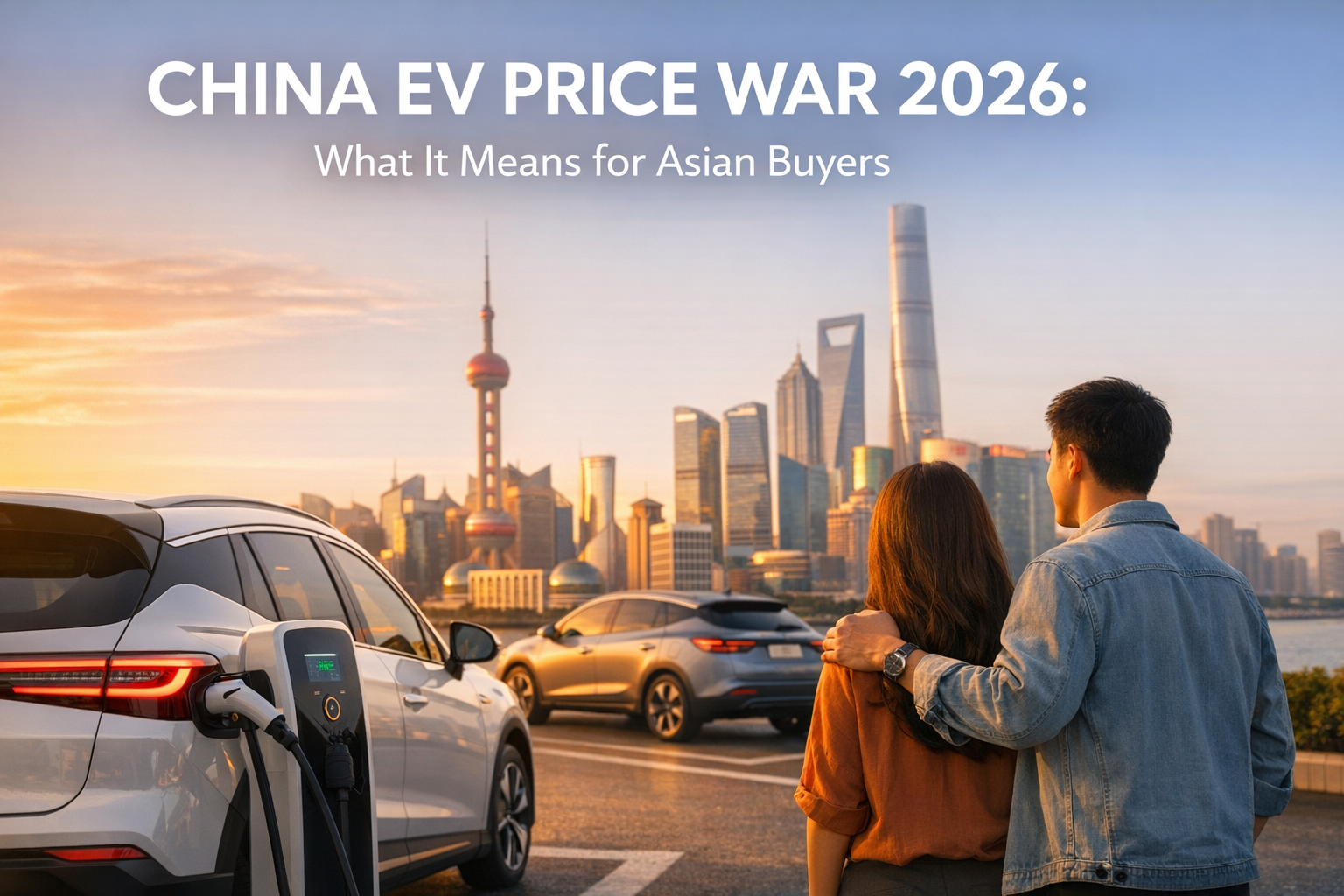
China’s EV price war is reshaping the market, with Pakistani buyers standing to benefit from lower prices and local production. Here’s what you need to know:
- Chinese EV prices have dropped by 19% since 2023, with brands like BYD, XPeng, and Li Auto slashing costs to compete.
- BYD is starting local assembly in Karachi by mid-2026, reducing prices further by cutting import duties and freight costs.
- Key models like the BYD Seagull could cost as low as Rs 28,00,000, while financing options like zero-interest loans make EVs more accessible.
- XPeng and Li Auto focus on premium imports, but lack local assembly, making them pricier and harder to maintain in Pakistan.
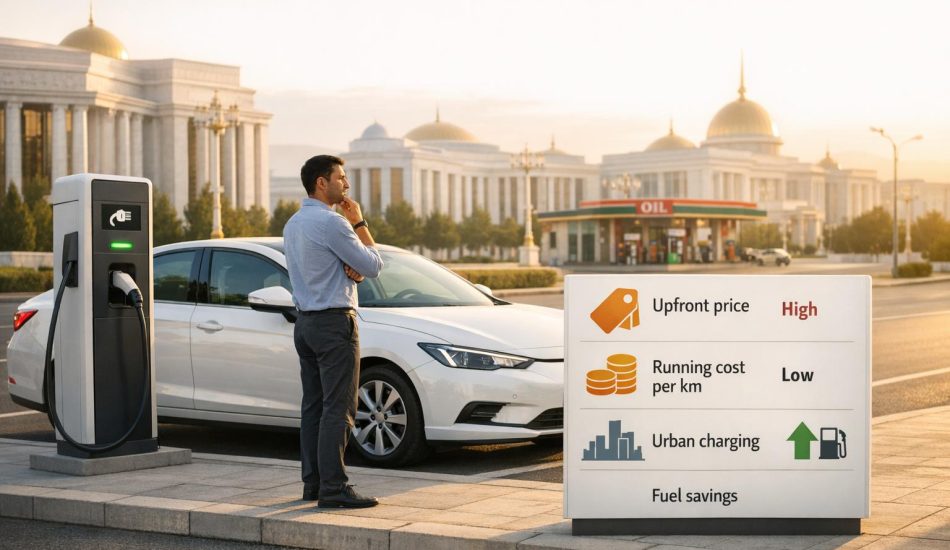
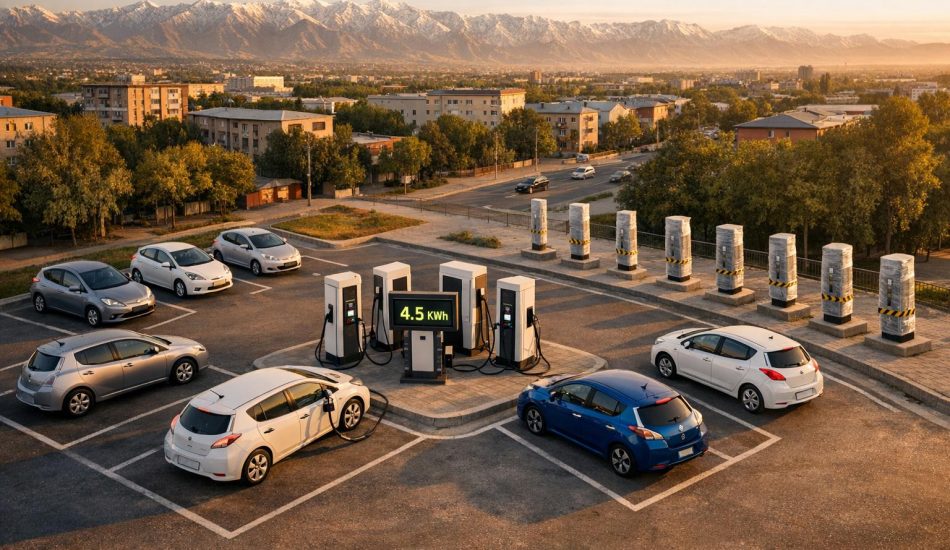
- EV charging costs in Pakistan are dropping, thanks to a 45% reduction in power tariffs for EV chargers, effective January 2026.
For buyers in Pakistan, 2026 offers a strong opportunity to purchase affordable EVs, especially with BYD’s local production and aggressive pricing. However, premium brands like XPeng and Li Auto may appeal to those seeking high-tech features despite their higher costs.
BYD Slams EV Price War as ‘Unsustainable’ – But Keeps SLASHING EV Prices
EV Models and Price Changes in 2026
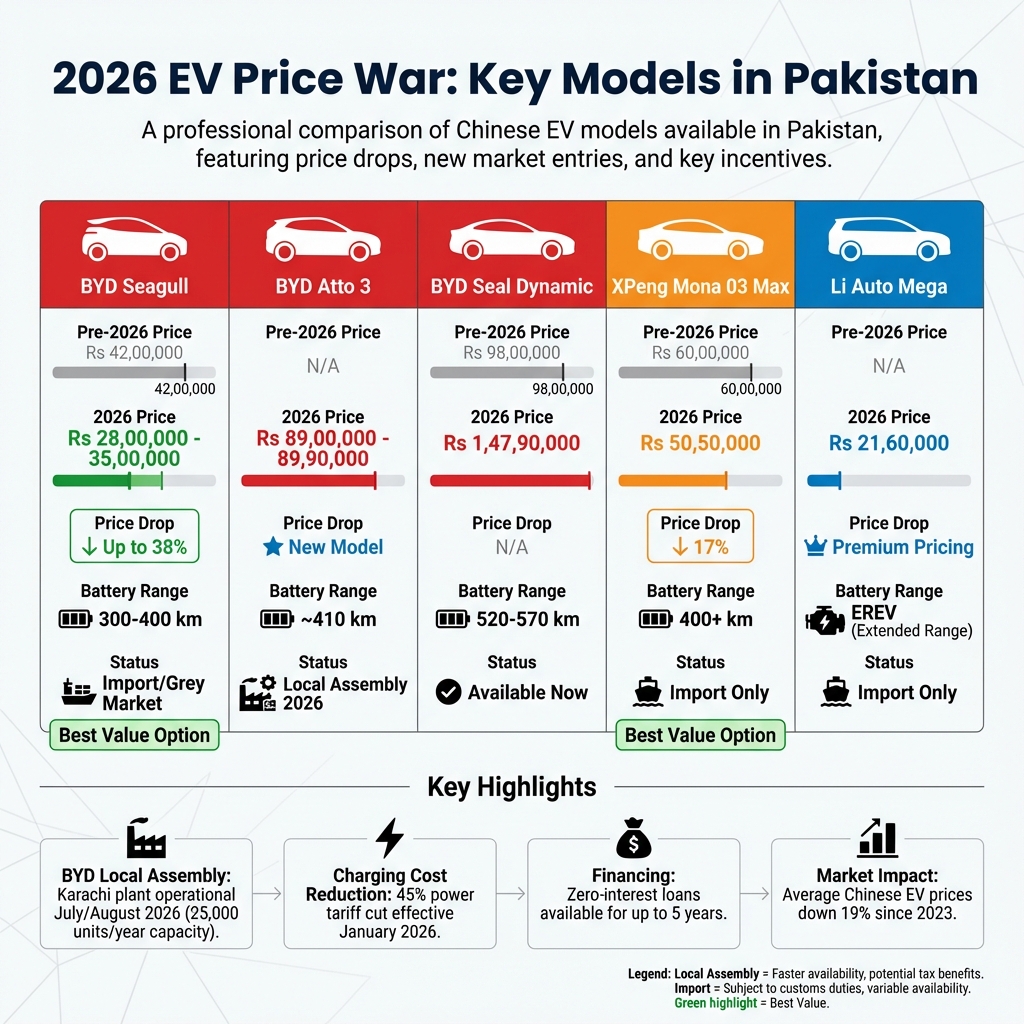
China EV Price Comparison 2026: BYD vs XPeng vs Li Auto Models in Pakistan
The ongoing EV price war in China is having a noticeable impact on Pakistan, driving down the prices of key electric vehicle models. For example, BYD’s Seagull, which was priced at around Rs 42,00,000, is expected to drop to a range of Rs 28,00,000 to Rs 35,00,000 by 2026. Some models may see price reductions of up to 38% as manufacturers aim to clear out inventory. Adding to the appeal, buyers can also take advantage of zero-interest financing plans for up to five years.
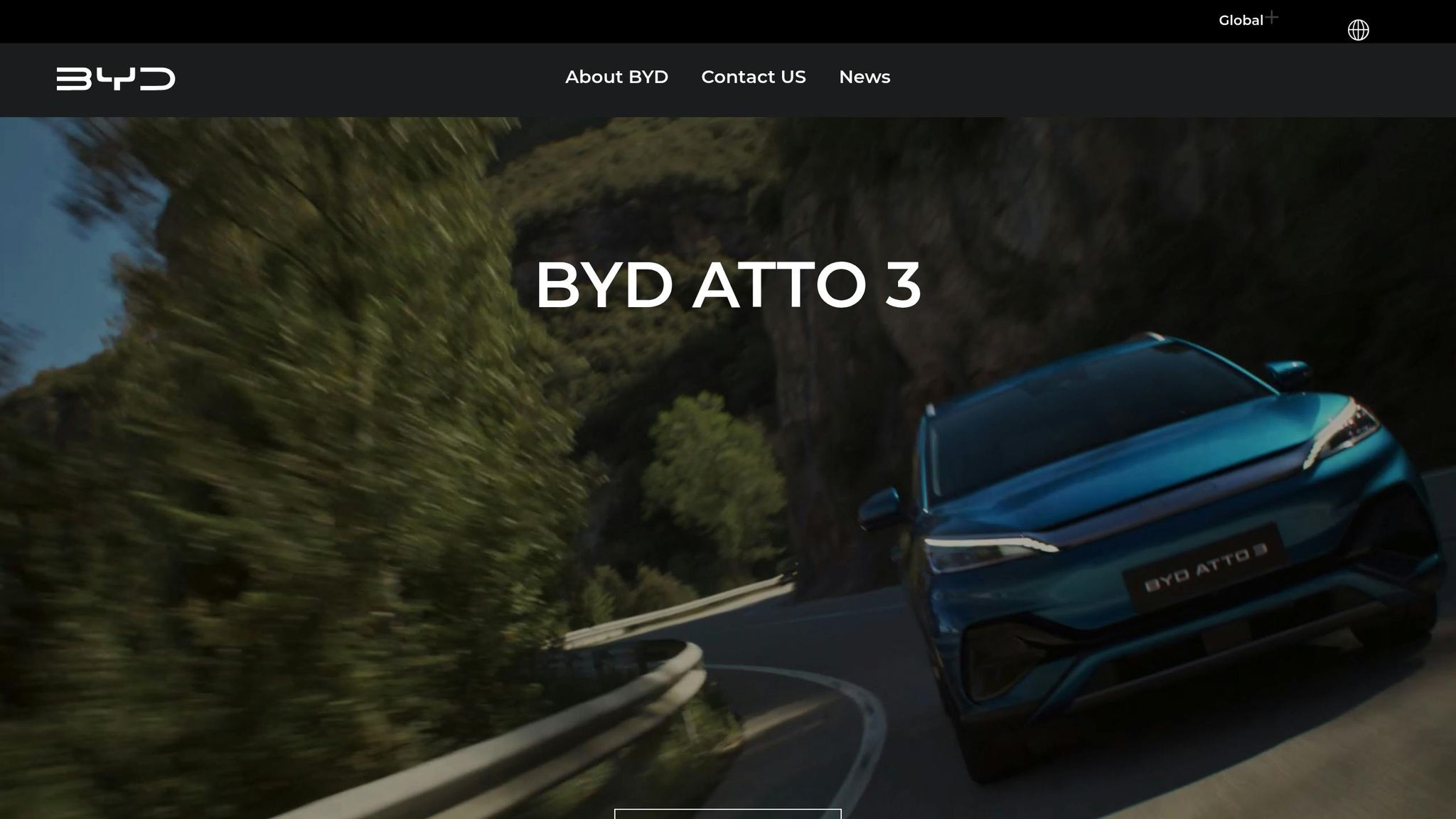
For Pakistani consumers, these price cuts are further supported by local initiatives. BYD has announced plans to roll out its first locally assembled vehicle by July or August 2026 at its Karachi plant, which has an annual production capacity of 25,000 units. This move is expected to significantly lower costs by reducing import duties and freight expenses. Currently, the BYD Atto 3 is priced between Rs 89,00,000 and Rs 89,90,000 (ex-factory), while the premium BYD Seal ranges from Rs 1,47,90,000 for the Dynamic variant to Rs 1,69,90,000 for the Premium version. Meanwhile, the BYD Shark 6 plug-in hybrid, which launched in January 2026, is priced at approximately Rs 1,99,50,000.
While BYD focuses on local production to make EVs more affordable, other brands are adopting different strategies. XPeng and Li Auto are adjusting their pricing to cater to specific market segments. XPeng’s Mona 03 Max, for instance, now costs approximately Rs 50,50,000 after a 17% price cut. On the other hand, Li Auto continues to target the premium market with models priced above Rs 1,26,00,000. Export prices for these vehicles remain higher due to additional shipping, logistics, and localisation costs, but the domestic market in Pakistan benefits from aggressive pricing. Additionally, the "grey market" offers zero-mileage "used" cars at reduced prices, although these vehicles often come without official warranties.
Below is a summary of the price adjustments and specifications for key EV models:
| Model | Pre-2026 Price (PKR) | 2026 Projected Price (PKR) | Battery Range | Status |
|---|---|---|---|---|
| BYD Seagull | ~42,00,000 | 28,00,000 – 35,00,000 | 300 – 400 km | Import/Grey Market |
| BYD Atto 3 (Advance) | N/A | 89,00,000 – 89,90,000 | ~410 km | Local Assembly 2026 |
| BYD Seal (Dynamic) | ~98,00,000 | 1,47,90,000 | 520 – 570 km | Available |
| BYD Shark 6 (PHEV) | N/A | ~1,99,50,000 | – (Plug-in Hybrid) | Launched Jan 2026 |
| XPeng Mona 03 Max | ~60,00,000 | ~50,50,000 | 400+ km | Import |
BYD’s local assembly plans are backed by a 45% reduction in power tariffs for EV chargers, effective January 2026. This combination of lower EV prices and reduced charging costs could make electric vehicles a practical option for middle-income families in Pakistan, potentially boosting BYD’s market share to 30–35%.
1. BYD EV Models
Price Reductions
In 2025, BYD shook up the market by slashing prices on 22 of its models, with reductions ranging from 10% to 30%. For instance, the Seagull saw its price drop by 20%, going from 69,800 yuan to 55,800 yuan (around $7,750), while the Qin Plus DM-i experienced a similar 20% cut, falling from 79,800 yuan to 63,800 yuan.
By early 2026, Chinese regulators intervened, urging NEV manufacturers to curb internal competition. In response, BYD chose a strategic path: instead of further price cuts, it enhanced its plug-in hybrid models with better features while maintaining their existing prices. Analysts believe this pricing strategy will remain a key tactic as the market’s growth slows in 2026 and 2027.
"BYD… has avoided outright price cuts in the current NEV price war. Instead, it has opted to upgrade several plug-in hybrid models without increasing their sticker prices." – Caixin Global
Battery Range (km)
Performance improvements are another area where BYD stands out. The Han EV long-range version offers an impressive 605-kilometre range on a single charge, as measured by the NEDC test cycle. For Pakistani buyers concerned about limited charging infrastructure, the Han DM plug-in hybrid provides a practical alternative. It delivers 81 kilometres of pure-electric range and a combined range of over 800 kilometres, addressing range anxiety while the country works on expanding its charging network.
Adding to this, the government’s decision to cut power tariffs for EV chargers by 45%, effective January 2025, is expected to boost the development of private charging stations. These measures are crucial for easing the transition to EVs in Pakistan as the infrastructure catches up.
Shipping Time to Pakistan
BYD began delivering imported EVs to Pakistan in March 2025. By mid-2026, its Karachi plant is set to start local assembly, which will significantly reduce delivery times compared to imports. This shift to local production means Pakistani buyers will enjoy quicker access to BYD vehicles, making the brand even more appealing in the local market.
2. XPeng EV Models
Price Adjustments
In response to regulators limiting drastic price cuts – like the 30% slash in late 2025 – XPeng shifted gears. Instead of relying on aggressive pricing, the company began focusing on improving technology and smart features.
By 2026, XPeng launched its budget-friendly Mona brand on a global scale. A standout model, the Mona M03, starts at a base price of about 119,000 yuan (roughly $17,000 or Rs 47,00,000) in China. This pricing aims to attract cost-conscious buyers while showcasing XPeng’s technological advancements. The demand for XPeng vehicles remains strong, as seen in the first half of 2025 when the company delivered 197,189 units. This move also reflects XPeng’s focus on boosting performance, particularly with advancements in battery technology.
Battery Range (km)
XPeng is tackling the issue of range anxiety, a major concern in areas where charging infrastructure is still developing. While specific range details for the 2026 models haven’t been released yet, the industry is making strides. For instance, CATL, a leading Chinese battery manufacturer, has introduced technology enabling a 515-kilometre range with just 5 minutes of charging.
XPeng’s focus on integrating autonomous driving and smart features firmly establishes its reputation as a tech-forward brand in Asia’s growing EV market. However, its lack of hybrid options means that dependable charging networks are crucial for users.
Shipping to Pakistan
XPeng’s global expansion strategy also impacts Pakistani buyers. The company plans to extend its Mona brand internationally by 2026. For Pakistan, vehicles will be imported directly from China. Shipping times will vary depending on the method used – roll-on/roll-off or container shipping – each offering different timelines and costs.
sbb-itb-5f05a6f
3. Li Auto EV Models
Price Reductions
Li Auto stepped into 2026 amidst fierce price wars, with industry experts describing the market as being in a state of "involution" [36,37]. While many competitors aggressively slashed prices, Li Auto took a more cautious approach. Its flagship model, the Li Mega MPV, comes with a hefty price tag of RMB 529,800 (around US$76,180 or approximately Rs 21,60,000). This makes it one of the most expensive domestically produced Chinese EVs. By positioning itself as a premium brand with relatively limited sales, Li Auto’s restrained pricing strategy sets it apart from rivals but raises questions about its ability to compete in export markets such as Pakistan.
Adding to its challenges, the company faced a recall of 11,411 Li Mega units due to a battery fire incident. This contributed to an 18.81% drop in total deliveries in 2025, bringing the figure down to 406,343 units. Monthly deliveries fell sharply, from 3,277 in September 2025 to only 661 by January 2026 [33,38]. For Pakistani buyers, assessing the technical features, particularly battery range, is essential when considering Li Auto’s offerings.
Battery Range (km)
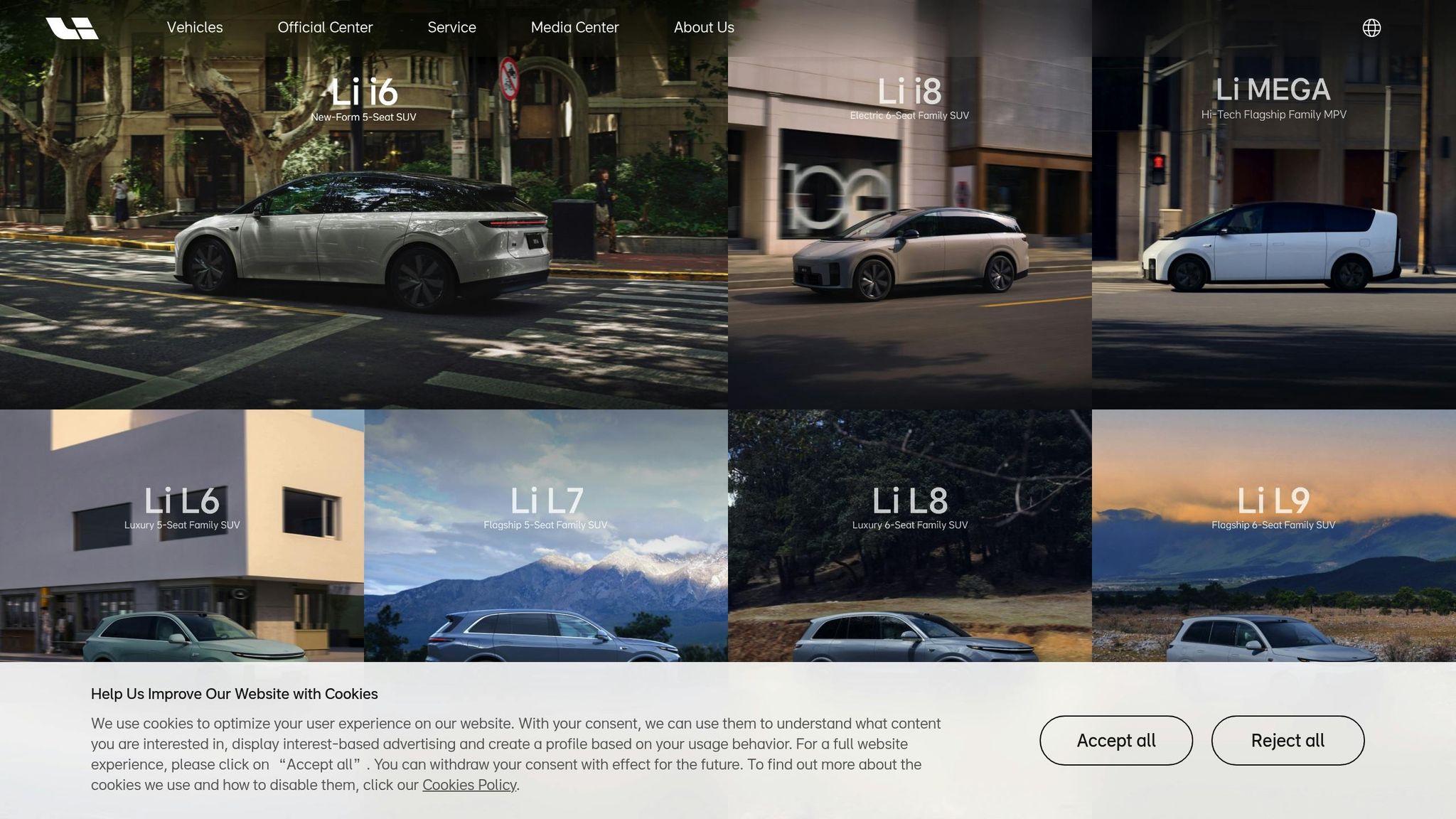
Li Auto caters to varying driving needs with two distinct powertrain options. Its Battery Electric Vehicles (BEVs) – including models like the Li Mega, Li i8, and Li i6 – rely entirely on battery power. Meanwhile, its Extended-Range Electric Vehicles (EREVs) – such as the L6, L7, L8, and L9 – combine a petrol engine with a battery, offering extended range. This hybrid setup is particularly appealing for Pakistani drivers, as it helps alleviate range anxiety during long trips between cities like Karachi, Lahore, and Islamabad [33,38].
The Li Mega, marketed as a "Mobile Home" for families, stands out with its impressive 5,350 mm length and a fast-charging solution likened to "5G speed" [38,39]. However, specific range figures for the 2026 models are yet to be officially disclosed. Beyond performance, affordability remains a critical factor for buyers in Pakistan.
Import Costs in PKR
With the exchange rate at Rs 284 per US$, the base price of the Li Mega at US$76,180 translates to roughly Rs 21,60,000 – before duties and shipping costs. These additional charges make Li Auto’s vehicles less competitive in a market where local assembly is helping to bring prices down. To encourage EV adoption, Pakistan introduced incentives in January 2025, including a 45% reduction in power tariffs for EV charging stations [26,28].
Despite these supportive measures, Li Auto faces tough competition from brands like BYD. BYD has joined forces with Mega Motor Company to begin local assembly in Pakistan by mid-2026. This local production is expected to significantly lower costs compared to fully imported vehicles, putting further pressure on Li Auto’s premium pricing strategy [26,28].
Advantages and Disadvantages
When it comes to the 2026 EV market in Pakistan, Chinese brands bring a mix of benefits and challenges for buyers. Let’s break it down.
BYD is taking a significant step by starting local assembly operations in Karachi with Mega Motor Company in July/August 2026. This move is a game-changer for pricing. By assembling vehicles locally, BYD can sidestep hefty freight charges and import duties, making their cars more affordable for Pakistani buyers. They’re also focusing on plug-in hybrids, like the Shark 6, which are better suited to Pakistan’s limited charging infrastructure compared to fully electric vehicles. As Danish Khaliq, Vice President of Sales and Strategy at BYD Pakistan, explained:
"We do not foresee excess capacity in our system as demand in Pakistan will catch up".
On the other hand, XPeng and Li Auto face some hurdles. Neither brand has plans for local assembly in Pakistan, which means longer delivery times, higher costs, and less robust after-sales support. Their focus remains on markets like Europe and Mexico, leaving Pakistani buyers to deal with the higher costs of completely built-up (CBU) imports and limited service networks. This makes spare parts and maintenance more challenging for these brands.
Here’s a quick comparison of the key factors:
| Brand | Local Assembly | Primary Model Type | Market Presence | Cost |
|---|---|---|---|---|
| BYD | Starting July/August 2026 (Karachi) | PHEVs & BEVs (e.g., Atto 3, Seal, Shark 6) | Strong (targeting 30–35% share) | Lower due to local production incentives |
| XPeng | None confirmed | High-tech BEVs | Limited | Higher due to CBU import costs |
| Li Auto | None confirmed | EREVs & BEVs | Limited | Higher due to CBU imports and premium pricing |
For buyers looking for affordability and practical range, BYD’s locally assembled plug-in hybrids stand out as the best option in 2026. However, for those willing to invest in premium, high-tech models, XPeng and Li Auto might still appeal despite their higher costs and limited local support. These factors highlight the evolving dynamics of the EV market in Pakistan and Asia as a whole.
Conclusion
China’s 2026 EV price war is reshaping the landscape for Pakistani car buyers. Over the past two years, average car prices in China have dropped by 19%, settling around Rs 6,500,000 ($22,900). Hybrid models have seen even steeper reductions, with prices slashed by up to 27%. A standout example is the BYD Seagull, now available for just Rs 2,200,000 ($7,750), signalling a significant shift in affordability.
Closer to home, BYD’s plans to begin local assembly in Karachi by early 2026 are expected to bring further benefits. These include reduced costs, better availability of spare parts, and lower import-related expenses. Usman Qadir from the Pakistan Institute of Development Economics highlights the potential:
"If they are able to assemble their vehicles in Pakistan or a third country, then they can bypass tariffs and get into the market with their lower prices."
As local production ramps up, competition is set to heat up. Zhang Yichao from AlixPartners forecasts:
"the price war will probably last one to two years,"
indicating that buyers can look forward to sustained price reductions and increasingly attractive features, such as advanced driver-assist systems now becoming standard.
For Pakistani buyers navigating this rapidly evolving market, EV24.asia offers a practical and transparent solution. The platform connects you directly to surplus inventory created by China’s intense domestic competition. It provides clear pricing across three key segments: budget (under Rs 2,800,000), mid-range (Rs 2,800,000–8,500,000), and premium (above Rs 8,500,000). With Pakistan’s 25% customs duty on EVs priced under $50,000 and ongoing price cuts, 2026 offers an exceptional opportunity to embrace electric vehicles at more competitive rates.
Whether you’re purchasing your first EV or upgrading your fleet, this is the moment to act. With aggressive pricing, the advantages of local assembly, and streamlined import processes, 2026 is shaping up to be the ideal year to transition to electric mobility.
FAQs
How will BYD’s local assembly in Karachi impact EV prices in Pakistan?
BYD’s decision to begin assembling electric vehicles (EVs) in Karachi by 2026 could significantly lower EV prices in Pakistan. By shifting production locally, the company can sidestep hefty import duties and shipping costs that often drive up prices. This means Pakistani buyers might soon see more affordable EV options on the market.
On top of that, the ongoing price competition in China – where EV manufacturers are slashing prices to stay ahead – could also ripple into the Pakistani market. Combined with the cost savings from local assembly, this could lead to a broader selection of EVs at more budget-friendly prices. This initiative has the potential to accelerate EV adoption in Pakistan, making electric transportation a more practical and economical choice for many.
How do zero-interest financing options benefit EV buyers in 2026?
Zero-interest financing makes owning an electric vehicle (EV) much easier on the wallet by removing the additional cost of loan interest. This means buyers can spread out their payments over time without worrying about paying extra. In a competitive market like China in 2026, where price wars are making EVs more accessible, this financing option plays a huge role in bringing EV ownership within reach for more people.
For buyers, especially during tough economic times, these financing plans help with better budget management. They make it possible to invest in EVs without stretching finances too thin. On the flip side, manufacturers benefit too – this strategy helps them increase sales without slashing vehicle prices. It’s a win-win, particularly in Pakistan, where affordability and managing costs are top priorities for most consumers.
How do lower electricity tariffs affect EV charging costs in Pakistan?
Lowering electricity tariffs in Pakistan has the potential to make electric vehicles (EVs) much more accessible for the average consumer. When electricity costs drop, the expense of charging an EV also decreases, making it a more budget-friendly option for daily use. In a price-sensitive market like Pakistan, this could be a game-changer, as affordability is often a deciding factor for buyers.
Cheaper electricity doesn’t just benefit individual EV owners – it can also encourage businesses and entrepreneurs to set up more EV charging stations. This would improve accessibility and convenience for EV users, addressing one of the key barriers to adoption. By reducing the overall cost of owning and operating an EV, lower power tariffs could play a major role in speeding up the transition to cleaner and greener transportation across the country.