
 Arka Pratama
Indonesia’s EV market in 2026 is shifting towards local manufacturing, leveraging its nickel reserves to build a complete EV supply chain. Key highlights include:
- EV Growth: BEV sales rose by 152.5% in Q1 2025 compared to 2024, with EVs comprising 15% of total car sales by 2024.
- Top EV Models: Affordable options like Wuling Air EV (Rs. 214 million) cater to city drivers, while mid-range and premium options like BYD Atto 3 (Rs. 390 million) and Hyundai Ioniq 5 (Rs. 713 million) offer versatility and advanced features.
- Incentives Shift: Post-2025, tax benefits now favour locally assembled EVs with 40% local content, pushing manufacturers like BYD and Volkswagen to invest Rs. 15.4 trillion in local production.
- Charging Network: Public charging stations have grown to 4,655, with fast and ultra-fast options supporting long-distance travel. Home charging remains economical with off-peak discounts.
This transition positions Indonesia as a growing hub for EVs, balancing affordability, infrastructure, and sustainability.
Mobil Listrik Terlaris di Indonesia Tahun 2026, Mobil Listrik Terbaru Januari 2026.
sbb-itb-5f05a6f
Best Electric Cars in Indonesia for 2026
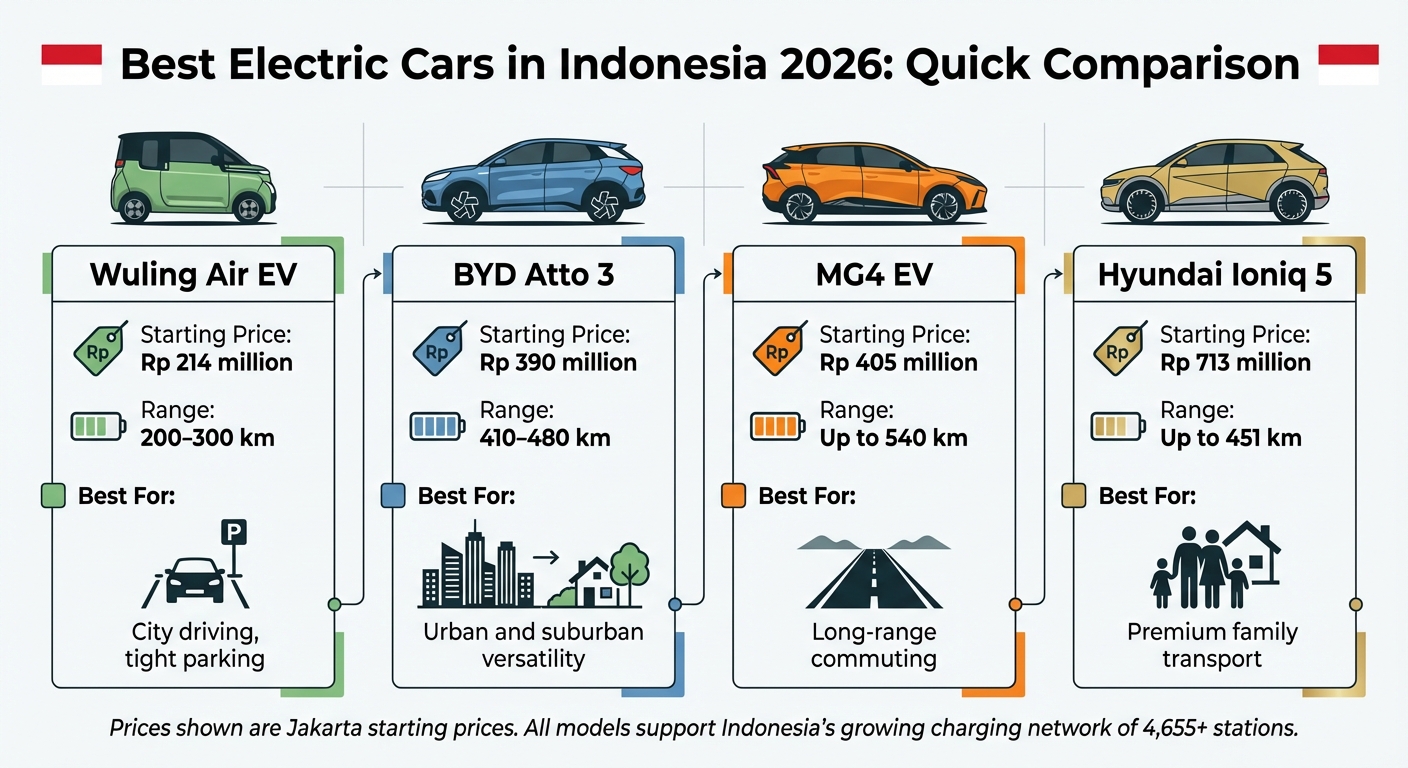
Indonesia EV Market 2026: Top Electric Cars Comparison by Price, Range and Use Case
Indonesia’s electric vehicle (EV) market in 2026 offers a broad selection of models, catering to a variety of budgets and preferences. Prices range from compact city cars starting at around Rp 214 million to high-end luxury SUVs exceeding Rp 1.6 billion. Thanks to local assembly efforts, prices remain competitive, and the variety of available models continues to grow. Chinese manufacturers like BYD, Wuling, and MG dominate the affordable and mid-range categories, while brands like Hyundai focus on the premium segment.
BYD Atto 3
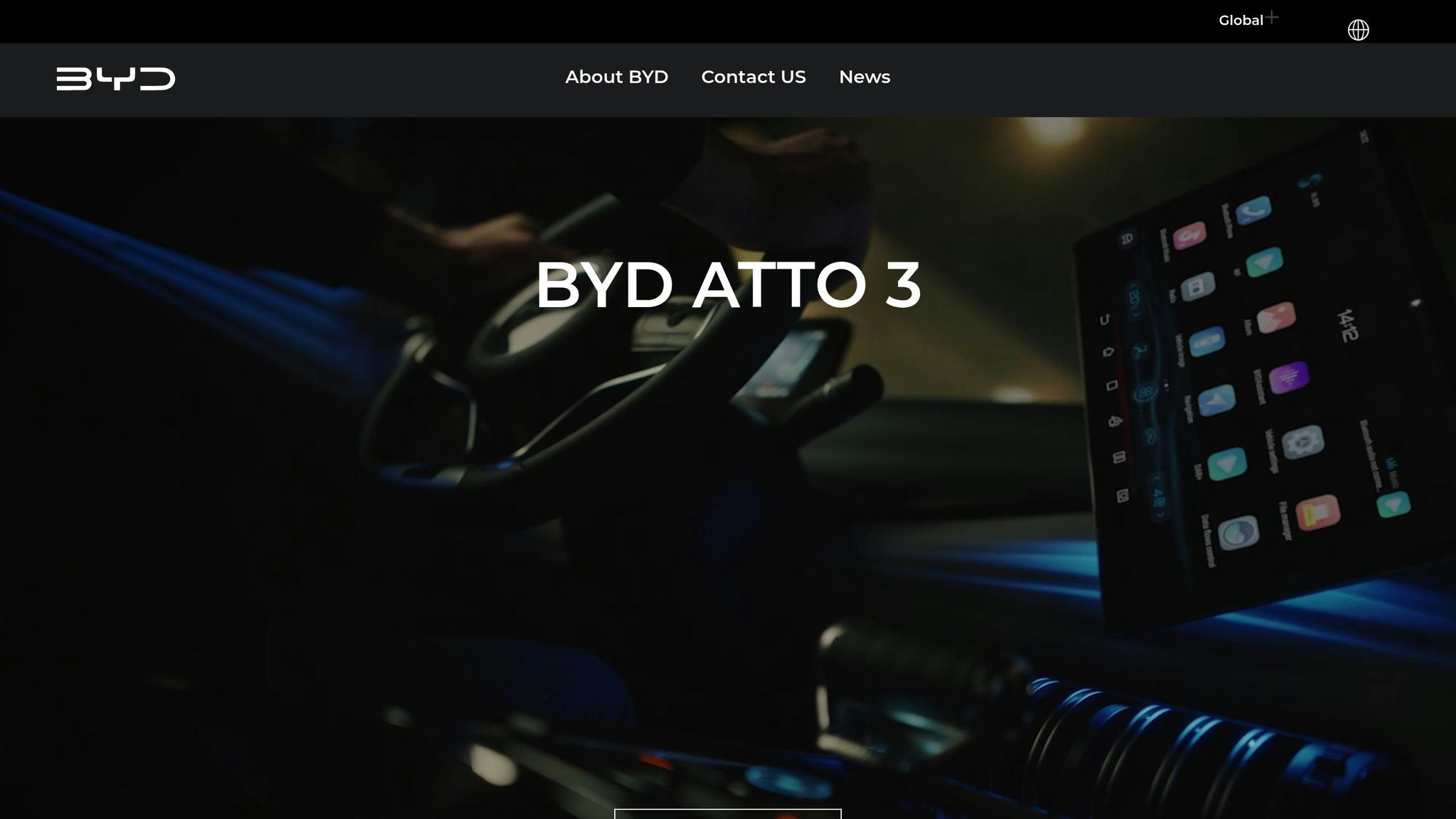
The BYD Atto 3 is a versatile SUV designed to handle Indonesia’s varied road conditions, thanks to its 175 mm ground clearance. It boasts a range of 410–480 km per charge and is powered by a 204 hp electric motor that accelerates from 0–100 km/h in just 7.9 seconds. Safety features such as a 360-degree camera and Adaptive Cruise Control make it an excellent choice for both city commutes and longer trips. In Jakarta, the Advanced variant starts at Rp 390 million, while prices in other cities, such as Denpasar, can go up to Rp 405 million. The vehicle also comes with an 8-year or 160,000 km battery warranty, offering peace of mind for buyers.
Wuling Air EV
Designed for urban drivers on a budget, the Wuling Air EV features a compact design with a length of just 2,974 mm, making it perfect for navigating and parking in crowded city areas. The Lite 200 variant is priced at roughly Rp 214 million, while the Pro 300 variant is available for around Rp 307.5 million. With a range of 200–300 km and running costs estimated at about Rp 118 per kilometre, it’s an economical choice for daily city commutes.
Hyundai Ioniq 5
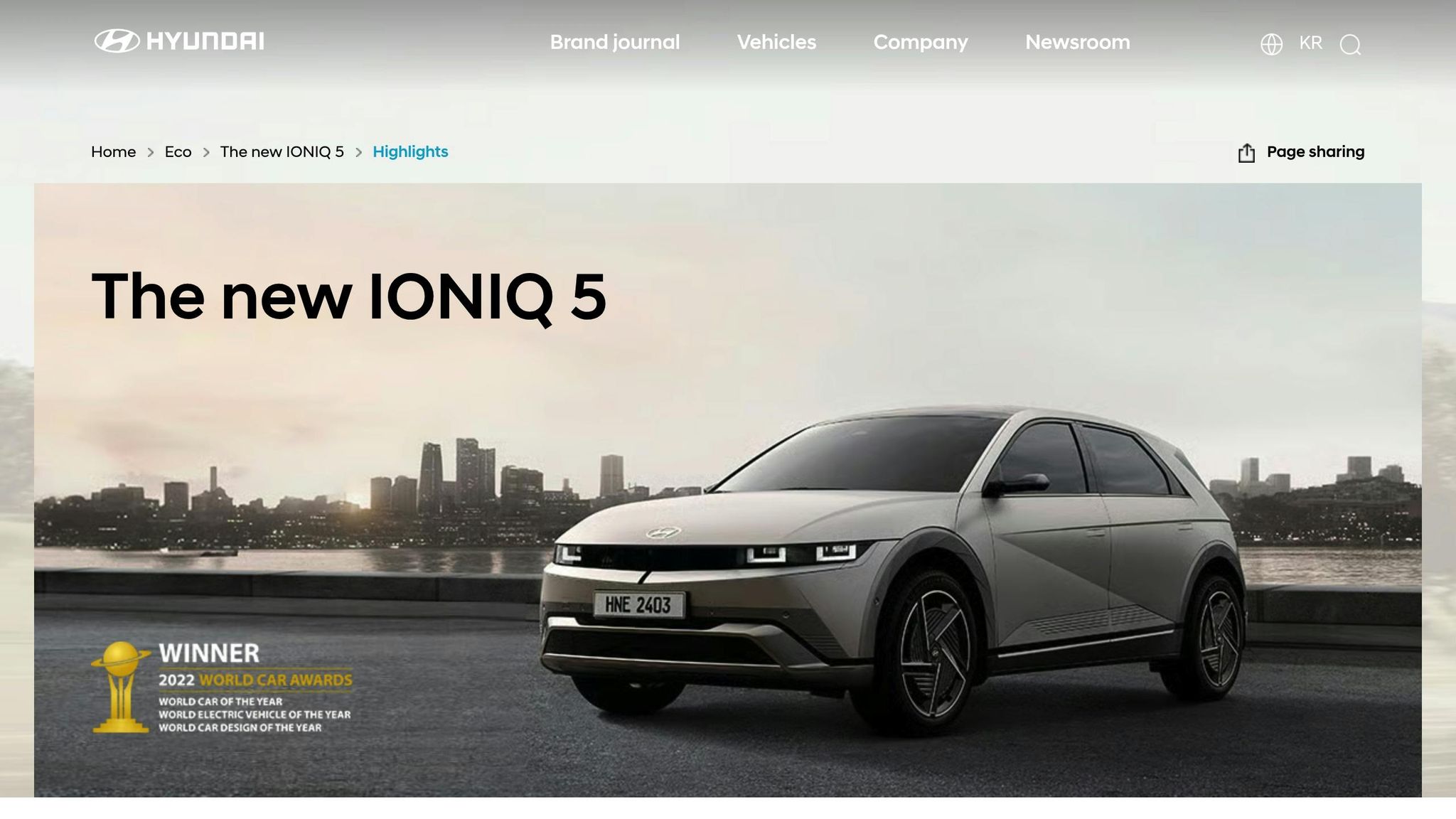
For families looking for a high-end EV with spacious interiors and cutting-edge technology, the Hyundai Ioniq 5 stands out. It offers a range of up to 451 km and supports DC fast charging, allowing an 80% charge in just 1.5 hours. Pricing starts at approximately Rp 713 million for the Standard variant and goes up to Rp 902.4 million for the Signature model, reflecting its premium features and design.
MG4 EV
The MG4 EV is a strong contender in the mid-range segment, offering a blend of affordability and impressive performance. Priced between Rp 405 million and Rp 419 million depending on the location, it delivers an impressive range of up to 540 km. This makes it an ideal option for suburban commuters who need a vehicle that can handle both city driving and longer distances. Its modern design and fast-charging capability further enhance its appeal.
| Model | Starting Price (Jakarta) | Range | Best For |
|---|---|---|---|
| Wuling Air EV | Rp 214 million | 200–300 km | City driving, tight parking |
| BYD Atto 3 | Rp 390 million | 410–480 km | Urban and suburban versatility |
| MG4 EV | Rp 405 million | Up to 540 km | Long-range commuting |
| Hyundai Ioniq 5 | Rp 713 million | Up to 451 km | Premium family transport |
Government Incentives for EV Buyers in 2026
Indonesia’s approach to electric vehicle (EV) incentives has undergone a major shift. The focus has moved from supporting imports to encouraging local production, with financial perks now tied to vehicles assembled within the country. The tax breaks that made imported EVs more affordable throughout 2025 officially ended on 31 December 2025 [9,28]. Here’s a closer look at how tax policies, import duties, and local content requirements are shaping the EV market in 2026.
Tax Exemptions and Subsidies
In the past, EV buyers benefited from a combined tax rate of just 12% for eligible vehicles, a stark contrast to the standard rate of up to 77% for non-incentivised imports. A key part of this was the Value Added Tax (VAT) relief, which reduced consumer tax to 1% on vehicles with at least 40% local content. However, this incentive has now evolved into a production-based policy [7,26].
"EV incentives should not be positioned as a long-term policy… The focus should shift from ‘how big the subsidy is’ to ‘how strong the market structure is’" – Agus Purwadi, Energy and Industrial Policy Observer, Bandung Technology Institute
Import Duty Reductions
The 0% import duty for Completely Built-Up (CBU) EVs ended on 31 December 2025. This means imported EVs now face full taxes unless manufacturers shift to local assembly [29,31,9].
"We will no longer issue CBU permits… automotive manufacturers who have been receiving these incentives must meet their production obligations and comply with domestic content requirements starting in 2026" – Agus Gumiwang Kartasasmita, Industry Minister
In response, major companies like BYD, VinFast, and Volkswagen have pledged investments totalling approximately Rp15.52 trillion to establish local production facilities and avoid higher import taxes.
Eligibility Criteria for Incentives
From 2026, EVs must meet a minimum local content requirement (TKDN) of 40% to qualify for any remaining benefits. This applies strictly to locally assembled vehicles. Manufacturers who benefited from the 2024–2025 CBU import scheme are now required to produce an equivalent number of EVs locally under a 1:1 ratio between 2026 and 2027. The TKDN requirement will rise to 60% for 2027–2029 and 80% by 2030 [28,10,30].
"If they do not produce in Indonesia by 2026, import taxes will increase. They have several options, either building their own factories or partnering with local assemblers" – Muhammad Rachmat Kaimuddin, Deputy for Infrastructure and Transportation Coordination
| Incentive Type | 2025 Status | 2026 Status |
|---|---|---|
| Import Duty (CBU) | 0% for committed investors [9,28] | Expired; standard rates apply [9,28] |
| Luxury Tax (PPnBM) | 0% for CBU/CKD [27,10] | Expired for CBU; CKD production focus [27,10] |
| VAT (PPN DTP) | 1% for TKDN ≥40% [7,10] | Production mandates apply [7,10] |
| TKDN Requirement | 20%–40% [9,28] | Minimum 40% required [9,28] |
EV Charging Infrastructure: 2026 Reality
Indonesia’s electric vehicle (EV) charging network has grown rapidly, evolving from a pilot phase to a full-scale national system. By 2026, the network includes 4,655 public charging stations, marking a staggering 299% increase from 2023 to 2024. These stations are spread across Java, Sumatra, Bali-Nusa Tenggara, Kalimantan, Sulawesi, and Papua. Java leads with 2,667 stations, followed by Sumatra with 442 and Bali-Nusa Tenggara with 246. While PLN remains the dominant player, private operators like Starvo, Voltron, and Charge+ have entered the market, obtaining licenses in under two hours. Charging transactions on PLN‘s network surged by over 300% in early 2025, with the vehicle-to-charger ratio improving to 21:1 by March 2025.
Public Charging Stations
Charging stations are no longer confined to cities – they now support long-distance travel too. For instance, during the March 2025 Eid al-Fitr season, 3,500 SPKLUs were deployed along major routes, ensuring a maximum distance of 26 km between stations. This setup accommodated a projected 500% increase in EV traffic, supported by 1,680 standby officers.
In February 2026, a consortium led by PLN, Mega Energi Biru Indonesia (MEBI), and Huawei Digital Power launched the Zora Signature station in Kabupaten Tangerang. This facility boasts eight DC ultra-fast chargers, each capable of delivering up to 480 kW of power.
"This collaboration demonstrates that by working together, the transformation of electric vehicles to support decarbonisation in the transportation sector is possible." – Darmawan Prasodjo, President Director, PLN
Charging tariffs remain regulated, with rates set at approximately IDR 2,466 per kWh, and session-based fees of IDR 25,000 for fast charging and IDR 57,000 for ultra-fast charging. To expand accessibility, PLN has partnered with retail chains like Alfamart, installing chargers at high-traffic locations such as malls and minimarkets.
Home Charging Options
Despite the growth of public stations, many EV owners still prefer the convenience of charging at home. By March 2025, over 33,086 customers had opted for PLN’s home charging services. However, home charging requires a minimum electrical capacity of 7,700 VA. To ease this transition, PLN introduced the "Ramadan Terang, Lebaran Tenang" programme in March 2026, offering a 50% discount on power upgrade fees. For example, customers upgrading from 2,200 VA to 7,700 VA paid IDR 2,664,750 instead of the usual IDR 5,329,500 during the promotion period from 25 February to 10 March 2026.
"Through this program, PLN presents the convenience of increasing power at a lighter cost so that people can carry out activities… without being constrained by power limitations." – Adi Priyanto, Director of Retail and Commerce, PT PLN (Persero)
Home charging is also more economical. Residential electricity rates range from IDR 1,352 to IDR 1,444 per kWh, with a 30% discount for charging between 22:00 and 05:00 WIB. The PLN Mobile app further simplifies the process by allowing users to schedule charging, track electricity usage, and redeem vouchers for power upgrades.
Fast-Charging Developments
Fast-charging solutions are advancing quickly, helping to ease range anxiety for EV users. The Zora Signature station stands out with its eight ultra-fast chargers capable of charging high-end EVs from 10% to 80% in just 20 minutes. The Combined Charging System (CCS2) has become the dominant standard in Indonesia, supported by 87.7% of EV models available in the market.
| Charging Type | Power Output | Typical Charging Time (to 80%) | Primary Application |
|---|---|---|---|
| AC Level 1 | 3.7–7 kW | 8–12 hours | Residential / Overnight |
| AC Level 2 | 22–43 kW | 4–6 hours | Workplace / Retail |
| DC Fast | 50–150 kW | 30–60 minutes | Public Stations / Highways |
| DC Ultra-Fast | 200–480 kW | 15–20 minutes | Strategic Corridors / Hubs |
The PLN Mobile app’s "Trip Planner" feature further enhances user experience by offering real-time battery monitoring and mapping SPKLU locations for route planning. Meanwhile, investments in charging infrastructure remain high. Setting up a DC fast-charging station (50–150 kW) costs between IDR 500 million and IDR 1.5 billion, while ultra-fast stations (200–400 kW) range from IDR 1.5 billion to IDR 3 billion.
Market Challenges and Opportunities in 2026
Indonesia’s electric vehicle (EV) market in 2026 finds itself at a critical juncture. With consumer positivity reaching 88% across the Asia-Pacific region, the sector is brimming with potential. However, alongside this optimism, the market faces some tough challenges that demand attention. These obstacles, though significant, also pave the way for opportunities in areas like environmental impact and cost efficiency.
Challenges: Infrastructure, Costs, and Awareness
One of the biggest roadblocks is the lack of adequate charging infrastructure. Even with the expansion to 4,655 public charging stations, the charger-to-car ratio remains skewed at 1:34 – meaning each charging plug must serve 34 electric vehicles. This creates a strain for EV owners, particularly those without access to home charging facilities.
Financially, the market has become more challenging. The removal of incentives for imported CBUs (completely built units) has pushed manufacturers to focus on local production, which now requires a 60% TKDN (local content) compliance. At the same time, the VAT increase from 11% to 12% in January 2025, coupled with high interest rates, has bumped up vehicle prices, making buyers more cautious.
"Consumers are no longer just tempted by cheap prices, but are starting to consider brand reputation, service networks, and the certainty of spare parts."
– Rudi MF, Project Manager, Dyandra Promosindo
Another complication stems from manufacturer-specific charging systems, which limit accessibility and force buyers to evaluate not just the vehicle but the entire ecosystem – service centres, spare parts availability, and charging options.
While these challenges are real, they also underline the potential for growth and improvement in the EV market.
Opportunities: Sustainability and Long-Term Savings
The environmental benefits of EVs are becoming increasingly hard to ignore. Indonesia’s 11 million conventional cars produce over 35 million tonnes of carbon emissions annually, contributing to 70–80% of urban air pollution. Switching to EVs presents a clear path to cleaner air and a smaller carbon footprint, which appeals to environmentally conscious buyers.
Although EVs come with higher upfront costs, they offer notable savings over the long term. Home charging costs between Rs. 220 and Rs. 235 per kWh (IDR 1,352 to IDR 1,444), with a 30% discount during off-peak hours (10 PM to 5 AM). Over time, these savings can significantly offset the initial investment, making EV ownership more appealing.
Indonesia’s ambitions to become the world’s third-largest electric battery producer by 2027 further strengthen the market outlook. Leveraging its vast nickel reserves, the country aims to establish a complete supply chain – from raw materials to finished batteries. This strategy promises more stable local production, competitive pricing, and a stronger domestic EV ecosystem.
"The growth shows that our ecosystem is already in place and functioning."
– Ali Murtopo, Deputy for Trade and Digital Economy Coordination, Coordinating Ministry for the Economy
Importing EVs to Indonesia via EV24.asia
As Indonesia’s electric vehicle (EV) market grows, EV24.asia simplifies the often-complicated process of importing EVs. By 2026, importing an EV has become more challenging, especially with the discontinuation of permits for CBU (Completely Built-Up) EVs. EV24.asia offers a seamless experience, helping buyers navigate model selection, customs requirements, and registration processes. It all starts with access to a wide selection of EV models.
Wide Selection of EV Models
EV24.asia connects buyers to a diverse range of EVs that are popular in Indonesia. The platform features models from well-known brands like BYD (Atto 3, Seal, Dolphin, M6), VinFast (VF e34, VF 3, VF 5), Wuling, Tesla, Volkswagen, and XPeng. Whether you’re after a budget-friendly city car or a high-end family SUV, there’s something for every preference and budget.
Chinese manufacturers continue to dominate Indonesia’s EV market. Between 2020 and mid-2025, SAIC accounted for 31.6% of battery electric vehicle sales, while BYD Auto captured 29.7%. This dominance ensures buyers have access to proven models with reliable service networks and readily available spare parts.
Transparent Pricing and Payment Options
One common concern when importing EVs is unclear pricing. EV24.asia addresses this by offering clear, upfront pricing with no hidden fees. Flexible payment options are also available, making it easier for buyers to manage costs.
However, with the expiration of CBU incentives on 31 December 2025, imported EVs are now priced higher than locally assembled vehicles that meet the 40% local content (TKDN) requirement. EV24.asia helps buyers understand these cost differences and guides them toward the best value options. Along with transparent pricing, the platform ensures a smooth import process through comprehensive shipping and compliance support.
Shipping and Compliance Support
Importing an EV involves multiple steps, including shipping, clearing customs, and local registration. EV24.asia takes care of these complexities. Buyers can choose between RoRo (Roll-on/Roll-off) or container shipping, depending on their preferences and budget. Major EV shipments to Indonesia often rely on LNG-powered cargo ships, arriving at key ports like Tanjung Priok.
The platform also handles customs notifications by submitting all required vehicle details upon arrival. This ensures compliance with Indonesia’s Ministry of Finance Regulation No. 202/PMK.04/2019. Once customs clearance is complete, EV24.asia assists with local registration, making sure the vehicle is ready for use on Indonesian roads. By managing these steps end-to-end, the platform eliminates the hassle of dealing with multiple agencies, making the import process straightforward and stress-free.
Conclusion
Indonesia’s electric vehicle (EV) market is on a fast track for change in 2026. With a projected growth rate of 20.96% CAGR, the market is expected to reach USD 3,575.24 million by 2032. By Q2 2025, EVs are anticipated to account for 15.2% of total passenger car sales, and the government is aiming for 2 million battery EVs on the road by 2030. These numbers highlight the country’s accelerating move toward cleaner transportation.
This momentum is also reflected in a shift from reliance on imports to a focus on local manufacturing. EVs with a minimum of 40% Domestic Component Level (TKDN) now qualify for a 10% VAT reduction, encouraging local production over imports. Public charging infrastructure is expanding, and incentives like 30% off-peak electricity discounts from 10 PM to 5 AM are making EV ownership even more appealing.
"The EV segment remains a bright spot, driven by foreign direct investment, favourable tax policies, and infrastructure development such as charging stations." – Lukmanul Arsyad, Industry and Services Leader & Partner, PwC Indonesia
Although incentives for Completely Built-Up (CBU) imports ended on 31 December 2025, platforms like EV24.asia are stepping in to simplify the process for buyers. EV24.asia connects customers with popular EV brands like BYD, Wuling, and Tesla, while managing shipping, customs, and registration.
Whether you’re after a budget-friendly city car or a premium family EV, 2026 offers more choices, better infrastructure, and clear paths to ownership. These developments reflect Indonesia’s growing dedication to sustainable transport and invite consumers to join the EV movement.
FAQs
How can I check if an EV meets the 40% TKDN rule in 2026?
To check if an EV complies with the 40% TKDN (Domestic Component Level) requirement for 2026, look at its TKDN certification or official documents. These will outline the percentage of components sourced locally. Alternatively, you can reach out to the manufacturer for confirmation. Meeting this requirement is essential for qualifying for domestic production incentives and staying aligned with government regulations on local content.
What’s the real cost difference between home charging and fast charging?
The price gap between charging your EV at home and using a fast charger boils down to electricity rates and infrastructure costs. Charging at home tends to be more economical since residential electricity rates are generally lower, and you can take advantage of off-peak pricing.
On the other hand, fast charging – known for its speed and convenience – comes with a heftier price tag. The per-kWh rates for fast chargers are higher, partly due to the costs of maintaining the advanced equipment. In fact, fast charging often costs 2 to 3 times more per kWh compared to home charging. This makes fast charging a practical option for urgent situations or when you’re covering long distances, but it’s less budget-friendly for regular use.
Can I reliably take long trips in Indonesia with the 2026 charging network?
Long trips across Indonesia in an electric vehicle (EV) are expected to become much easier by 2026. This is largely thanks to the rapid growth of charging infrastructure, including fast chargers being installed in major cities and along highways. However, rural areas might still face limited charging options, making careful route planning a must for such journeys. With consistent government backing and private sector investments, travelling long distances in EVs is becoming a more practical option in areas with established connectivity.