
 Arka Pratama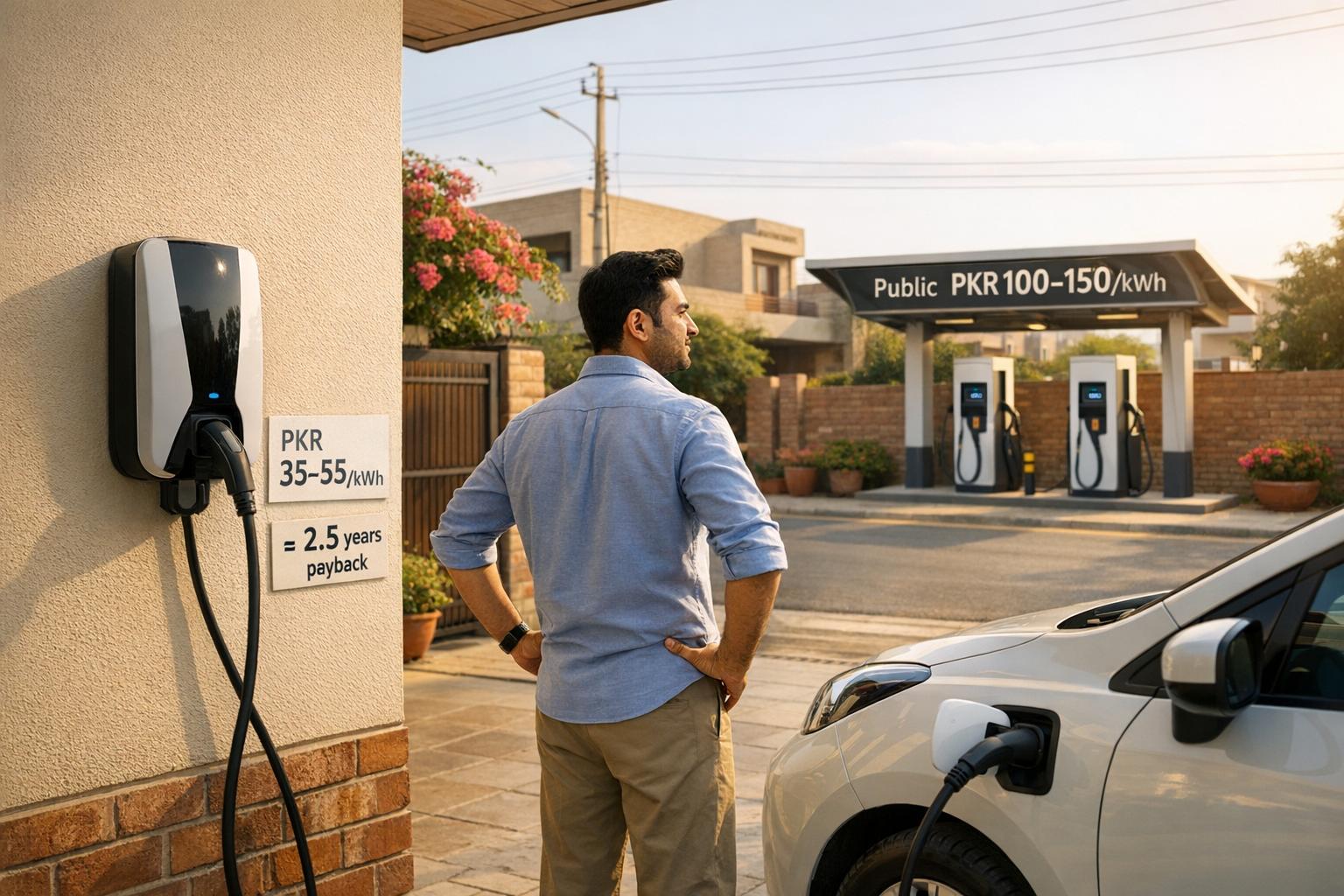
Charging an electric vehicle (EV) at home in Pakistan is much cheaper than using public chargers. Home charging costs around PKR 35–55 per kWh, while public charging is 2–3 times more expensive due to commercial tariffs. Fully charging a standard 44.5 kWh EV battery at home costs about PKR 2,000, compared to PKR 8,000–10,000 for a petrol vehicle’s tank. Public charging, although faster, adds 20–40% markups and is better suited for emergencies or long trips.
Installing a home charger costs PKR 250,000–600,000, but the savings (60–70% compared to public charging) can offset this in 2.5 years. Public chargers are convenient for long-distance travel but come with higher costs and potential waiting times. For most EV owners driving under 150 km daily, home charging is the most cost-effective and practical option.
Quick Comparison:
| Factor | Home Charging | Public Charging |
|---|---|---|
| Cost per kWh | PKR 35–55 | PKR 39.70–71 |
| Upfront Cost | PKR 250,000–600,000 | None |
| Charging Speed | 6–10 hours (Level 2 AC) | 20–60 minutes (DC Fast) |
| Convenience | Charge overnight at home | Travel to station required |
| Long-term Savings | 60–70% savings | No savings |
For daily use, focus on home charging for lower costs. Use public chargers only when necessary, such as during long trips.
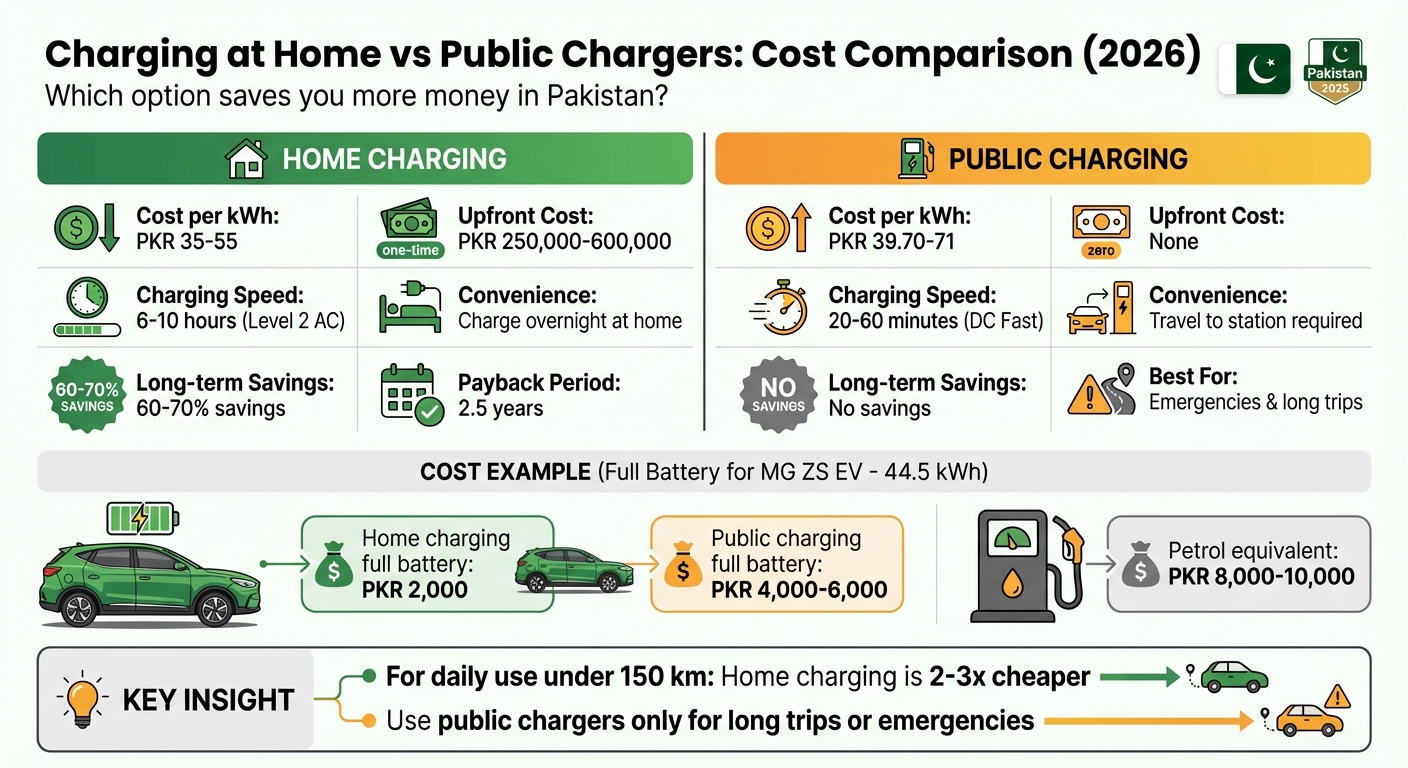
Home vs Public EV Charging Cost Comparison in Pakistan 2026
1. Home Charging
Cost per kWh
Charging your EV at home in Pakistan costs between PKR 35 and PKR 55 per kilowatt-hour, with an average of PKR 45 per kWh. This cost depends on your monthly electricity usage – higher consumption generally means paying a higher rate per unit. For instance, charging an MG ZS EV, which has a 44.5 kWh battery, would cost around PKR 2,002.5 for a full charge, offering a range of 320–400 kilometres. However, you should factor in a 5–16% conversion loss, meaning you’ll pay for slightly more energy than the battery’s stated capacity.
When compared to nearby countries, Pakistan’s home charging costs are relatively competitive. India’s residential electricity rates range from ₹7 to ₹10 per kWh (approximately PKR 23–33), while Malaysia’s tiered pricing starts at RM 0.218 per kWh (around PKR 14) for the first 200 kWh and goes up to RM 0.571 per kWh (around PKR 36) for higher consumption.
Installation/Setup Costs
Setting up a home charging system in Pakistan can cost anywhere between PKR 250,000 and PKR 600,000. A standard 7.2 kW smart charger with installation typically ranges from PKR 350,000 to PKR 500,000, while an 11 kW unit costs between PKR 400,000 and PKR 550,000. For those on a tighter budget, locally made generic chargers are available for PKR 100,000 to PKR 200,000, though they often lack advanced features.
Beyond the charger itself, installation costs can add another PKR 100,000 to PKR 150,000. These expenses include labour, cable ducting, and circuit breakers (usually 32A for a 7 kW setup). Older homes may also require an upgrade to their electrical panels to support Level 2 (240V) charging. While these upfront costs might seem steep, they need to be weighed against the convenience and long-term benefits of having a home charging setup.
Convenience and Accessibility
The convenience of home charging is hard to beat. Waking up to a fully charged car eliminates the hassle of visiting public charging stations. A dedicated 7–11 kW Level 2 charger can charge most EVs in 6–8 hours, making overnight charging a practical solution for those with a dedicated parking spot. This is especially beneficial in Pakistan, where public charging infrastructure is still limited to major cities like Karachi, Lahore, and Islamabad.
Professional installations also address common local issues, such as voltage fluctuations and load shedding, by using customised equipment and conducting site-specific assessments. To save even more, consider charging during off-peak hours (typically 11 PM to 7 AM) if your electricity provider offers time-of-use tariffs.
Subsidies and Incentives
While operational costs for EVs are lower, the initial setup costs can be daunting. Unfortunately, Pakistan currently lacks direct government subsidies for residential charger installations. However, the government has reduced electricity tariffs for EV charging stations by 45%, bringing the rate down to PKR 39.70 per unit. Additionally, reduced import duties have made international charging brands like Wallbox and Delta more affordable.
In contrast, other countries offer more robust incentives. For example, Malaysia provides tax relief of up to RM 2,500 (around PKR 158,000) for EV charging equipment and installation, valid until 2027. India, while mainly focusing on public charging infrastructure, offers special EV-specific home tariffs in some states, such as Delhi, where rates can be as low as ₹4.50 per kWh.
sbb-itb-5f05a6f
2. Public Charging
Cost per kWh
Public charging in Pakistan and across Asia tends to be 2–3 times more expensive per kWh compared to charging at home. In Pakistan, NEPRA has approved a specific commercial tariff of PKR 22.98 per kWh as part of the "Charge Pakistan" initiative. Additionally, the government has reduced electricity tariffs for charging stations by 45%, bringing the rate down to PKR 39.70 per unit.
In comparison, India charges ₹12–₹16 per kWh for public AC charging and ₹18–₹26 per kWh for DC fast charging. Similarly, Malaysia and Thailand also have higher public charging rates compared to home charging. For instance, India’s home rates are just ₹5–₹10 per kWh, Malaysia’s are RM 0.22 per kWh (approximately PKR 14), and Thailand’s are 2.6 THB per kWh (around PKR 23).
It’s worth noting that energy losses occur during charging: AC charging loses 5–10%, while DC fast charging loses 10–15%.
Beyond cost, the location and dependability of public charging stations play a major role in user convenience.
Convenience and Accessibility
Public charging stations are strategically located in high-traffic areas like shopping malls, office complexes, and petrol stations along major highways. For instance, Malaysia had 3,354 EV charging stations (including 956 DC fast chargers) as of October 2024. India, by April 2025, had approximately 26,367 public EV charging stations, equating to about one charger for every 235 electric vehicles.
One of the biggest advantages of public charging is speed. DC fast chargers can provide an 80% charge in just 20–60 minutes, making them ideal for long trips or urgent situations. On the other hand, public AC charging takes much longer – anywhere from 2 to 10 hours – offering little advantage over home charging.
However, accessibility can sometimes be hindered by issues like app-based registration processes, connector malfunctions, or payment glitches.
"Consistency matters more than peak speed. A 50 kW station that works every time beats a 120 kW one that fails half the attempts." – Andre Silva
Some networks, such as Tesla‘s in Malaysia, even impose idling fees (e.g., RM 2 per minute) if vehicles remain parked after charging is complete. To keep costs manageable, it’s best to reserve DC fast charging for long-distance travel or emergencies.
Subsidies and Incentives
Government incentives play a crucial role in reducing public charging costs. In Pakistan, the government supports public charging through a 45% tariff reduction, lowering rates from PKR 71 to PKR 39.70 per unit. NEPRA’s dedicated commercial tariff of PKR 22.98 per kWh further supports the "Charge Pakistan" initiative. Additionally, approvals for setting up charging stations have been streamlined, with processing times reduced to just 15 days for a nominal fee of PKR 50,000.
"The government recently slashed electricity tariffs for EV charging stations by 45%, reducing the rate to Rs 39.70 per unit from Rs 71 per unit. This step encourages more businesses to establish public charging stations, benefiting EV owners." – Usama Mahmood, Acom Distributors
Other Asian countries also offer support. In India, state-level initiatives help offset the high installation costs of DC fast chargers, which can range from ₹8 lakh to ₹25 lakh. Special EV tariffs have also been introduced, with rates as low as ₹4.50 per kWh in Delhi and ₹6 per kWh in Tamil Nadu. Singapore provides an EV Common Charger Grant, covering up to 50% of charger installation costs for condominiums and commercial buildings. Meanwhile, Malaysia offers RM 2,500 in tax relief for EV charging equipment and installation, valid through 2027.
The Truth About Public EV Charging Costs Compared to Diesel
Pros and Cons
Here’s a breakdown of how home and public charging stack up against each other. The table below summarises the key differences between the two in terms of cost, convenience, and practicality:
| Factor | Home Charging | Public Charging |
|---|---|---|
| Cost per kWh | Charged at lower residential rates, leading to significant long-term savings | Charged at commercial rates, often 2–3 times higher than residential prices |
| Upfront Investment | PKR 250,000–PKR 600,000 for installation | No upfront cost |
| Charging Speed | Takes about 6–10 hours for a full charge (Level 2 AC) | Typically 20–60 minutes for a full charge (DC fast charger) |
| Convenience | Allows overnight charging at home with no waiting | Requires travel to charging stations and possible wait times |
| Long-term Savings | Can save around 60–70% on costs, with a payback period of approximately 2.5 years | No savings in the long term – higher costs for faster charging |
| Accessibility | Ideal if you have a dedicated parking space or garage | Necessary for apartment residents and helpful during road trips |
| Battery Health | Slower charging is easier on the battery | Frequent fast charging may impact battery life over time |
For daily commutes under 150 km, home charging is the clear winner in terms of cost and ease. Public fast charging, on the other hand, is better suited for emergencies or long journeys. While the upfront cost of home charging might seem steep, the lower electricity rates and reduced wear on your battery can make up for it in the long run.
A balanced approach works best: using home charging for the majority of your needs (around 80–90%) and relying on public chargers for occasional long-distance trips. This not only helps you save money but also keeps your battery in better condition.
Conclusion
Home charging emerges as the most cost-effective option for daily EV use, offering 60–70% savings compared to public charging stations. For those with dedicated parking – whether at a house or an apartment – investing in a Level 2 charger (costing around PKR 250,000–PKR 600,000) can pay off in approximately 2.5 years through reduced electricity expenses. For example, in India, home charging costs about ₹1.0–₹1.2 per km, while public DC fast charging can cost nearly ₹2.80–₹2.87 per km.
That said, public charging plays a crucial role for long-distance trips or emergencies. However, relying on public chargers for daily commutes can triple monthly costs. While public chargers are faster (taking 20–60 minutes instead of 6–10 hours), this convenience comes with higher costs due to commercial tariffs and infrastructure fees, which can add 20–40% markups. This makes it essential to adopt a balanced charging strategy.
A hybrid approach works best: use home charging for 70–90% of your daily needs and reserve public charging for occasional long journeys. For additional savings, consider Time-of-Use metres. In regions like Thailand or Nepal, overnight electricity rates can be 50% lower than daytime rates. Setting your charger to operate during off-peak hours (typically 10 PM to 6 AM) can help cut costs further.
For apartment dwellers, innovative solutions like Peer-to-Peer charging networks – such as BharatRevolt in India – offer rates between ₹8–₹12 per kWh, bridging the gap between residential and commercial pricing. Additionally, always explore government incentives before installing equipment. For instance, Malaysia provides RM 2,500 in tax relief for EV charging equipment.
"If you own an EV and have a parking space, installing a home charger is the smartest financial choice you can make." – ISIEINDIA
For most Asian EV owners driving under 150 km daily, home charging remains the most economical and practical solution. This analysis underscores that for routine driving needs, home charging is the best choice in terms of both cost and convenience in the Asian context.
FAQs
How do I calculate my EV’s per-km charging cost at home?
To figure out how much it costs to charge your EV per kilometre at home, start by dividing the total cost of a full charge by the distance your EV can cover on that charge.
Begin with your electricity rate per kWh, then adjust it to account for charging losses (typically between 6% and 16%). Multiply your EV’s battery capacity (in kWh) by this adjusted rate to get the total cost of a full charge. Finally, divide that amount by the vehicle’s range (in kilometres) to find the per-km cost.
Do I need a meter or wiring upgrade for a 7 kW home charger?
If you’re planning to install a 7 kW home charger, your current wiring might need an upgrade. These chargers usually require an electrical panel capable of managing the extra load. The installation cost can vary based on your existing wiring and the capacity of your electrical system. It’s best to consult a licensed electrician who can evaluate your setup and advise whether any upgrades are required.
When should I use DC fast charging instead of home charging?
When you’re in a hurry – like during long road trips or an urgent situation – DC fast charging is your best bet. Although it’s pricier than charging at home, it drastically cuts down the time needed to recharge, making it perfect for those moments when every minute counts.