
 Arka Pratama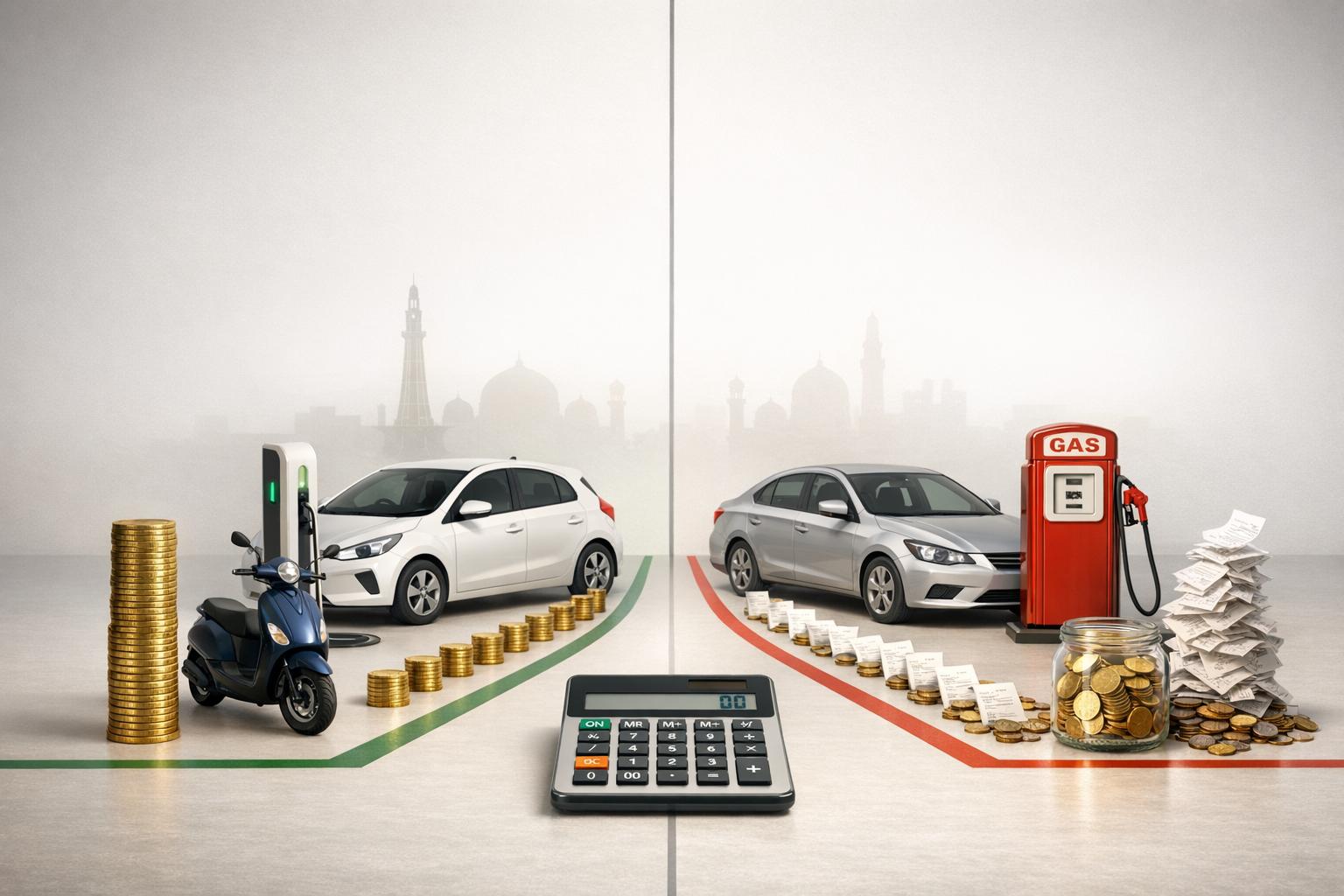
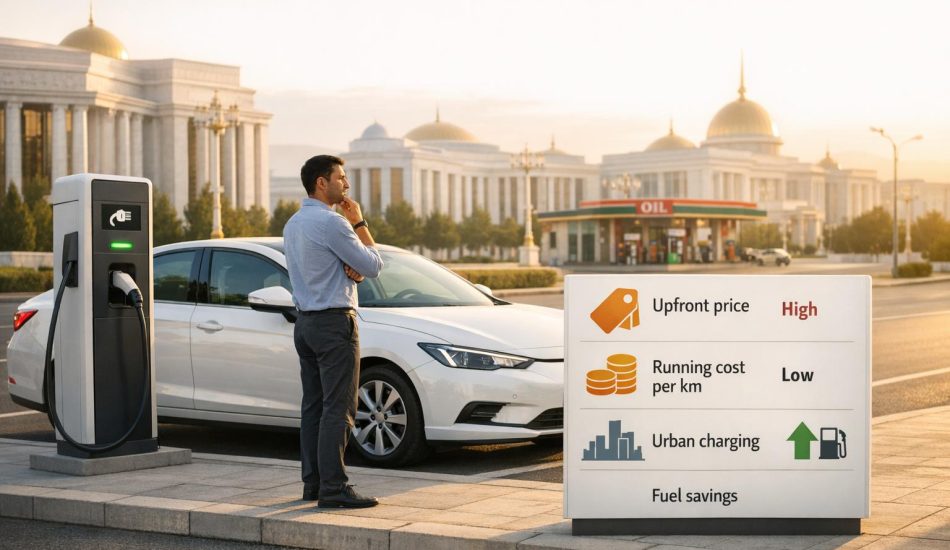
Thinking about getting an electric vehicle (EV) in Pakistan? Here’s the bottom line: EVs cost more upfront, but they can save you millions in the long run – especially if you drive a lot.
- Initial Price Difference: EVs are 20%–64% pricier than petrol cars in Pakistan. For example, an entry-level compact EV costs around PKR 5.5 million, compared to PKR 4.5 million for a petrol car.
- Running Costs: EVs cost PKR 2.8 per km, while petrol cars cost PKR 7.6 per km – a 63% saving.
- Payback Period: Compact EVs can take over 11 years to break even. However, electric bikes recover their cost in just 4–6 months.
- Government Incentives: EVs enjoy lower taxes (1% vs up to 45% for petrol cars), but four-wheeler subsidies are still limited.
- Maintenance Costs: EVs have fewer moving parts, cutting maintenance costs by about 50%.
Quick Comparison: EV vs Petrol Car (Pakistan, 2026)
| Aspect | EV | Petrol Car |
|---|---|---|
| Upfront Cost | Higher (PKR 5.5M) | Lower (PKR 4.5M) |
| Fuel/Energy Costs | PKR 2.8/km | PKR 7.6/km |
| Maintenance | Lower (PKR 22,500/year) | Higher (PKR 45,000/year) |
| Taxes | Lower (1%) | Higher (up to 45%) |
| Resale Value | Dependent on battery | Stable but policy-driven |
EVs are ideal for high-mileage drivers or businesses, while petrol cars may still be a better fit for low-mileage users. For two-wheelers, EVs are a no-brainer with their short payback time. Want to calculate your costs? Use the EV vs Petrol Calculator to see what works best for you.
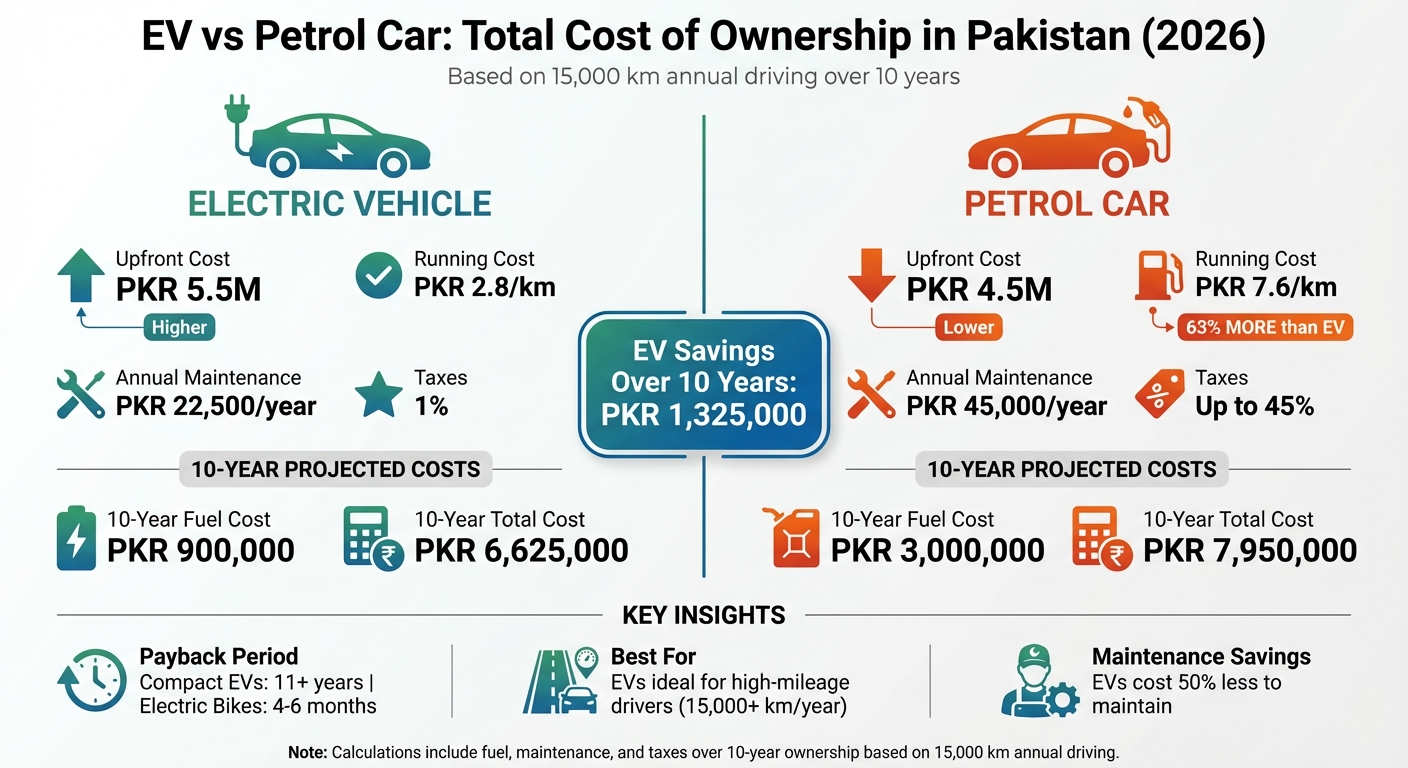
EV vs Petrol Car Total Cost Comparison Pakistan 2026
Electric Vehicles in Pakistan 2025: EV vs Petrol Comparison & Ownership Guide
sbb-itb-5f05a6f
What Makes Up Total Cost of Ownership
The Total Cost of Ownership (TCO) combines two primary components: CAPEX (Capital Expenditure) and OPEX (Operational Expenditure). CAPEX includes the manufacturer’s retail price, registration costs, import duties, and the expense of charging equipment (after accounting for subsidies). OPEX covers recurring costs like fuel or electricity, registration fees, insurance, and maintenance. Additionally, the residual value of the vehicle after 10 years is factored in.
In Pakistan, the National Electric Vehicle Policy (NEVP) has significantly lowered acquisition and registration taxes for electric vehicles (EVs) to just 1%, providing a stark contrast to the higher duties imposed on internal combustion engine (ICE) vehicles.
Financing terms also play a critical role. Factors like interest rates (e.g., KIBOR in Pakistan) and loan tenure can greatly influence the total amount paid over time. The International Energy Agency highlights the importance of subsidies and tax reductions in making EVs more affordable:
"Reducing the amount that must be borrowed by introducing a subsidy or reducing taxes can make vehicle B [EV] more affordable and more competitive in terms of TCO."
Now, let’s explore how purchase price and subsidies set the stage for differences in TCO.
Purchase Price and Government Subsidies
Government incentives are key to narrowing the initial price gap between EVs and petrol cars. In Pakistan, NEVP has reduced acquisition and registration taxes for EVs to 1%, making them more attractive to buyers. Similarly, in India, central subsidies under FAME II can save buyers up to ₹1.5 lakh, with additional state-level incentives ranging from ₹30,000 to ₹1.5 lakh.
For instance, consider the Tata Nexon EV MR in India. Its ex-showroom price is approximately ₹14.49 lakh, compared to ₹11.69 lakh for the petrol variant (XZ+). However, after applying FAME II and Delhi-specific subsidies, the EV’s effective price drops to about ₹11.49 lakh – making it cheaper than the petrol version.
While subsidies reduce the upfront cost, running costs provide another significant advantage for EVs.
Running Costs: Electricity vs Petrol
This is where EVs truly excel. In Pakistan, the running cost for EVs is about PKR 2.8 per kilometre, compared to PKR 7.6 per kilometre for petrol vehicles – a 63% reduction in fuel expenses.
EVs are inherently more energy-efficient than petrol engines. A September 2025 study comparing light commercial vehicles focused on the Hyundai Porter H-100 as a reference diesel model in Pakistan. While the electric version had a higher upfront cost, its lower operational cost (0.119 EUR per km for EVs versus 0.136 EUR per km for diesel) made it more economical over its lifetime.
For commercial users, EVs become cost-competitive when driven around 50 kilometres per day. As automotive journalist John Voelcker puts it:
"The cheapest way to charge your electric car is almost always at home, overnight."
Maintenance and Resale Value
EVs require less maintenance due to their simpler mechanics and fewer moving parts. There’s no need for oil changes, clutch servicing, or replacing filters and belts. However, EVs aren’t entirely maintenance-free. Owners should budget for items like cabin filters, coolant, and specialised tyre care. High torque in EVs can also lead to faster tyre wear compared to petrol vehicles.
Resale value is improving. While historically lower, resale values for EVs are rising as battery warranties – often lasting up to 8 years – offer more assurance to second-hand buyers. Factors like battery health reports and brand reliability are becoming increasingly important for resale value. To maximise battery life and resale value, EV owners are advised to maintain good charging habits, such as keeping the battery between 20% and 80% capacity.
These elements – low maintenance costs and evolving resale value – play a crucial role in shaping TCO for EVs across the region.
| TCO Component | EV (Electric Vehicle) | Petrol/Diesel (ICE) |
|---|---|---|
| Upfront Cost | Higher (due to battery) | Lower |
| Taxes/Duties | Lower (1% in Pakistan) | Higher (up to 45% in Pakistan) |
| Fuel/Energy | Lower (Electricity) | Higher (Petrol/Diesel) |
| Maintenance | Lower (fewer moving parts) | Higher (oil, filters, belts) |
| Resale Value | Dependent on battery health | Stable but policy-dependent |
| Registration | Often subsidised/exempt | Standard rates |
EV vs Petrol Cost Comparison Across Asia in 2026
In 2026, the cost dynamics between electric vehicles (EVs) and petrol-powered cars vary significantly across Asia. In China, the average battery electric vehicle (BEV) is priced at around $24,000 – approximately $700 less than a comparable petrol car. This pricing shift gives EVs a clear edge in the world’s largest automobile market.
Thailand follows closely, with BEV price premiums staying below 5% across all vehicle categories. This competitive pricing is largely due to the influx of affordable Chinese imports, which make up over 80% of BEV sales in the country. Meanwhile, in India, the gap is narrowing, with EVs costing about 15% more for small cars and 25% more for SUVs. This is driven by strong local manufacturing efforts from companies like Tata and Mahindra, which achieve 70–90% local production content. Beyond the upfront costs, EVs also demonstrate considerable savings in operational expenses, making them an increasingly attractive option.
Running Costs: A Clear Advantage for EVs
When it comes to running costs, EVs consistently outperform petrol vehicles across the region. For instance, in India, charging an EV at home costs approximately ₹1.00–₹1.50 per kilometre, compared to ₹8.50–₹9.50 per kilometre for petrol cars. A Tata Nexon EV owner driving 15,000 kilometres annually could save about ₹93,600 in fuel costs, with maintenance expenses also 35–40% lower over five years.
Cost Breakdown by Country
The table below highlights the key cost differences between EVs and petrol cars across selected Asian countries:
| Country | Upfront Price Gap (2026) | Running Cost Advantage (EV) | Key Cost Driver |
|---|---|---|---|
| China | EVs are about $700 cheaper | ~50% lower fuel costs | Battery prices reduced by 25%; subsidies extended to 2027 |
| Thailand | BEVs carry a premium of <5% | ~50% lower fuel costs | Affordable Chinese imports; EV3.5 policy support ($26B) |
| India | EV premium of 15–25% | ₹1.00 vs ₹8.50 per km | Local manufacturing; FAME II subsidies |
| Pakistan | Significant premium (PKR 18M–20M) | PKR 2.8 vs PKR 7.6 per km | Early-stage market; limited local production |
In Pakistan, where the EV market is still in its infancy, models like the BYD Atto 3 come with a significant price premium, underlining the challenges of local EV adoption. While operational costs are lower – PKR 2.8 per kilometre compared to PKR 7.6 for petrol – the high upfront cost remains a barrier.
These country-specific insights provide a comprehensive view of EV and petrol vehicle costs, helping consumers and policymakers make informed decisions across the region.
Pakistan-Specific Cost Analysis for 2026
By 2026, Pakistan’s electric vehicle (EV) market is still finding its footing. High prices and a limited charging network are major hurdles. However, the New Energy Vehicle (NEV) Policy 2026–30 aims to boost adoption by offering subsidies – up to PKR 80,000 for electric motorcycles and PKR 400,000 for electric three-wheelers. Yet, four-wheeler EVs remain costly, carrying a 20%–64% price premium over comparable petrol vehicles.
Tax incentives provide some relief. EVs are exempt from Federal Excise Duty (FED) and the NEV Adoption Levy (which adds 1–3% on petrol vehicles). Additionally, customs duty on locally assembled EV parts is just 1%. Even so, entry-level compact EVs are priced around PKR 5,500,000, compared to PKR 4,500,000 for petrol cars, underscoring the persistent price gap.
When it comes to running costs, EVs have the edge. Charging at home costs about PKR 45 per kWh, translating to PKR 5–6 per kilometre. In contrast, petrol cars cost PKR 18–25 per kilometre. Over five years, an entry-level compact EV could save around PKR 1,041,000 in fuel and maintenance. However, the payback period for compact EVs is about 11.3 years, and for mid-range sedans or SUVs, it can stretch beyond 20 years.
"For around PKR 1,800 to PKR 2,500, you can fully charge most EVs and enjoy 200–400 kilometres of quiet, emission-free driving. Compare that to the cost of refuelling with petrol or diesel, and the savings speak for themselves." – Acom Distributors
The real opportunity lies in two- and three-wheelers, which make up over 90% of registered vehicles in provinces like Punjab. Electric motorcycles, for instance, offer payback periods as short as 4 to 6 months, with annual fuel and maintenance savings exceeding PKR 62,000. For four-wheelers, the financial benefits only become clear with high mileage or if battery prices drop significantly.
Example: Entry-Level EV vs Petrol Car in Pakistan
Here’s a look at how costs stack up over 10 years for an entry-level compact EV versus a petrol hatchback, assuming 15,000 kilometres of annual driving. Using average running costs – PKR 20 per km for petrol and PKR 6 per km for EVs – and maintenance costs (PKR 45,000 annually for petrol cars and PKR 22,500 for EVs), the comparison looks like this:
| Cost Component | Petrol Car | Electric Vehicle |
|---|---|---|
| Purchase Price | PKR 4,500,000 | PKR 5,500,000 |
| Government Incentives | PKR 0 | PKR 0 (subsidies for 2/3-wheelers only) |
| 10-Year Fuel/Energy Cost | PKR 3,000,000 | PKR 900,000 |
| 10-Year Maintenance Cost | PKR 450,000 | PKR 225,000 |
| Total 10-Year Cost | PKR 7,950,000 | PKR 6,625,000 |
| Net Savings (EV) | – | Approx. PKR 1,325,000 |
While EVs save about PKR 1,325,000 over a decade, the higher upfront cost means buyers driving less than 10,000 kilometres annually may face payback periods exceeding 15 years.
Petrol hatchbacks typically cost PKR 40,000–50,000 annually for servicing, compared to PKR 20,000–25,000 for small EVs, thanks to fewer moving parts and no oil changes. However, resale values remain uncertain, as EVs may depreciate faster, with battery health being a key factor. For instance, replacing a hybrid vehicle battery can cost around PKR 1,000,000.
High-mileage drivers and fleet operators stand to gain the most from four-wheeler EVs. Meanwhile, two-wheeler owners can recover their investment almost instantly. To make EVs a mainstream choice for families, Pakistan needs stronger policy support, local manufacturing, and a more extensive charging network.
This analysis lays the groundwork for understanding how our EV vs petrol calculator can help buyers make informed decisions.
How to Calculate Your EV vs Petrol Costs
Figuring out whether an electric vehicle (EV) is worth it comes down to a simple Total Cost of Ownership (TCO) calculation. The TCO formula is straightforward: start with the vehicle’s purchase price, subtract any government incentives, then add up all running costs over the ownership period. These include fuel or electricity, maintenance, insurance, and registration fees. Finally, subtract the resale value of the vehicle at the end of the period.
The costs can vary depending on your driving habits and location. For instance, someone driving 20,000 kilometres annually in Karachi will have different expenses compared to someone driving 8,000 kilometres in Lahore. Charging at home during off-peak hours can also significantly reduce your per-kilometre electricity costs compared to relying on public fast chargers.
"When one tallies up electricity vs petrol and simpler maintenance, EVs tend to be far cheaper to run." – Muhammad Ahmad, Industry Analyst
By 2026, the upfront price of EVs in Pakistan may be 20%–64% higher than petrol vehicles, but operational savings could exceed PKR 1 million over five years. Using a calculator tailored to your driving habits can help determine if these savings justify the initial investment.
Calculator Formula and Step-by-Step Example
Here’s how the TCO formula works:
TCO = (Purchase Price − Incentives) + (Annual Fuel/Energy Cost × Years) + (Annual Maintenance × Years) + (Annual Insurance × Years) − Resale Value
Let’s break this down using an example of a mid-range sedan in Pakistan, assuming 15,000 kilometres of driving annually over 10 years.
Step 1: Upfront Costs
- Petrol sedan price: PKR 6,000,000
- EV sedan price: PKR 8,500,000
- Government incentives: PKR 0
Step 2: Annual Fuel/Energy Costs
For the petrol sedan (12 km/litre efficiency, PKR 272.50 per litre):
- Annual fuel consumption: 15,000 km ÷ 12 km/litre = 1,250 litres
- Annual fuel cost: 1,250 × PKR 272.50 = PKR 340,625
For the EV sedan (6 km/kWh efficiency, PKR 39.70 per kWh):
- Annual electricity consumption: 15,000 km ÷ 6 km/kWh = 2,500 kWh
- Annual charging cost: 2,500 × PKR 39.70 = PKR 99,250
Step 3: Maintenance Costs
- Petrol sedan: PKR 45,000 per year (includes oil changes, filters, exhaust checks)
- EV sedan: PKR 22,500 per year (brake pads, tyres, coolant – no oil changes)
Step 4: Insurance Costs
- Petrol sedan: PKR 60,000 per year
- EV sedan: PKR 70,000 per year (slightly higher due to battery repair considerations)
Step 5: Resale Value After 10 Years
- Petrol sedan: PKR 1,800,000 (30% of original price)
- EV sedan: PKR 2,125,000 (25% of original price, accounting for battery wear)
Here’s how the 10-year TCO adds up:
| Cost Component | Petrol Sedan (10 Years) | EV Sedan (10 Years) |
|---|---|---|
| Purchase Price | PKR 6,000,000 | PKR 8,500,000 |
| Fuel/Energy (10 years) | PKR 3,406,250 | PKR 992,500 |
| Maintenance (10 years) | PKR 450,000 | PKR 225,000 |
| Insurance (10 years) | PKR 600,000 | PKR 700,000 |
| Subtotal | PKR 10,456,250 | PKR 10,417,500 |
| Resale Value | − PKR 1,800,000 | − PKR 2,125,000 |
| Total 10-Year TCO | PKR 8,656,250 | PKR 8,292,500 |
| Net Savings (EV) | – | PKR 363,750 |
In this example, the EV saves about PKR 363,750 over a decade. However, these savings depend on consistent driving and holding the vehicle for the full period. If your annual mileage is lower, the payback period becomes longer, potentially making petrol vehicles more economical.
For two-wheelers, the savings are even more pronounced. An electric bike like the Jolta JE-70D costs just PKR 21,000 more upfront, but it saves over PKR 62,000 annually on fuel and maintenance. This results in a payback period of just 4.1 months.
Final Thoughts on EV Ownership in Asia by 2026
The financial outlook for electric vehicles (EVs) in Asia is promising, though affordability depends on the type of vehicle. In Pakistan, electric two- and three-wheelers stand out with notably short payback periods, making them the most accessible option for widespread adoption.
"Electric two- and three-wheelers – comprising more than 90 percent of registered vehicles – offer a significantly more practical and affordable pathway for mass adoption [in Pakistan]."
- Sarim Zia, Energy Unit, Sustainable Development Policy Institute (SDPI)
On the other hand, four-wheeler EVs come with a higher upfront cost. However, they present considerable operational savings over a five-year period, making long-term ownership key to maximising these benefits. This highlights the need for a detailed Total Cost of Ownership (TCO) analysis when evaluating an EV purchase.
Switching to EVs also has broader economic implications. For instance, Pakistan’s oil import bill jumped by 23%, reaching USD 2.53 billion in just the first two months of FY2024–25. By replacing petrol with locally produced electricity, the country can enhance energy security and retain economic value within its borders.
Whether you’re eyeing an electric motorcycle for your daily commute or contemplating a long-term investment in an electric car, understanding your specific costs is vital. Use the TCO calculator to factor in your driving habits, electricity rates, and vehicle preferences. This personalised approach helps you make a well-informed decision about transitioning to electric mobility.
FAQs
How many kilometres a year make an EV worth it in Pakistan?
Driving between 10,000 to 15,000 kilometres per year makes owning an electric vehicle (EV) a practical choice in Pakistan. Why? The lower running costs of EVs, combined with government incentives, can help balance out the higher upfront price over time, making them a smart investment for frequent drivers.
Does home charging or fast charging change the EV payback?
Yes, charging your EV at home can often reduce the time it takes to recover your investment compared to relying on fast charging. Home charging is usually more affordable and convenient, which can help bring down overall ownership costs in the long run.
How much does battery health affect EV resale value?
Battery health plays a major role in determining the resale value of an electric vehicle (EV). By 2026, it’s expected to become the primary factor influencing price. Why? Batteries that are significantly degraded can cause a sharp drop in value, as replacing them comes with a hefty price tag – anywhere between $8,000 and $22,000.
A poorly maintained battery not only reduces the vehicle’s range but also impacts its overall performance. On the flip side, EVs with well-maintained batteries are likely to hold their value better, especially as the market grows and more reliable data on battery longevity becomes available.