
 Arka Pratama
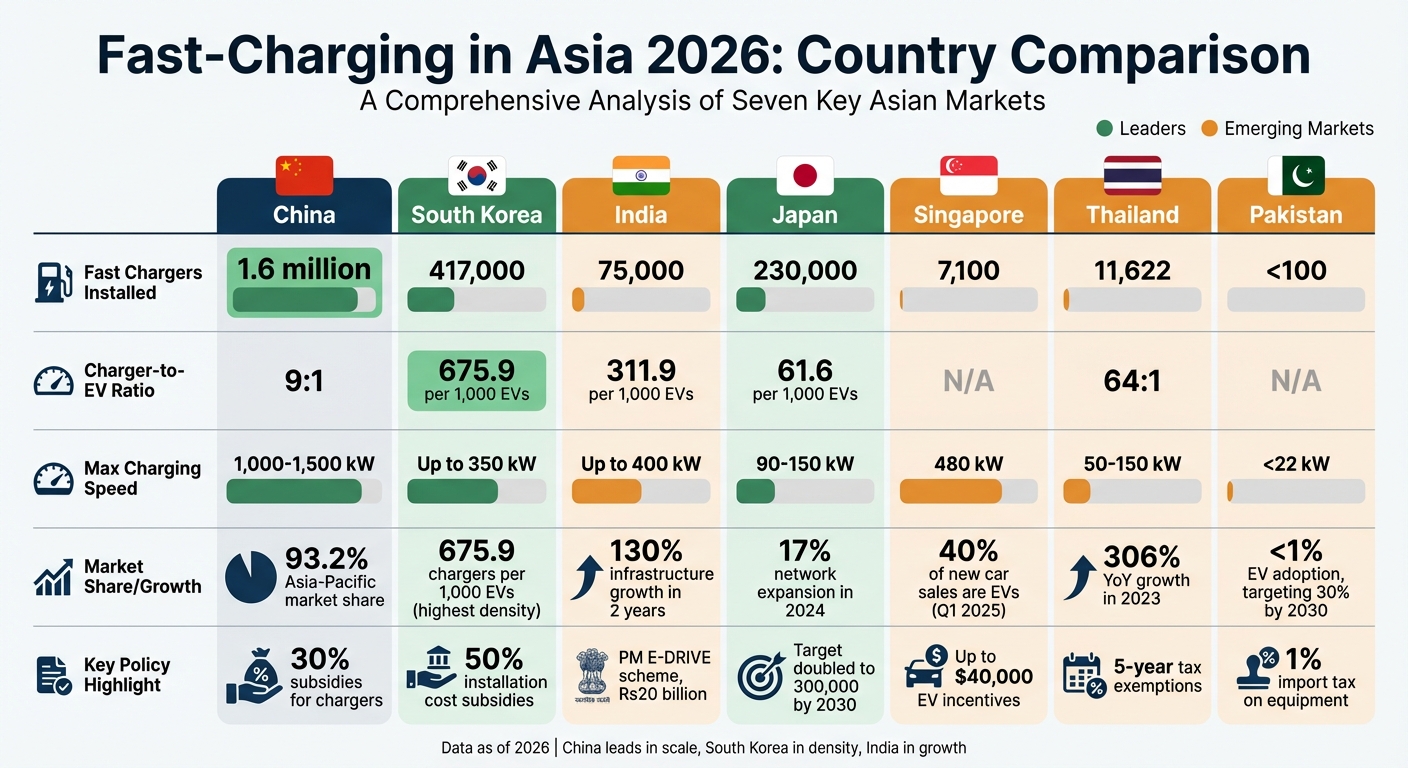
Asia’s EV fast-charging scene is rapidly evolving, led by China, South Korea, and India. Here’s what you need to know:
- China: Dominates with 1.6 million fast chargers, 93.2% market share, and cutting-edge 1 MW+ charging speeds. Policies now focus on infrastructure over EV subsidies.
- South Korea: Offers the highest charger density per EV (675.9/1,000) and government-backed subsidies for fast chargers.
- India: Charging infrastructure grew 130% in two years, with a strong push for highway coverage and urban networks.
- Japan: Lags in ultra-fast charging adoption but focuses on expressway upgrades and policy reforms.
- Singapore: Compact but ambitious, aiming for 60,000 chargers by 2030, including ultra-fast options.
- Thailand: Emerging as an EV hub, with growing DC fast charger installations and tax incentives.
- Pakistan: Early-stage development with fewer than 100 fast chargers but plans for 3,000 by 2030.
Quick Comparison
| Country | Fast Chargers Installed | Charger-to-EV Ratio | Max Speed (kW) | Key Policies/Initiatives |
|---|---|---|---|---|
| China | 1.6 million | 9:1 | 1,000–1,500 | 30% subsidies for chargers, urban-rural expansion plans |
| South Korea | 417,000 | 675.9:1,000 | Up to 350 | 50% subsidies, performance-linked funding |
| India | 75,000 | 311.9:1,000 | Up to 400 | PM E-DRIVE scheme, highway focus |
| Japan | 230,000 | 61.6:1,000 | 90–150 | CHAdeMO upgrades, kWh-based pricing |
| Singapore | 7,100 | N/A | 480 | EV Early Adoption Incentive, ultra-fast liquid-cooled tech |
| Thailand | 11,622 | 64:1 | 50–150 | Tax breaks, low electricity tariffs for chargers |
| Pakistan | <100 | N/A | <22 | Tariff cuts, streamlined setup process |
China leads in scale and speed, while South Korea and India excel in density and growth. Pakistan’s efforts are nascent but show promise with supportive policies. Each country is tackling unique challenges to boost EV adoption and infrastructure.
Asia Fast-Charging Infrastructure Comparison 2026: 7 Countries
1. China
Fast-charging station count
China boasts the largest EV charging network in the world, with a staggering 20.09 million total units by the end of 2025. This network includes 4.72 million public charging facilities and 15.38 million private units. Impressively, the infrastructure doubled from 10 million to 20 million units in just 18 months leading up to 2026. Of the public chargers, nearly half are fast-charging stations, giving China an estimated 2.1 to 2.3 million public fast chargers.
To further expand this network, the government launched a three-year action plan in October 2025 through the National Development and Reform Commission. The plan aims to reach 28 million charging facilities by the end of 2027, with public capacity exceeding 300 million kilowatts to support 80 million EVs. Key industry players are also contributing to this growth: BYD plans to build 4,000 megawatt charging stations, Huawei is targeting 100,000 ultrafast stations, and a joint venture between Mercedes-Benz and BMW is set to roll out 7,000 premium charging stations by 2026.
Charging speed (kW)
The average power of a single public charging unit reached 46.5 kW in 2026, marking a 33% improvement in efficiency compared to the previous year. While this figure includes slower AC chargers, China is at the forefront of ultra-fast charging technology. The latest systems can deliver 1 MW to 1.5 MW, far exceeding the 350 kW standards commonly seen in markets like the United States. By November 2025, the combined rated power of public charging facilities had reached approximately 210 million kilowatts.
Government policy support
China’s government has shifted its focus from subsidising EV purchases to supporting charging infrastructure. Up to 30% of the cost of new charging stations is now subsidised. Policies are prioritising upgrades to urban fast-charging networks and expanding coverage in expressway service areas and rural towns. By early 2026, 98% of highway service areas had charging piles, and 19 provincial-level regions achieved full charging coverage in all townships.
EV adoption rate
China’s EV-to-charger ratio stands at 9:1, slightly behind the Netherlands (5:1) but ahead of Europe (10–13:1) and the United States (31:1). The country’s extensive charging network supports over 40 million new energy vehicles. In 2024, China dominated the Asia Pacific EV charging station market with a 93.2% share, solidifying its leadership position in the region. These accomplishments set a high bar as we next explore South Korea’s progress in fast-charging infrastructure.
2. South Korea
Fast-charging station count
South Korea stands out in the region with approximately 417,000 public charging points catering to around 617,000 EVs as of 2024. This results in an impressive ratio of 675.9 public charging points per 1,000 EVs, one of the highest in the area. Looking ahead, the government has earmarked 545.7 billion won for charging infrastructure by 2026, aiming to install 4,450 fast chargers. The steady expansion of fast chargers highlights the country’s commitment to improving charging speeds and accessibility.
Charging speed (kW)
The majority of South Korea’s fast-charging network operates within the 50–100 kW range. However, cutting-edge advancements are emerging, such as Hyundai’s "E-pit" stations, which can deliver speeds of up to 350 kW. On the technology front, SK Innovation has introduced batteries capable of reaching 80% charge in just 15 minutes. To meet the growing demand in high-traffic areas, the government is transitioning from predominantly AC chargers, which currently make up 87% of the network, to DC fast-charging solutions.
Government policy support
South Korea’s "Green New Deal" plays a major role in expanding EV infrastructure, offering subsidies that cover up to 50% of installation costs for DC fast chargers. As Director-General Seo Young-tae explained:
We have moved a step beyond merely increasing installations to enhancing quality and reliability.
In a move to ensure high standards, the government has implemented performance-linked subsidies. These reduce support by 20% if critical components fail to meet minimum performance benchmarks.
EV adoption rate
South Korea’s efficient infrastructure has driven a rapid increase in EV adoption. The EV-to-charger ratio sits at 11.5, significantly better than the global average of 15.9. EV sales have surged from 134,962 units in 2020 to 543,900 in 2023, as private-sector giants like Hyundai, SK, and LG expanded their presence, growing the market to 350 companies. This growth reflects the dynamic development of South Korea’s fast-charging ecosystem and its ability to keep pace with rising consumer demand.
Full Tour Of A Typical DC Fast Charging Park In South Korea!
3. Japan
As China and South Korea push forward with rapid advancements, Japan takes a more measured approach, focusing on incremental improvements to its EV infrastructure.
Fast-charging station count
By early 2026, Japan had established around 230,000 public charging points to serve approximately 3,730,000 electric vehicles. This translates to a ratio of 61.6 public chargers per 1,000 EVs. A notable emphasis has been placed on expressway infrastructure, with the number of expressway chargers expected to grow from 402 units in 2020 to 1,073 by 2025. Japan’s network primarily utilises the CHAdeMO standard, reflecting its long-standing commitment to this technology.
Charging speed (kW)
Most of Japan’s fast chargers deliver between 3 kW and 90 kW, with around 60% operating below 50 kW. Recognising the need for higher power, the government has set minimum standards of 90–150 kW for expressway chargers and 50 kW for other public areas. Despite these efforts, only 40% of Japanese drivers feel that public charging speeds meet their needs, compared to a global satisfaction rate of 60%. This slower adoption of ultra-fast charging technologies places Japan behind nations like China and South Korea, where high-power networks are becoming the norm. The Ministry of Economy, Trade and Industry (METI) is actively pushing for upgrades to bridge this gap.
Government policy support
In response to growing challenges, METI has doubled its 2030 target for charging connectors from 150,000 to 300,000. A significant regulatory shift in 2023 removed the designation of chargers exceeding 200 kW as "electrical substations", thereby reducing installation costs. Additionally, the government plans to transition from time-based charging fees to a kWh-based pay-per-use system by the end of fiscal year 2025. These policy changes aim to strengthen Japan’s position in Asia’s fast-charging landscape. METI has stated:
Japan aims to develop a society with EV charging infrastructure that is highly convenient and sustainable, on par with the rest of the world, comprehensively taking into account the three principles of ‘improving user convenience,’ ‘making EV charging businesses more independent and sophisticated,’ and ‘reducing burdens on society as a whole’.
EV adoption rate
Japan’s EV adoption remains modest, with sales penetration at just 4% in 2024, far below the global average of 25% and China’s 49%. In 2024, the country added 1,200 new DC chargers, expanding its public charging network by 17%, which is roughly half the global growth rate of 33%. Only 64% of Japanese EV drivers report satisfaction with their charging experience, compared to a global average of 89%. This highlights the challenges Japan faces in meeting the expectations of its EV users.
4. India
India has emerged as a key player in the global fast-charging market, experiencing a remarkable 130% growth in its charging infrastructure over the past two years. By the close of 2024, the country had established around 75,000 public charging points, with nearly 35% of these being DC fast-charging units [27,33,41]. This equates to an impressive 311.9 public chargers per 1,000 EVs, placing India second globally in charger density per EV. These developments mark a significant leap forward, supported by both technical advancements and policy initiatives.
Fast-charging station count
India’s charging network has grown exponentially, climbing from 5,151 stations in December 2022 to over 29,277 public charging stations by August 2025 [43,45]. National Highway 48, connecting Delhi and Chennai, stands out as the most densely equipped corridor, boasting 652 public fast-charging stations in 2025 – a 41% increase from the previous year. Highlighting this growth, Akshit Bansal, CEO of Statiq, noted:
"Beyond Delhi-Chandigarh, we are seeing Delhi-Jaipur and Jaipur-Udaipur emerge as India’s EV tourism highways".
Tata Power EZ Charge has also played a significant role, operating over 5,300 public and semi-public charging points across 530 cities, with plans to expand to 25,000 public stations by 2028. As the number of stations increases, so does the push to deliver faster charging solutions.
Charging speed (kW)
India’s public charging network is currently composed of 65% AC chargers and 35% DC fast chargers [41,45]. DC fast chargers range from 15 kW for basic units to high-performance setups delivering up to 400 kW. The Ministry of Power categorises chargers above 50 kW as "fast", with service charges capped at Rs12 per unit. Some of the newer deployments now offer speeds of up to 360 kW, capable of reducing charging times to under 20 minutes [41,42]. However, there are challenges – nearly 50% of public chargers were reported as nonfunctional in early 2024 due to maintenance or connectivity issues.
Government policy support
In September 2024, the government replaced the FAME II scheme with the PM E-DRIVE scheme, doubling financial support to Rs20 billion (about USD 240 million) [33,41,43,45]. The scheme aims to install 22,100 fast chargers for four-wheelers and 1,800 for e-buses by March 2026 [41,45]. Additionally, the Ministry of Power has mandated the placement of charging stations every 25 km on major highways and within a 3×3 km grid in major cities. Speaking on the importance of this infrastructure, Benjamin Lin, President of Delta Electronics India, remarked:
"India’s EV journey hinges on the creation of a well-orchestrated charging infrastructure ecosystem – where policy support, industry action, and consumer readiness align for large-scale, sustainable adoption".
EV adoption rate
India’s total EV sales reached 2.27 million units in 2025, representing 8% of total vehicle dispatches. Electric car sales alone saw a 77% year-on-year increase, hitting 176,817 units in the same period. Despite this growth, the country maintains approximately one public charger for every 235 EVs, a ratio that still lags behind other markets. Compounding the issue, only 55% of Indian consumers have access to home charging, making the expansion of a dependable public fast-charging network even more critical. This growing EV adoption underscores India’s rising prominence in Asia’s fast-charging ecosystem.
sbb-itb-5f05a6f
5. Singapore
Singapore is making strides in fast-charging infrastructure despite its compact size. By September 2024, the country had installed an impressive 15,300 charging points nationwide, including 7,100 public stations. Looking ahead, the government has ambitious plans to scale this up to 60,000 charging points by 2030 – dividing them into 40,000 for public carparks and 20,000 for private premises. Additionally, 120 fast chargers are set to be installed across 60 HDB commercial and industrial sites to cater to high-mileage commercial drivers.
Charging Speed (kW)
Singapore is stepping into the future with ultra-fast liquid-cooled chargers. In July 2025, SP Mobility and Huawei signed an agreement to introduce the country’s first 480 kW liquid-cooled chargers at Temasek Polytechnic. These chargers are capable of delivering over 200 km of driving range in just five minutes. Dean Cher, Managing Director of SP Mobility, shared:
"By partnering with Huawei, we look forward to scaling up ultra-fast charging deployments to support the electrification of heavy vehicle segments".
Currently, SP Mobility’s fast chargers cost between 76.3¢ and 81.8¢ per kilowatt-hour. The new ultra-fast chargers, however, are expected to come at a higher price due to the advanced infrastructure involved.
Government Policy Support
Singapore’s government has introduced several incentives to encourage EV adoption. The EV Early Adoption Incentive (EEAI) and Enhanced Vehicular Emissions Scheme (VES) reduce upfront costs by up to $40,000. Additionally, the Electric Vehicles Charging Act (EVCA), implemented in 2022, ensures safety and reliability in the charging network and mandates EV-ready provisions for new developments.
From 1 January 2026, two new schemes will further boost adoption: the EHVCG will offer up to 50% co-funding (capped at $30,000), and the HVZES will provide a $40,000 incentive for every new zero-tailpipe heavy vehicle. By 2030, all new car and taxi registrations must be cleaner-energy models.
EV Adoption Rate
Singapore’s EV market is growing at a remarkable pace. In the first quarter of 2025, electric vehicles made up 40% of all new car sales. During the first half of 2024, nearly 33% of new car registrations were electric, a significant jump from 18% in 2023. Light goods vehicles also saw strong adoption, with 44% of new registrations in the first nine months of 2024. By May 2025, there were 5,806 fully electric commercial vehicles and buses on the road. This rapid shift highlights Singapore’s dedication to sustainable transportation and sets a promising example for the region.
6. Thailand
Thailand is making waves as a regional hub for EV production, thanks to strong government incentives and significant private sector investment. By March 2025, the country had surpassed its goals, with 3,720 charging stations and 11,622 chargers installed across the nation. Looking ahead, the government aims to have 12,000 public quick chargers operational by 2030. However, the EV-to-charger ratio has jumped from 14 in 2021 to 64 in 2023, highlighting the growing pressure on the existing infrastructure.
Charging Speed (kW)
Thailand’s charging network is increasingly dominated by DC fast chargers. These chargers range from 22 kW to 350 kW, with the majority offering speeds between 50 kW and 150 kW – ideal for inter-city travel. Major players like PTT Oil and Retail Business (OR) and Energy Absolute (EA) are focusing on expanding coverage along key transport routes. In January 2024, Asset World Corporation teamed up with PTT subsidiary Arun Plus to roll out "on-ion" branded charging stations across 17 locations in Bangkok, Chiang Mai, and Phuket, featuring chargers with capacities of up to 100 kW.
Government Policy Support
Thailand’s EV growth is heavily supported by targeted policies. The Board of Investment offers five-year corporate income tax exemptions for charging stations equipped with at least 40 chargers, including DC fast chargers. EV buyers, meanwhile, can access subsidies of up to 100,000 Baht per vehicle. Public chargers benefit from low-priority electricity tariffs until 2025, while home chargers leverage off-peak time-of-use rates to lower costs. Additionally, the Power Development Plan 2025–2037 aims to generate 51% of the country’s electricity from renewable sources by 2037, paving the way for solar-powered charging hubs.
EV Adoption Rate
By mid-2025, EVs captured a 13% market share, with Battery Electric Vehicle registrations skyrocketing by 241% in 2022. The charging market, valued at USD 203.52 million, is expected to grow to USD 1.545 billion by 2030. Infrastructure expansion saw an impressive 306% year-over-year growth in 2023, driven by robust public and private investments. However, nearly 70% of the charging infrastructure remains concentrated in urban centres like Bangkok, reflecting a need for broader distribution.
7. Pakistan
Pakistan’s journey into the world of fast EV charging is still in its early stages, presenting a mix of hurdles and potential. As of early 2025, the country had fewer than 100 public charging stations, concentrated in major cities. The government has set a goal to increase this number to 3,000 by 2030 – a modest target compared to regional giants like China, which plans to hit 4.717 million by 2025.
Fast-Charging Station Count
Currently, Pakistan’s EV charging infrastructure relies heavily on AC slow chargers (up to 22 kW). The absence of ultra-fast chargers (above 350 kW) is a significant barrier to wider EV adoption and discourages private investment. Much like its neighbours, Pakistan faces hurdles such as limited infrastructure and market instability. However, major Chinese companies are stepping in to bridge the gap. For instance, ADM Group is working with local partners to install 3,000 charging stations, while BYD has announced plans to set up a manufacturing facility in the country.
Government Policy Support
The government has introduced several measures to encourage EV adoption. Electricity tariffs for charging operators have been slashed to Rs39.70 per unit from Rs71.10. Additionally, under the National Electric Vehicle Policy, charging equipment imports are taxed at just 1%, and EVs enjoy a reduced General Sales Tax of 1%, compared to the 17% levied on petrol vehicles. The process for setting up charging stations has also been streamlined, with a fast-track registration system that completes within 15 days. Energy Minister Awais Leghari highlighted the sector’s financial appeal, stating:
The government expects an internal rate of return of more than 20% for investors in the sector.
EV Adoption Rate
As of 2025, EVs account for less than 1% of vehicle sales in Pakistan. However, the government has ambitious plans to boost this figure to 30% by 2030. The initial focus is on two- and three-wheelers, with a goal to convert 10 million motorcycles. This shift is projected to save around US$6 billion annually in fuel imports. Yet, the road ahead is challenging, with the country grappling with high fuel import costs (approximately US$13 billion annually), severe air pollution, and an unreliable power grid. These issues, combined with supportive policies, lay the groundwork for the future of Pakistan’s EV market.
Strengths and Weaknesses by Country
Every country approaches fast-charging infrastructure with its own strategies, showcasing both advantages and hurdles along the way.
China stands out with an impressive 1.6 million fast chargers and a commanding 93.2% market share as of 2024. Nearly half of its charging infrastructure is fast-charging stations. However, challenges like low utilisation rates and an urban–rural divide persist. For instance, 57% of public chargers are concentrated in just 15 cities. This highlights the disparity between urban hubs and rural areas, where expansion remains a significant issue.
South Korea is a leader in technological advancements, boasting batteries that can reach 80% charge in as little as 15 minutes. The country has allocated 60% of its 2025 budget to fast-charging infrastructure. Despite these efforts, reliance on public funding and grid strain in urban centres remain key obstacles.
Japan has set an ambitious goal of installing 30,000 public fast-charging stations by 2030, a significant leap from its starting point of roughly 3,000 units in 2022.
India is experiencing rapid growth in charging infrastructure, largely propelled by strong government support. However, limitations in the power grid continue to pose challenges.
Singapore and Thailand have developed strong urban networks, primarily relying on Type 2 connectors. Yet, the high costs of installation remain a barrier, with DC fast chargers costing anywhere between $30,000 and $80,000 per unit.
According to the IEA, "access to public charging points is key to supporting mass adoption".
While countries with established networks grapple with high installation expenses, emerging markets like Pakistan face foundational hurdles. Pakistan’s fast-charging network is still in its infancy but shows potential. Recent government initiatives, such as simplified registration processes and competitive electricity tariffs, signal a commitment to growth. However, expanding coverage and upgrading to ultra-fast charging capabilities remain significant challenges.
A major issue across Asia is the lack of unified technical standards, complicating cross-border compatibility. For example, China uses the GB/T standard, Japan relies on CHAdeMO, and countries like India and several in Southeast Asia prefer Type 2 and CCS standards. This fragmentation forces manufacturers and users to juggle multiple systems, creating barriers for cross-border EV travel and increasing costs. Understanding these country-specific dynamics is essential for shaping the future of Asia’s fast-charging ecosystem.
Conclusion
By 2026, China has firmly established itself as the leader in fast-charging infrastructure, commanding 93.2% of the Asia-Pacific market and operating an impressive 1.6 million public fast-charging points. This dominance is a result of aggressive government mandates, BYD’s rollout of megawatt flash charging, and strong public-private partnerships. In contrast, other key markets in the region are following varied paths to develop their charging networks.
India, for instance, has emerged as the fastest-growing market, with its charging infrastructure expanding by about 130% within just two years. This rapid growth has been fuelled by initiatives like FAME and partnerships such as Delta Electronics’ collaboration with Tata Motors to install 250 fast-charging stations across 50 cities by August 2024. Meanwhile, South Korea and Japan continue to refine their technologies and policies, supported by significant government investments.
For developing markets like Pakistan, there are valuable lessons to be learned from these regional leaders. Modernising the power grid and incorporating energy storage technologies can help mitigate peak-time blackouts. Early adoption of unified charging standards, such as CCS or GB/T, can prevent the kind of fragmentation that currently complicates cross-border EV travel in Asia. Additionally, Pakistan’s abundant solar energy resources present an opportunity to establish off-grid fast-charging solutions. A case in point is India’s ESR Group, which launched a solar-powered charging facility at Taloja Industrial Park in March 2025.
Focusing on electrifying commercial fleets can also yield faster returns and higher utilisation rates. Logistics hubs and public transport depots are ideal starting points for deploying fast-charging infrastructure. Financial incentives, including tax rebates and low-interest loans, could encourage private operators to set up chargers along busy urban routes. Collaborations with existing petrol station networks could provide added convenience for EV users.
The Asia-Pacific EV charging market is forecasted to grow from US$25.86 billion in 2025 to US$68.55 billion by 2032, with DC charging expected to expand at a CAGR of 25.5%. This growth offers immense potential for developing markets that are ready to invest strategically. Regional collaboration on standardisation and policy alignment, akin to Europe’s "Spark Alliance", which unified 11,000 charging points across 25 countries through a single app in April 2025, could further accelerate progress across Asia.
Pakistan’s simplified registration processes and competitive electricity tariffs highlight its commitment to growth. However, expanding coverage to rural areas and upgrading to ultra-fast charging capabilities remain critical steps. By adopting successful strategies from regional leaders and leveraging its solar energy potential, Pakistan can build a strong fast-charging network to support widespread EV adoption. Strategic investments, supportive policies, and technological advancements will be key to ensuring the region’s sustainable growth in the EV charging sector.
FAQs
What makes China a leader in the fast-charging infrastructure across Asia?
China is at the forefront of the fast-charging market, thanks to its rapidly expanding infrastructure. By late 2025, the country is expected to have over 20 million EV charging facilities in place. This impressive growth is fuelled by robust government initiatives, including subsidies and policies designed to boost EV adoption, alongside advancements in ultra-fast liquid-cooled charging technology.
China’s focus on innovation and large-scale investments has not only helped it keep up with the rising demand for EVs but also set a standard for other Asian countries aiming to advance in this sector.
Why does South Korea have one of the best charger-to-EV ratios in Asia?
South Korea has emerged as a leader in maintaining an impressive charger-to-EV ratio, thanks to government-led efforts, financial incentives, and large-scale investments in charging infrastructure. With just 11.5 EVs per public charger, the country ensures EV users have easy access to charging points.
This achievement stems from strong collaboration between the government and private giants like LG and Hyundai. Policies that promote rapid expansion of charging networks, subsidies to encourage EV purchases, and technological advancements in charging systems have firmly placed South Korea at the forefront of Asia’s fast-charging landscape.
What obstacles is Pakistan facing in developing its fast-charging network for electric vehicles?
Pakistan faces several obstacles in creating a dependable fast-charging network for electric vehicles (EVs). One of the biggest hurdles is upgrading the national power grid to support the extra electricity demand from EV charging stations. This isn’t a quick fix – it requires large-scale investment and careful, long-term planning. Without a stronger grid, the system could struggle to handle the load, leading to inefficiencies.
The current infrastructure for EV charging is also limited, and expanding it comes with its own set of challenges. From logistical issues to financial constraints, scaling up requires both strategic effort and resources. Another pressing issue is the absence of advanced technology and standardised high-capacity charging stations. These are essential for building a reliable ecosystem, yet Pakistan is still in the early stages compared to nations like China, which have made considerable strides in this area.
Economic and social factors add another layer of complexity. Public awareness about EVs remains low, and affordability is a concern for many. Policies that support EV adoption, along with incentives for both users and businesses, are crucial for encouraging growth. To tackle these challenges, Pakistan needs a mix of strategic planning, government support, and active participation from the private sector. Only then can the country move towards a fast-charging network that’s both reliable and accessible.