
 Arka Pratama
In 2026, EV import policies across Asia have shifted significantly. Governments are moving away from broad tax exemptions, instead focusing on local assembly and tiered tax systems. Importers now face varying duties, sales taxes, and incentives depending on the country. Here’s what you need to know:
- Pakistan: Import duties for fully built EVs are 25%, plus a 17% sales tax. Heavy commercial EVs have just 1% duty. Local assembly incentives include reduced taxes for up to 100 units per variant.
- China: Domestic production dominates, but Free Trade Agreements (like ACFTA) reduce import duties for Chinese EVs in ASEAN markets (e.g., 5% in Malaysia).
- India: High tariffs (up to 125%) on fully imported EVs encourage local manufacturing. Some tax reductions apply for EVs priced over $35,000 with a local production commitment.
- Thailand: Import tariff reductions (up to 40%) and excise tax cuts (as low as 2%) apply to importers committing to local assembly by 2027.
- Japan: Premium EVs face standard import duties (0–10%) and strict safety/emission regulations, often increasing costs.
Key Insights:
- Free Trade Agreements (e.g., ACFTA) play a critical role in reducing duties for specific markets.
- Governments are incentivizing local assembly to balance industrial growth with EV adoption.
- Costs vary widely: Import duties range from 0% in Japan to 125% in India, depending on the market and vehicle type.
For importers in Pakistan, platforms like EV24.asia simplify the process by offering transparent pricing, customs clearance, and local registration support. Navigating these policies effectively can reduce costs and ensure compliance in this evolving market.
EV Import Taxes and Duties in Major Asian Markets
Tax policies for imported EVs vary widely across Asia. Here’s a closer look at how Pakistan, China, India, Thailand, and Japan handle EV import duties in 2026.
Pakistan: Import Taxes and Duties for EVs
In Pakistan, CBU 4-wheeler EVs are subject to a 25% customs duty, applicable until 30 June 2026. Importers also face a 17% sales tax and a 6% additional customs duty (ACD), with the latter depending on engine size.
For heavy commercial EVs, the duty is just 1%. Manufacturers planning to establish local assembly can import up to 100 units of a specific EV variant at a reduced duty of 12.5% (half the standard rate), provided they obtain approval from the Engineering Development Board.
Used EVs of Asian origin follow a fixed duty structure based on engine size. For instance, 1,001cc–1,300cc models incur a duty of $13,200, while 1,301cc–1,500cc models are taxed at $18,590. A 1% monthly depreciation applies based on the vehicle’s age.
China: Import Policies for High-Volume Markets
China’s EV market is dominated by domestic production, with the country serving as a major exporter. Thanks to the ASEAN-China Free Trade Agreement (ACFTA), Chinese EVs entering Malaysia enjoy reduced duties as low as 5%, compared to the standard 30% for non-FTA vehicles. However, South Korean brands like Hyundai and Kia are classified as "highly sensitive" and remain subject to the full 30% duty.
India: Import Taxes and Local Assembly Requirements
India imposes steep tariffs on fully imported EVs, aiming to protect and encourage domestic manufacturing. At the same time, the country offers significant reductions in sales and purchase taxes to promote EV adoption.
Thailand: Reduced Import Tariffs for EVs
Thailand’s BEV 3.5 policy (2024–2027) offers import tariff cuts of up to 40% for passenger EVs priced below THB 2 million during 2024 and 2025, provided importers commit to local assembly by 2026–2027. Additionally, the excise tax on passenger battery electric vehicles has been lowered from 8% to 2%.
These incentives come with strict conditions. Importers must meet a 1:2 production-to-import ratio by 2026 or a 1:3 ratio by 2027, ensuring that for every imported unit, two or three are manufactured locally. For 2026, subsidies for locally assembled passenger BEVs with batteries of 50 kWh or more are set at THB 50,000 per unit, down from THB 100,000 in 2024.
Japan: Import Rules for Premium EVs
Japan focuses on premium EVs, applying standard import duties and consumption taxes based on the vehicle’s value. Strict safety and emissions regulations often lead to higher prices for imported models.
Government Incentives for EV Importers in Asia
Asian governments are actively introducing measures to reduce import costs for electric vehicles (EVs), with policies often tied to local manufacturing goals. Here’s a closer look at some country-specific strategies.
Pakistan: Tax Relief and Import Schemes
Pakistan has introduced various tax exemptions to make EV imports more affordable. For instance, the country has waived the Value Addition Tax (VAT) on 4-wheeler CKD kits for small cars and SUVs with battery capacities of 50 kWh or less. Light commercial vehicles with up to 150 kWh batteries also enjoy this benefit under both CKD and CBU conditions until 30 June 2026. Additionally, EVs are exempt from Regulatory Duty (RD) and Additional Customs Duty (ACD).
Electric buses, trucks, and prime movers are subject to only a 1% customs duty, while auto-rickshaws and motorcycles pay half the usual customs tariff. Specific EV components like batteries, motors, and controllers – key for local assembly – are also taxed at a minimal 1% customs duty.
For overseas Pakistanis, importing vehicles is possible under the Gift or Transfer of Residence (TR) Scheme, provided they have spent at least 850 days abroad in the past three years. Duties must be paid through foreign remittances, though the personal baggage scheme has been discontinued as of 2026.
Thailand: Production-Linked Incentives
Thailand has taken a different approach, focusing on Plug-in Hybrid Electric Vehicle (PHEV) incentives tied to domestic production targets. Starting 1 January 2026, PHEVs with an electric range of 80 km or more will face a 5% excise tax, while those with shorter ranges will be taxed at 10%. Importantly, the previous restriction on fuel tank sizes (45 litres) has been removed, allowing for more design flexibility.
To encourage local assembly, import duties on essential EV components – such as batteries, traction motors, and battery management systems – have been waived through 2025. However, importers must commit to producing at least 100,000 locally manufactured PHEVs or EVs by 2026 to qualify for the most substantial support. These policies are already yielding results; in May 2025, Thailand reported a 641% year-on-year increase in Battery Electric Vehicle production and a 130% rise in PHEV output.
China: Focused Subsidies for NEVs
China has made adjustments to its subsidy programme for New Energy Vehicles (NEVs). Starting 1 January 2026, the country shifted from a full purchase tax exemption to a 50% reduction, with a cap of RMB 15,000 (around Rs. 6,50,000) per vehicle for 2026–2027. Eligible NEVs include Battery Electric Vehicles (BEVs), Plug-in Hybrid Electric Vehicles (PHEVs), and Extended-Range Electric Vehicles (EREVs), provided they meet technical benchmarks.
For PHEVs and EREVs, the required all-electric range has been increased to 100 km under the WLTC cycle, up from 43 km. BEVs with a curb weight over 2,710 kg must meet an electricity consumption standard of 19.1 kWh/100 km to qualify. Low-range hybrids under 100 km no longer benefit from tax reductions.
"The policy adjustment is not only a fiscal change but also a deliberate industrial signal. By tightening qualification standards, Beijing aims to steer the NEV market away from ‘price-driven competition’ towards ‘value-driven competition.’"
- Executives from the China Automobile Dealers Association.
Tax and Incentive Comparison Across Asian Markets
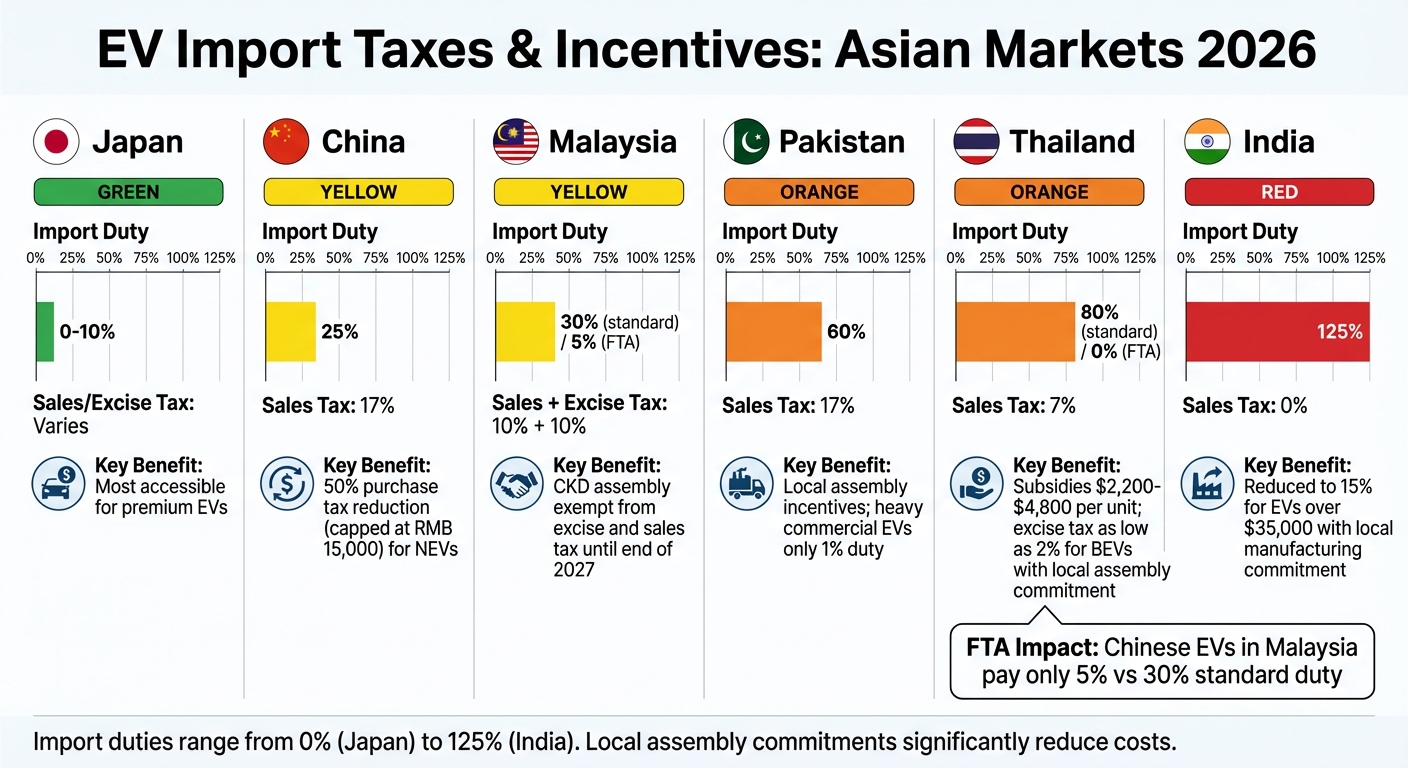
EV Import Taxes and Incentives Across Major Asian Markets 2026
Managing EV import costs starts with understanding how tariffs, excise duties, and sales taxes differ from country to country. Import duty rates in Asia vary widely, from as low as 0% to as high as 125%. India, for example, applies a hefty 125% duty – the highest among major Asian markets – while Japan offers a more lenient range of 0% to 10% for EV imports. Other notable rates include Thailand’s 80%, Pakistan’s 60%, and China’s comparatively moderate 25%.
Free Trade Agreements (FTAs) can dramatically alter these figures. For instance, under the ACFTA, Chinese-made EVs imported into Malaysia face just a 5% duty, while South Korean imports are subject to a much steeper 30%. These agreements significantly impact the overall cost structure, particularly when combined with excise and sales taxes.
When you add excise and sales taxes into the mix, the calculations become even more intricate. In Malaysia, for example, the 2026 tax structure includes a 10% excise duty and a 10% sales tax on top of import duties. Similarly, China adds a 17% sales tax to its 25% import duty, while Pakistan’s 60% duty is supplemented by a 17% sales tax as well.
Market Comparison Table: Taxes and Incentives
| Country | Standard Import Duty | Sales/Excise Tax | Key Incentive or FTA Benefit |
|---|---|---|---|
| India | 125% | 0% | Reduced to 15% for EVs over $35,000 with local manufacturing commitment |
| Thailand | 80%; 0% for FTA partners | 7% | Subsidies of $2,200–$4,800 per unit; non-FTA imports face 40–60% based on battery size/price |
| Pakistan | 60% | 17% | Incentives aimed at encouraging local assembly |
| China | 25% | 17% | 50% purchase tax reduction (capped at RMB 15,000) for NEVs |
| Malaysia | 30% (standard), 5% for China/ASEAN | 10% + 10% | CKD assembly exempt from excise and sales tax until end of 2027 |
| Japan | 0–10% | Varies | Among the most accessible markets for premium EV imports |
This table highlights how each market’s policies can significantly influence EV import costs. India, for example, offers a reduced 15% duty for EVs priced above $35,000, provided there’s a local manufacturing commitment. Thailand, on the other hand, employs a tiered system based on battery size and price, while Pakistan focuses on incentives to promote local assembly.
Choosing the best market depends on factors like your sourcing location and whether you plan to import fully assembled vehicles or establish local production. Balancing base duty rates with available tax incentives and local production requirements is crucial for optimising costs.
sbb-itb-5f05a6f
Top Asian Markets for EV Imports in 2026
The analysis of tax policies and incentives highlights three standout markets for EV imports in 2026: Pakistan, China, and Thailand. Each offers unique advantages for importers, explained in detail below.
Pakistan: A Cost-Effective Option for EV Imports
Pakistan presents an affordable and straightforward opportunity for EV importers. The country’s tax-friendly policies and government-backed incentives are encouraging local EV assembly, making it a promising market. Platforms like EV24.asia simplify the entire process by offering transparent pricing in ₨, reliable RoRo shipping, and complete customs clearance. This comprehensive service allows buyers to focus solely on vehicle selection without worrying about logistical or administrative hurdles. Let’s now turn to China, a global leader in EV exports.
China: Asia’s Powerhouse for EV Exports
China’s EV market is driven by unmatched domestic production and export capabilities. Brands like BYD, XPeng, and Tesla (via its Shanghai Gigafactory) dominate the Asian market with their competitively priced EVs. Thanks to highly efficient supply chains and massive production capacity, Chinese manufacturers can deliver vehicles at lower costs. Regional free trade agreements further enhance their appeal by reducing duties, making imports more economical for buyers. This combination of cost efficiency and production scale cements China’s position as a leading source for high-volume EV imports across Asia.
Thailand: ASEAN’s EV Manufacturing Rising Star
Thailand is positioning itself as ASEAN’s EV manufacturing hub under the BEV 3.5 policy (2024–2027). By 2030, the country aims to produce 725,000 EVs annually, accounting for 30% of its total vehicle production. The BEV 3.5 policy provides significant perks, such as up to 40% import duty reductions for companies committing to local assembly and excise taxes as low as 2% for battery electric vehicles. However, a 10% excise tax now applies to imported models, nudging manufacturers towards local assembly. According to Thailand’s Public Relations Department, the country aspires to become "ASEAN’s hub for next-generation vehicle manufacturing", leveraging its policies to generate quality jobs and promote economic growth. For EV importers, Thailand’s evolving framework makes it more appealing as a manufacturing base rather than just an import destination.
These three markets showcase the dynamic landscape of EV imports in Asia, each offering distinct advantages tailored to specific needs and strategies.
Conclusion
The EV import dynamics across Asia in 2026 highlight a clear shift: governments are moving from broad tariff exemptions to more focused tariffs, with a strong emphasis on promoting local assembly instead of relying on fully imported vehicles. This changing approach has created a more intricate regulatory framework in key markets, making it crucial for importers and buyers to stay informed.
For Pakistani importers, understanding these regional differences is essential to navigate the complexities of EV imports. Being aware of policy changes, Free Trade Agreement (FTA) benefits, and necessary documentation can simplify the process and ensure compliance. Governments across Asia are carefully balancing their goals of increasing EV adoption with fostering industrial growth, adjusting policies to ease the transition while maintaining momentum in the sector.
Specialised platforms are making this shift easier for buyers. EV24.asia, for instance, offers a comprehensive solution by providing transparent pricing in ₨, reliable RoRo shipping, complete customs clearance, and support for local registration. Whether you’re importing a mid-range BYD or a high-end Tesla, their expertise in tariffs, FTA documentation, and compliance ensures a hassle-free experience, allowing buyers to focus on selecting their ideal vehicle.
In 2026, the Asian EV market favours those who make informed decisions. Knowing where tariffs are lower, which incentives apply, and how local assembly policies impact long-term costs can give importers a competitive edge in this evolving industry.
FAQs
What incentives does Pakistan offer for local EV assembly?
Pakistan offers several incentives to boost the local assembly and manufacturing of electric vehicles (EVs). One standout benefit is the reduced customs duty of just 1% on specific EV parts, including CKD kits, which makes local assembly much more affordable. On top of that, there are VAT exemptions on importing both CBU and CKD electric vehicles with batteries up to specific capacities. These exemptions are valid until 30 June 2026, helping to bring down costs even further.
To promote EV adoption, the government has also introduced a concessionary customs duty rate for completely built EV units (CBUs). This slashes duties to 50% of the standard tariff for certain EV categories. These initiatives aim to cut production costs, attract investors, and strengthen Pakistan’s domestic EV industry.
How do Free Trade Agreements (FTAs) impact EV import taxes in Asia?
Free Trade Agreements (FTAs) play a key role in cutting down import taxes on electric vehicles (EVs) across Asia. These agreements aim to lower or even completely remove tariffs between member countries, making EVs more budget-friendly for consumers and boosting trade in the process.
Take Malaysia as an example. Thanks to agreements like AFTA and ACFTA, the import duties on fully imported EVs (CBUs) from specific regions have been drastically reduced. Where these duties once stood at around 30%, they now drop to as low as 5% for certain partner nations. Additionally, some deals particularly benefit EVs manufactured in China, offering them more appealing tax advantages compared to imports from other areas.
By creating such tax-friendly scenarios, FTAs not only ease the path to EV ownership but also encourage regional trade and support the shift towards cleaner transportation options.
What challenges do importers face when bringing EVs into India?
Bringing electric vehicles (EVs) into India isn’t exactly straightforward. The high import duties and strict regulations make it a costly and complex process. For instance, as of 2025, taxes on imported EVs can go as high as 70% for vehicles priced under USD 40,000. This steep duty significantly raises the overall cost of these vehicles.
There is a conditional relief, though. EVs priced above USD 35,000 can qualify for a reduced duty of 15%. But there’s a catch: manufacturers must invest at least Rs 4,150 crore (roughly PKR 12.8 billion) in local operations to take advantage of this lower rate.
On top of that, there are limits on how many units can be imported each year, and the reduced duty policy only lasts for five years. This creates uncertainty for manufacturers trying to plan for the long term. To make matters more challenging, India’s push to strengthen its domestic EV industry through higher tariffs adds another layer of difficulty for importers.
Navigating these regulations requires careful planning to strike a balance between managing costs and staying compliant with the rules.