
 Arka Pratama
Asia’s electric vehicle (EV) market is booming, with the region’s valuation expected to more than double from $419.66 billion in 2025 to $927.96 billion by 2030. But high upfront costs remain a key barrier, especially in markets like India and Pakistan, where EVs are significantly pricier than petrol vehicles. To address this, innovative financing options like Battery-as-a-Service (BaaS), low-interest loans, and flexible leasing models are making EVs more affordable.
Key Highlights:
- EV Loans: China leads with 7-year loans at rates as low as 1.36%, while Pakistan offers green loans at 5% interest.
- Leasing: Leasing options reduce upfront costs and include maintenance, insurance, and battery subscriptions, making EVs accessible for middle-income buyers.
- Government Support: Subsidies, tax breaks, and reduced import duties are driving adoption across Asia, with Pakistan’s NEV Policy targeting 30% EV penetration by 2030.
- Usage-Based Models: Options like pay-per-mile and subscriptions lower initial costs by separating battery ownership, appealing to price-sensitive markets.
These financing trends are reshaping EV ownership in Asia, providing flexible solutions tailored to local market needs.
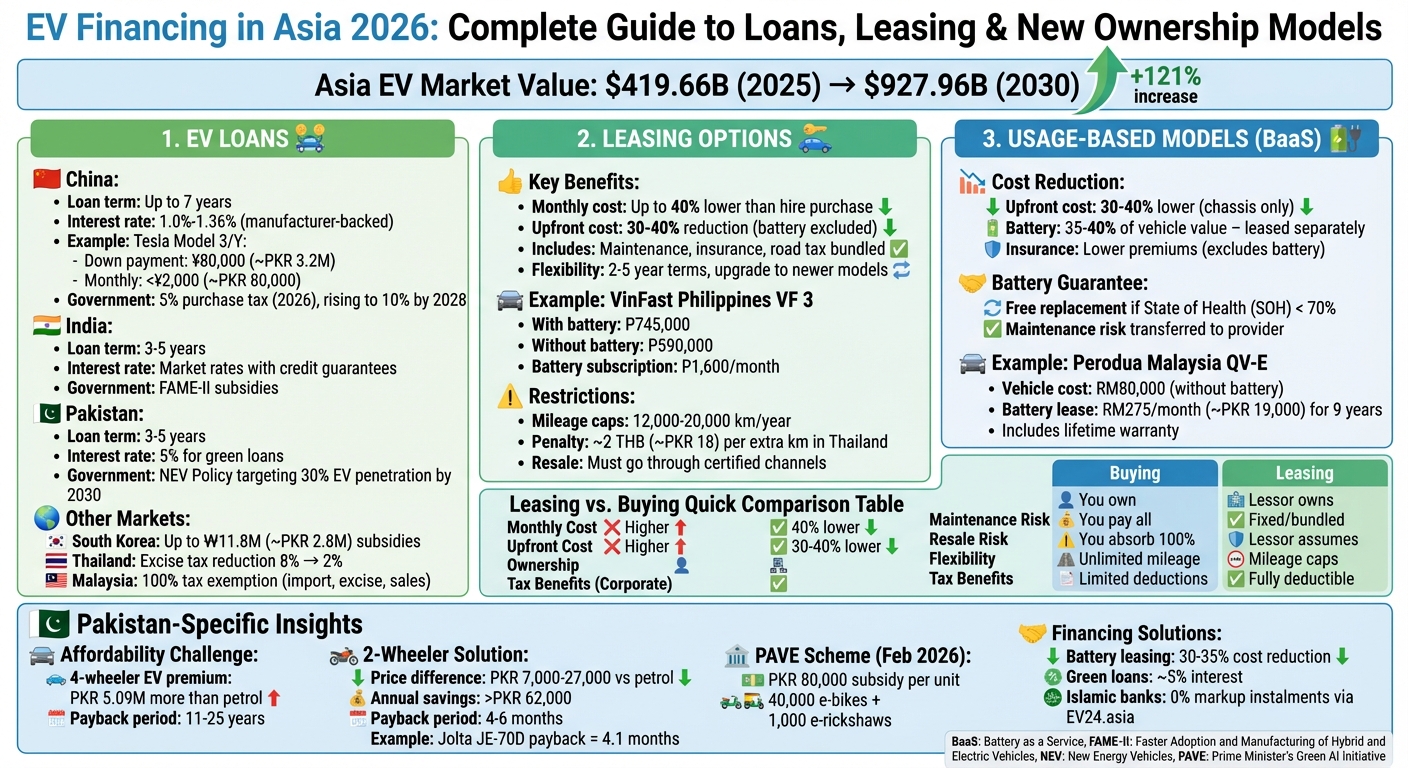
EV Financing Options Across Asia: Loans, Leasing & Usage-Based Models Comparison 2026
EV Loans and Government Support Programs
Loan Types and Interest Rates
Across Asia, banks and manufacturers offer two main types of EV loans: fixed-rate and variable-rate. Fixed-rate loans keep the interest constant throughout the repayment period, while variable-rate loans adjust based on market trends.
China has seen a significant shift toward manufacturer-backed financing. For instance, Tesla China introduced a seven-year loan programme in January 2026 with an exceptionally low annual interest rate of 1.36%, which is less than half of the typical 3% consumer loan rate. Xiaomi took it a step further, offering a 1% interest rate over seven years for its SU7 model. These low rates ease the financial burden on buyers. For example, purchasing a Tesla Model 3 or Y requires a down payment of 80,000 yuan (roughly PKR 3.2 million), with monthly instalments under 2,000 yuan (approximately PKR 80,000).
"All EV makers are facing a dilemma this year as rising raw-material costs eat into their profit margin, which prevents them from offering steep price cuts even though overall market demand has turned weak." – Chen Jinzhu, CEO, Shanghai Mingliang Auto Service
China’s move to extend loan terms to seven years is a notable shift aimed at making EVs more affordable. In contrast, Pakistan and India typically offer shorter loan terms of three to five years, often with higher interest rates. However, buyers who qualify for specialised green loans in these markets can access rates as low as 5%.
These competitive loan structures highlight the importance of government incentives in shaping the EV market across the region.
Government Incentives and Their Impact
Government programmes across Asia play a crucial role in reducing the cost of EV ownership. These include subsidies, tax breaks, and registration fee rebates, all of which influence both upfront costs and long-term affordability.
In China, the government is gradually phasing out its purchase tax exemption. Buyers will face a 5% purchase tax in 2026, up from 0% in 2025, with the full 10% tax reinstated by 2028. As direct subsidies diminish, manufacturers are stepping in with aggressive financing options to keep EVs affordable and maintain market demand.
Other Asian countries are offering substantial support to encourage EV adoption. For example:
- South Korea: Provides subsidies of up to ₩11.8 million (around PKR 2.8 million).
- Thailand: Offers an excise tax reduction from 8% to 2%, along with subsidies.
- Malaysia: Grants a 100% exemption on import, excise, and sales taxes.
Pakistan has introduced the New Energy Vehicle (NEV) Policy, aiming for 30% EV penetration by 2030 through reduced import duties and tax incentives. Despite these measures, four-wheel EVs remain out of reach for many middle-income buyers due to their price premium – around PKR 5.09 million more than comparable petrol vehicles. On the other hand, electric two-wheelers are more accessible, with price differences ranging from PKR 7,000 to PKR 27,000 compared to petrol models. They also offer annual savings of over PKR 62,000 in fuel and maintenance costs.
Loan Terms Across Asian Markets
Loan terms and interest rates vary widely across Asia, reflecting different levels of market maturity. In established markets like China, buyers enjoy longer loan terms and lower interest rates. Meanwhile, emerging markets like Pakistan and India are still working to make EV financing competitive with traditional vehicle loans.
| Market | Typical Loan Term | Interest Rate | Key Government Support |
|---|---|---|---|
| China | Up to 7 years | 1.0%–1.36% (Manufacturer-backed) | 5% purchase tax (rising to 10% by 2028) |
| India | 3–5 years | Market rates (credit guarantees) | FAME-II subsidies for public transport |
| Pakistan | 3–5 years | High market rates; 5% for green loans | NEV Policy with import duty relief |
| Japan | Varies | Bank-led | Up to ¥850,000 (~PKR 1.9 million) subsidy |
| South Korea | Varies | Bank-led | Up to ₩11.8 million (~PKR 2.8 million) total subsidies |
India is exploring new approaches to make EV loans more accessible. Multilateral institutions are proposing credit guarantees to help banks offer competitive loan-to-value ratios and interest rates similar to those for traditional vehicles. This strategy aims to encourage EV adoption without relying solely on direct government subsidies for every purchase.
sbb-itb-5f05a6f
China EVs & More – Bold Predictions for 2026
EV Leasing Options
Leasing has become a practical alternative to buying for many, especially for those concerned about depreciation – a worry for 42% of EV buyers across Asia. Unlike traditional loans, leasing transfers risks like depreciation and battery performance to the lessor. This approach is particularly relevant in Pakistan, where four-wheeler EVs come with a hefty price tag compared to petrol vehicles, making affordability a challenge for middle-income buyers. Leasing, alongside loans and subsidies, offers another way to make EVs more accessible.
Benefits of Leasing for Users and Companies
Leasing stands out by reducing cost uncertainties for users. The main advantage? Lower upfront costs. Battery-as-a-Service (BaaS) models, for instance, separate the battery cost from the vehicle price. Take VinFast in the Philippines: their VF 3 model costs P745,000 with the battery or P590,000 without it, with a battery subscription starting at just P1,600 per month.
"What we’re doing is we’re changing this high-value asset purchase to an everyday utility for as low as P1,600… We are targeting people who would like to have peace of mind when they’re making the big shift." – Toti Zara, CEO for Southeast Asia, VinFast
Operating leases take things further by bundling maintenance, insurance, and road tax into one fixed monthly payment, eliminating unexpected repair costs. For businesses, leasing offers tax perks. In Thailand, for example, corporate lease payments are fully tax-deductible up to THB 36,000 (around PKR 330,000), unlike the limited deductions for purchased vehicles. Additionally, monthly leasing costs can be up to 40% lower than hire-purchase payments since lessees only pay for the vehicle’s depreciation during the lease term.
Flexibility is another key benefit. Lease terms typically last two to five years, allowing users to upgrade to newer models with better battery technology and range once the contract ends. This feature is particularly useful in a market where EV and battery technology are evolving rapidly.
Pay-Per-Use Leasing Programmes
Pay-per-use leasing is gaining popularity in the Asia-Pacific region, especially in countries where battery concerns and high upfront costs are barriers to EV adoption. These programmes use telematics and GPS to track battery health, mileage, and payment compliance. Some manufacturers even have the option to remotely disable vehicles if payments are missed.
One example is Perodua‘s BaaS programme in Malaysia, tied to their QV-E model. It requires a nine-year battery lease at RM275 per month (around PKR 19,000). The programme includes a lifetime warranty and guarantees free battery replacement if its State of Health (SOH) drops below 70%. Payments, battery health monitoring, and roadside assistance are all managed via the P-Circle app.
However, these programmes often come with restrictions. For instance, annual mileage caps typically range from 12,000 to 20,000 kilometres in Asia-Pacific markets. Exceeding these limits can lead to penalties – for example, in Thailand, users pay approximately 2 THB (around PKR 18) per extra kilometre. High-mileage drivers should carefully evaluate these terms, as penalties can offset the cost savings.
Another point of contention is the "closed ecosystem" created by mandatory leasing models. For example, Perodua requires the QV-E to be resold only through official channels to ensure the battery lease transfers correctly. While this protects manufacturers, it limits buyers’ freedom. These programmes highlight the trade-offs between leasing and traditional ownership.
Leasing vs. Buying Comparison
Deciding between leasing and buying depends on factors like your budget, driving habits, and how long you plan to keep the vehicle. Here’s a quick comparison:
| Aspect | Buying (Hire Purchase) | Leasing (Operating Lease) |
|---|---|---|
| Monthly Cost | Higher (full principal + interest) | Up to 40% lower (pays only for depreciation) |
| Upfront Cost | Higher (includes full asset cost) | Lower (battery often excluded) |
| Ownership | You eventually own the vehicle | Lessor retains ownership |
| Maintenance Risk | You pay for all repairs | Fixed, bundled into a monthly payment |
| Resale Risk | You absorb 100% of depreciation | Lessor assumes residual value risk |
| Flexibility | Unlimited mileage and customization | Strict mileage caps (e.g., 12,000–20,000 km/year) |
| Tax Benefits (Corporate) | Depreciation deductions are often capped | Lease payments are fully deductible |
Buying becomes more advantageous if you plan to keep the vehicle for over seven years. This allows you to overcome high interest rates (ranging from 5.21% to 15.81% in markets like Thailand) and build equity. On the other hand, leasing is ideal for those prioritizing flexibility and avoiding depreciation risks. For businesses, operating leases are a smart choice to maximize tax benefits and keep vehicle assets off the books. This mix of options reflects the evolving EV financing landscape across Asia, including Pakistan.
New Usage-Based Ownership Models
A shift in financing options is transforming how people in Asia access electric vehicles (EVs). Usage-based models like Battery-as-a-Service (BaaS), subscription plans, and pay-per-mile financing are gaining traction. These approaches tackle the challenge of high upfront costs by spreading them into smaller, more manageable payments. By separating the EV’s chassis from its battery – often the most expensive component, making up 35% to 40% of the vehicle’s value – these models are particularly appealing in price-sensitive markets like Pakistan. This shift doesn’t just lower costs; it also offers flexible financing options tailored to different consumer needs.
Understanding Usage-Based Financing
Usage-based financing changes the way people think about owning an EV. Instead of buying the entire vehicle, consumers can purchase or finance the chassis while leasing the battery from a specialised provider. This setup can cut the upfront price of an EV by 30% to 40%. For instance, the higher-end VF 9 Plus drops from P5,390,000 to P3,845,000 when paired with a subscription plan.
One major benefit is that the battery’s maintenance and replacement risks are shifted to the provider. Companies like VinFast and Perodua offer a "State of Health" (SOH) guarantee, with free battery replacements if the SOH falls below 70%. Additionally, excluding the battery from the vehicle’s insured value can lead to lower insurance premiums.
These models also make financing more accessible for buyers with limited banking options. By reducing the loan amount required, usage-based financing lowers collateral demands, making it easier to secure a loan. In markets like Indonesia and India, regulators are even considering recognising leased batteries as valid collateral, moving away from traditional "one borrower, one asset" rules.
Addressing Affordability in Asian Markets
Usage-based models are particularly effective in regions where high upfront costs deter buyers. In Pakistan, for example, EVs cost 20% to 64% more than petrol-driven cars, with payback periods stretching from 11 to 25 years. For middle-income households, this makes EV ownership tough. However, electric two- and three-wheelers offer a more affordable solution, with payback periods of 4 to 6 months and annual savings exceeding PKR 62,000. Battery leasing further reduces the upfront cost of an electric motorcycle from PKR 150,000 to around PKR 100,000, making it competitive with petrol models.
In Malaysia, Perodua’s QV-E – launched in late 2025 as the country’s first domestically developed EV – utilises a BaaS model. The vehicle costs RM80,000 without the battery, which can be leased for RM275 per month over nine years. This system includes a "battery passport", developed with the Ministry of Investment, Trade and Industry, to track the battery’s lifecycle from production to disposal.
"The battery passport is where the battery is registered… The moment the battery is detached from the vehicle, some kind of information will be required by the government because it needs to know who the supplier of the battery is." – Datuk Seri Zainal Abidin Ahmad, President and CEO, Perodua
India faces additional challenges, such as an EV-to-charger ratio of 1:188 as of September 2023 – far below the global average of 6–20 EVs per charger. Usage-based models are being explored to address these infrastructure gaps while also improving affordability. In Pakistan, carbon-credit-linked microfinance – already tested in Kenya – is being evaluated to provide small-scale financing for low-income buyers by monetising verified emissions reductions.
Usage-Based vs. Standard Financing
Choosing between usage-based and standard financing depends on factors like budget, driving habits, and risk tolerance. Here’s how they compare:
| Feature | Standard Financing (Hire Purchase) | Usage-Based Financing (BaaS/Subscription) |
|---|---|---|
| Upfront Cost | High (includes battery) | 30–40% lower (chassis only) |
| Ownership Structure | Single integrated asset | Modular (chassis owned; battery leased) |
| Battery Risk | Owner bears degradation risk | Provider guarantees replacement if SOH < 70% |
| Insurance Premiums | Higher (covers full vehicle value) | Lower (excludes battery) |
| Flexibility | Fixed long-term loan | Subscription-style; pay-per-mile or monthly fee |
| Resale | Unlimited; owner handles depreciation | Restricted to certified channels |
| Collateral | Fully owned asset | Modular collateral |
While usage-based models lower entry barriers and shift maintenance risks, they come with trade-offs. Contractual terms may include mileage limits, restrictions on commercial use, and penalties for late payments. For example, Perodua charges a 1% annual fee for missed payments and can disable the battery if payments are overdue by two months. Resale can also be tricky; the QV-E must be resold through certified channels, ensuring the new owner signs a new battery lease.
For high-mileage drivers or those planning to keep their vehicle long-term, standard financing might still be the better option. However, usage-based models offer a flexible, affordable alternative for buyers who prioritise lower upfront costs, reduced risks, and access to the latest battery technology. These approaches complement traditional financing methods, providing more options for EV buyers across Asia, especially in cost-sensitive markets like Pakistan.
Financing Through EV24.asia
EV24.asia makes it easier for people across Asia, including Pakistan, to own electric vehicles (EVs). By combining clear pricing with flexible payment options, the platform simplifies the process of acquiring an EV. This complements earlier-discussed financing and leasing models, showing EV24.asia’s focus on making EV ownership more accessible.
Payment Plans and Pricing Transparency
EV24.asia provides easy-to-understand payment options, including interest-free EMI plans for 12 to 18 months. For those who need more time, structured plans are available for up to 30 months. Buyers can choose fixed down payments ranging from 30% to 50%. All costs, including ex-factory prices and administrative charges, are displayed clearly, ensuring transparency for potential buyers.
Import Services and Registration Help
The platform doesn’t just stop at flexible payment options. EV24.asia also takes care of the import process from start to finish. This includes handling customs clearance, offering shipping options (both RoRo and container), and assisting with provincial vehicle registration under the NEVP and 2026 NEV Policy. Buyers can benefit from reduced import duties while ensuring compliance with provincial Excise Departments. This service became especially important when vehicle reregistration began in Punjab in February 2026.
Financial Institution Partnerships
EV24.asia collaborates with banks and leasing companies to offer financing solutions tailored to Pakistani buyers. This includes connecting customers with partners under the PAVE Scheme and Islamic banks that provide 0% markup instalments. For businesses and SMEs, provincial programmes offer additional support, such as green loans and credit facilities. These initiatives, similar to those by institutions like UOB in Southeast Asia, help bridge the credit gap for new entrants into the EV market. Such tailored options address the specific needs of Pakistani buyers while aligning with broader EV financing trends across Asia.
Country Analysis: China, India, Pakistan
Let’s take a closer look at how China, India, and Pakistan are shaping their electric vehicle (EV) financing strategies. Each country’s approach reflects its unique economic landscape, policies, and market needs.
China: Shift to Market-Driven Financing
Starting 1st January 2026, China introduced a major policy change by halving its EV purchase tax exemption. This adjustment reduced the maximum deduction from 30,000 yuan to 15,000 yuan. The goal? To encourage the market to compete on value rather than price.
In response, manufacturers like Tesla China and Xiaomi rolled out aggressive financing options. For instance, Tesla China now offers seven-year loans with an interest rate as low as 1.36%, making EVs more accessible despite rising raw material costs. These strategies aim to maintain affordability while adapting to the evolving market.
India: Embracing Digital Lending and Subscriptions
India’s EV market saw a 50% surge in 2023, reaching 1.62 million units. However, the high upfront costs of EVs – 25% to 30% more than internal combustion engine (ICE) vehicles – have pushed companies towards innovative financing models.
Some of the most popular options include Battery-as-a-Service (BaaS) and flexible leasing programs. Companies like JSW MG Motor and Ola Electric offer leasing options, while Mahindra Reva provides subscription plans with energy fees starting at ₹2,599 per month. Yet, EV loans in India remain 1% to 4% more expensive than ICE loans, prompting calls for credit guarantees to bridge the gap.
India has also made strides in government spending. By late 2024, it had used 69% of its ₹11,500 crore FAME II budget, with FAME III expected to focus on passenger cars and trucks. However, challenges remain, such as the EV-to-charger ratio, which stood at a low 1:188 in 2023 – far from the global average of 6 to 20.
Pakistan: Growth Driven by Imports
In Pakistan, two- and three-wheelers dominate the EV market, accounting for over 90% of registered vehicles in provinces like Punjab. Four-wheeler EVs remain a luxury, with price premiums ranging from 20% to 64% over ICE vehicles and payback periods stretching from 11 to 25 years.
Electric two-wheelers, however, offer a more feasible alternative. The Jolta JE-70D, for example, achieved a payback period of just 4.1 months in 2025, with annual operational savings exceeding PKR 62,000. The price difference between electric and petrol motorcycles is relatively modest, ranging from PKR 7,000 to PKR 27,000.
In February 2026, the Engineering Development Board (EDB) launched Phase I of the Pakistan Accelerated Vehicle Electrification (PAVE) Scheme. This initiative allocated subsidies of PKR 80,000 per unit for 40,000 e-bikes and 1,000 e-rickshaws.
"The initiative aims to provide the public with affordable and environmentally friendly transportation whilst reducing the country’s dependence on fuel." – Hamad Ali Mansoor, CEO, EDB
To tackle financing barriers, Pakistan is exploring options like battery leasing (cutting upfront costs by 30% to 35%), concessional green loans at around 5% interest, and carbon-credit-linked microfinance. Platforms like EV24.asia are stepping in to simplify imports and connect buyers with Islamic banks offering 0% markup instalment plans. These efforts aim to make EVs more accessible for the average consumer.
| Country | Market Focus | Key Financing Tool | Interest Rates | Market Maturity |
|---|---|---|---|---|
| China | Premium & mass-market 4-wheelers | 7-year low-interest loans | ~1.36% | High (>45% penetration) |
| India | Passenger vehicles | BaaS & digital lending | 1–4% above ICE loans | Moderate |
| Pakistan | 2- and 3-wheelers (motorcycles/rickshaws) | Green loans & microfinance | Around 5% (proposed) | Early stage |
EV Financing Trends for 2026 and Beyond
Fintech and ESG Financing Solutions
By 2026, fintech advancements are reshaping how electric vehicles (EVs) are financed. These innovations include instant credit approvals and automated checks on battery health, making the process faster and more efficient. For instance, in May 2025, Indian fintech company Revfin revealed plans to finance 2 million commercial EVs with USD 240 million in loans. This initiative, which uses streamlined digital applications, is particularly aimed at gig workers and small fleet operators who often lack access to traditional credit systems.
Financing driven by environmental, social, and governance (ESG) principles is also gaining momentum. In November 2024, Volkswagen Financial Services issued its second Green Bond to support battery electric vehicle financing across Europe. Meanwhile, in Asia, Battery-as-a-Service (BaaS) models are making waves. In December 2024, Mahindra Finance introduced a specialised BaaS financing programme in India, reducing upfront costs for EV buyers by nearly 30%.
"Meeting India’s climate and mobility goals will require instruments beyond conventional auto loans. In 2026, the shift from subsidy dependence to pooled receivables, structured credit enhancements, and blended finance will prove essential." – Nelson D’Souza, Chief Financial Officer, Ecofy
Growth Potential in Developing Markets
Developing markets, particularly in South and Southeast Asia, are on the brink of significant growth in EV adoption. The mobility sector in these regions is expected to need US$1.3 trillion in green capital by 2030. This immense demand presents opportunities for innovative financing, especially in countries like Pakistan, India, and Indonesia, where traditional banking systems often fall short.
Fintech companies are stepping in to fill this gap by using alternative credit scoring methods. Instead of relying solely on conventional metrics, lenders are evaluating factors like ride patterns, income cycles, and vehicle usage data. This approach is helping first-time buyers, many from low-income backgrounds, access the EV market. In India, for example, 70% of electric three-wheeler buyers are first-time vehicle owners.
Usage-based repayment models are also proving effective, particularly for high-use segments like commercial drivers. EV drivers in India can earn 20% more income compared to those using diesel or CNG vehicles, thanks to lower operating costs. Flexible repayment plans tied to kilometres driven enable these drivers to align payments with their earnings, making EV ownership more feasible for those with fluctuating incomes.
Key Takeaways
Asia’s EV financing landscape is evolving rapidly, with traditional loans giving way to newer models like Battery-as-a-Service, kilometre-based repayment plans, and subscription services. Fintech integration is reducing approval times and expanding credit access, especially for underserved groups.
For buyers in Pakistan and other developing regions, exploring diverse financing options is crucial. Digital micro-lending platforms are emerging as viable alternatives for individuals without formal credit histories. Platforms like EV24.asia are simplifying the import process and connecting buyers to financial institutions offering competitive rates, including Islamic banks that provide 0% markup instalment plans.
The shift towards market-driven financing solutions, supported by ESG capital and government-backed credit guarantees, is making EVs more affordable and accessible across Asia. These innovative models are tackling affordability challenges head-on, turning electric mobility into a practical option for consumers in Pakistan and other developing markets. As EV adoption grows, financing will remain the key factor in making electric vehicles an everyday reality across the region.
FAQs
Is leasing cheaper than an EV loan in Pakistan?
As of February 2026, leasing an electric vehicle (EV) in Pakistan is often easier on the wallet compared to opting for an EV loan. Many recent programmes now feature zero-markup installment plans along with flexible leasing terms, making it a more budget-friendly option for a large number of buyers.
What happens to the battery if I use Battery-as-a-Service?
Battery-as-a-Service (BaaS) shifts battery ownership from the user to the provider. In this setup, the provider takes responsibility for maintaining the battery’s health and efficiency, tackling issues like degradation over time and its resale value. For users, this means added convenience and relief from worrying about the battery’s long-term performance.
How do mileage caps and penalties work in EV leases?
Mileage caps in EV leases restrict how far you can drive each year, usually ranging between 10,000 and 15,000 km. If you go over this limit, you’ll face penalties, often charged for every extra kilometre. For example, with a fee of PKR 10 per kilometre, exceeding the limit by 1,000 km would add PKR 10,000 to your costs. These charges are meant to preserve the vehicle’s value and compensate for additional wear and tear.