
 Arka Pratama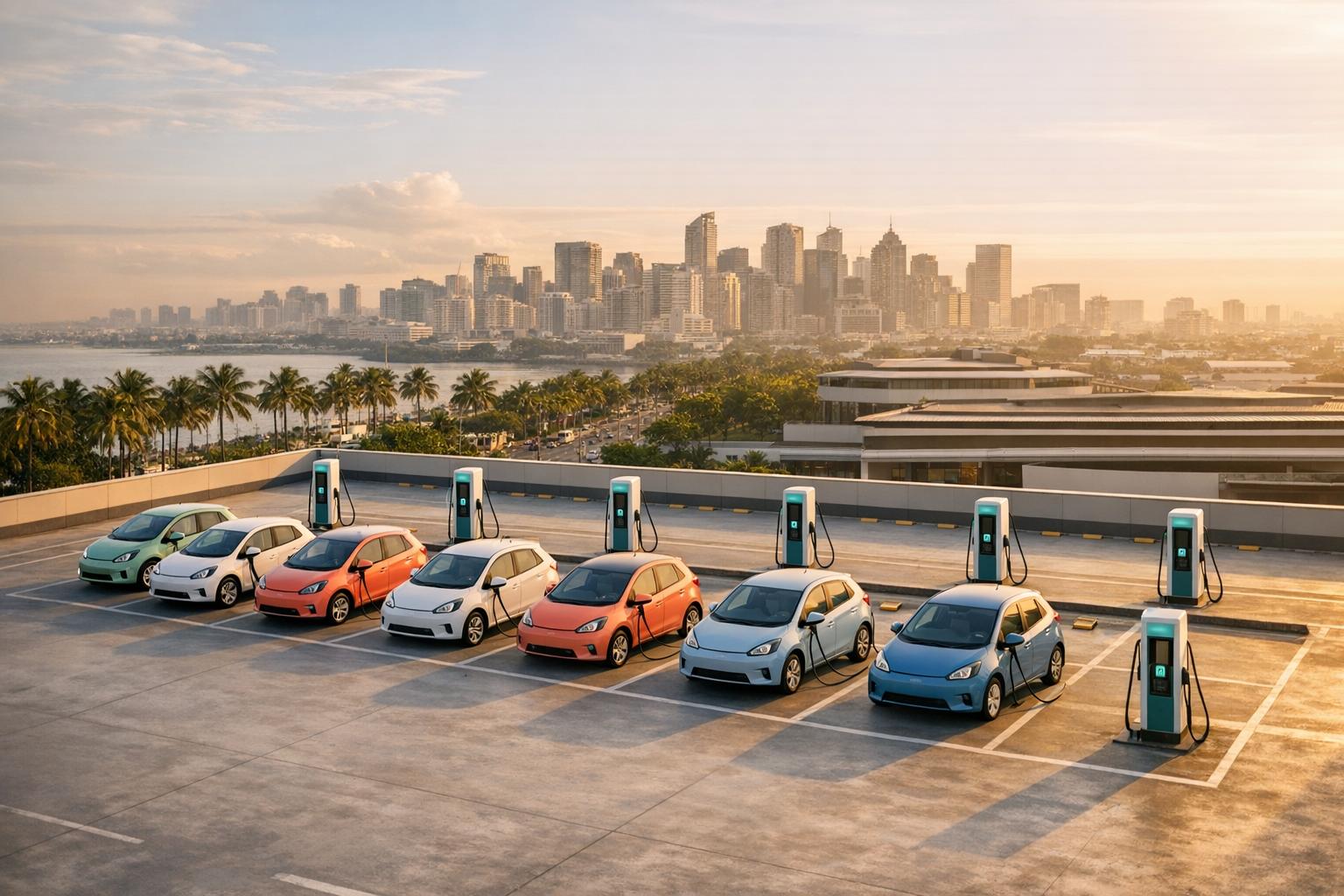
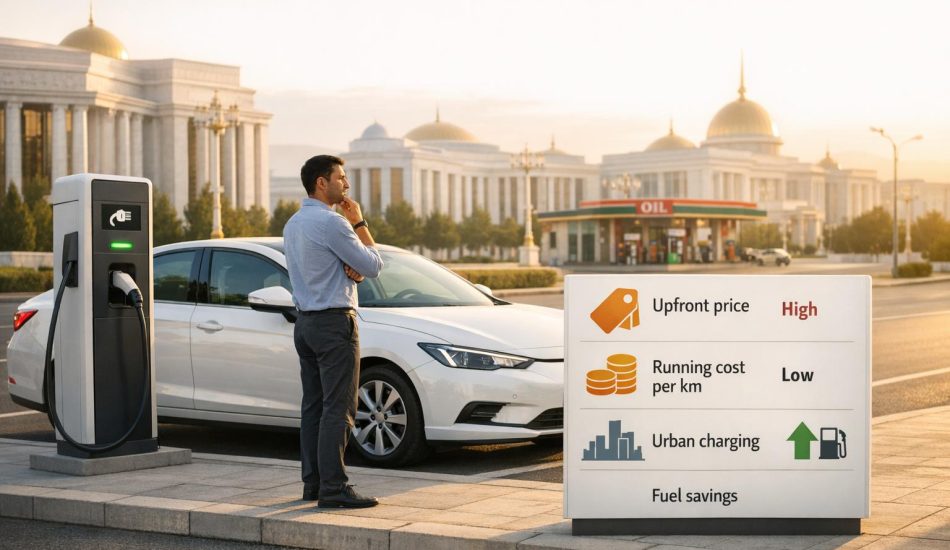
The electric vehicle (EV) market in the Philippines is growing quickly, driven by rising demand, government incentives, and expanding charging infrastructure. Here’s what you need to know:
- Market Growth: The EV market is projected to grow from USD 3.40 billion in 2025 to USD 20.57 billion by 2034, with a 19.73% annual growth rate.
- Government Support: Policies like 0% import tariffs (until 2028), excise tax exemptions, and charging station mandates are reducing costs for EV buyers.
- Affordable EVs: Budget-friendly options like the FAW Bestune Pony (₱588,000) and VinFast VF 3 (₱645,000) make EVs accessible to more Filipinos.
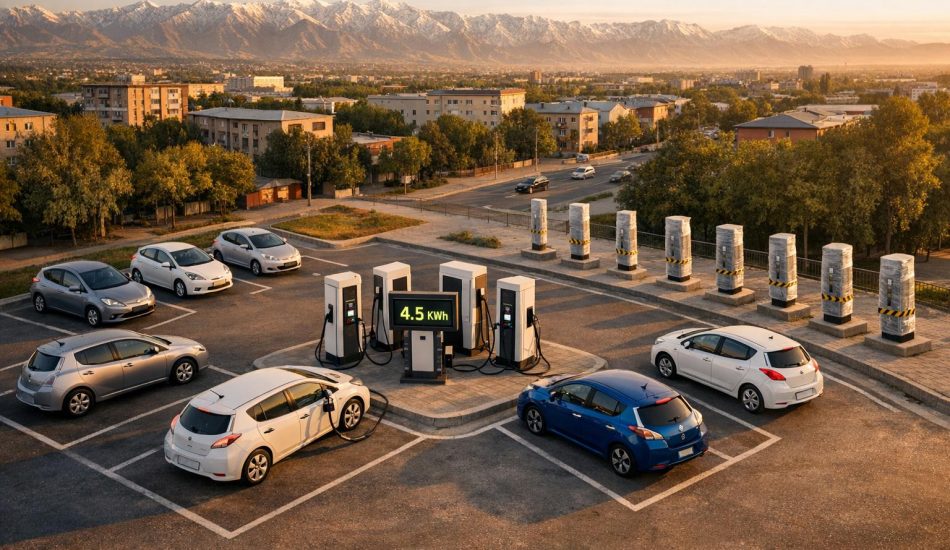
- Charging Network Expansion: Over 1,351 public charging stations are now operational, with plans to reach 7,300 by 2028. Metro Manila leads, but rural areas are catching up.
Despite challenges like high upfront costs and limited infrastructure in some areas, the market is making EVs more practical and affordable for everyday use. The shift to EVs is being accelerated by both private and public efforts, making the future of clean mobility in the Philippines promising.
EV sales surge in the Philippines | Edmund Araga | Business Brief
sbb-itb-5f05a6f
Most Affordable Electric Vehicles in 2026
Most Affordable Electric Vehicles in the Philippines 2026: Price and Range Comparison
By 2026, electric vehicles (EVs) in the Philippines cover a wide price range, from budget-friendly options under ₱600,000 to luxurious models exceeding ₱13 million. For those looking to make the eco-friendly switch without overspending, there are plenty of choices across three main categories: battery electric vehicles (BEVs), plug-in hybrid electric vehicles (PHEVs), and hybrid electric vehicles (HEVs).
Budget Battery Electric Vehicles (BEVs)
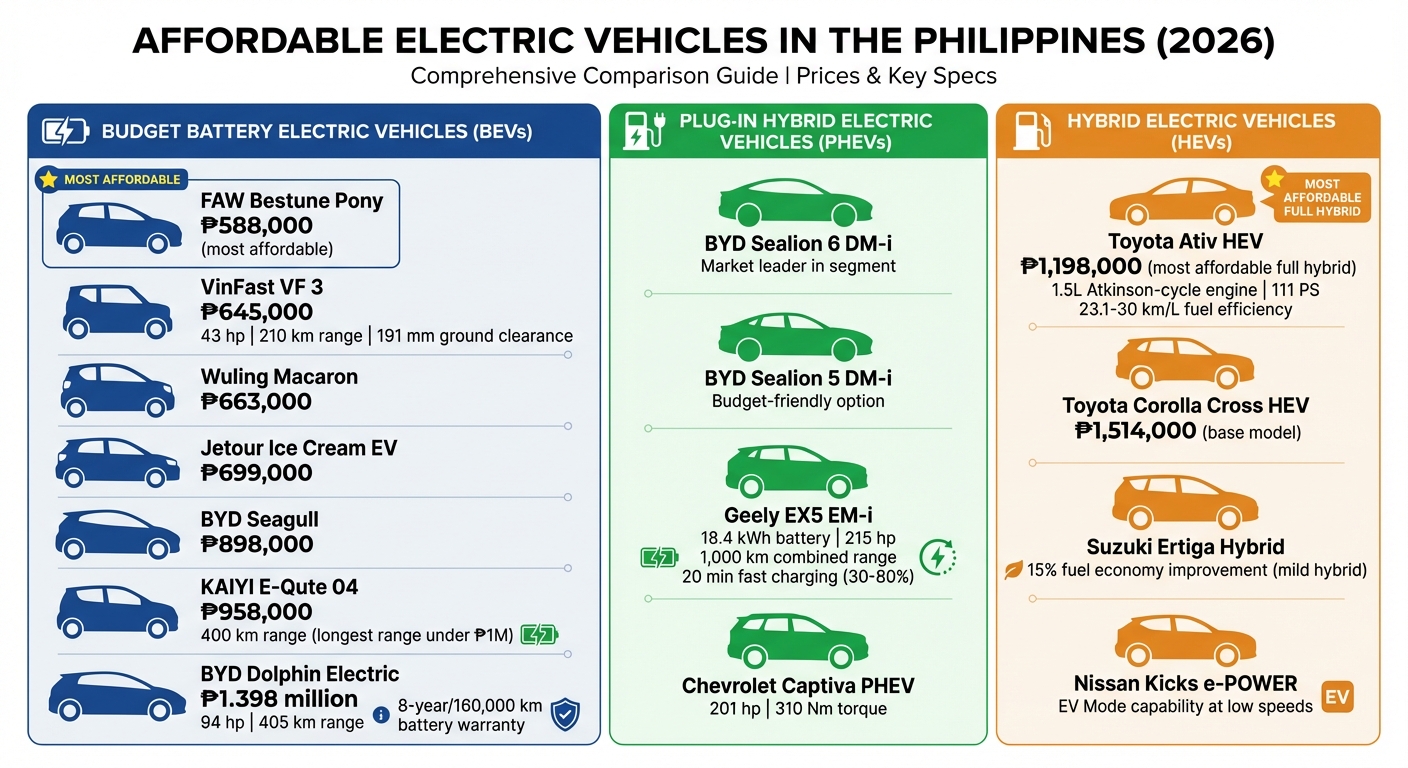
The FAW Bestune Pony takes the title of the most affordable electric car in the Philippines, priced at only ₱588,000. Not far behind, the VinFast VF 3 is available at ₱645,000, offering 43 hp and a range of 210 km – perfect for daily city driving. Other affordable options include the Wuling Macaron (₱663,000), Jetour Ice Cream EV (₱699,000), and the BYD Seagull (₱898,000) [13, 16].
For those who need a bit more range, the KAIYI E-Qute 04 stands out with a 400 km range, priced at ₱958,000 – making it the longest-range EV under ₱1 million. Meanwhile, the BYD Dolphin Electric offers a slightly longer 405 km range with 94 hp for ₱1.398 million. It also comes with an 8-year or 160,000 km battery warranty, and some dealerships are offering down payments as low as ₱17,000.
Most budget-friendly BEVs now come equipped with modern features like Apple CarPlay, Android Auto, and digital instrument clusters. Compact and designed for urban life, these vehicles also include practical features like the VinFast VF 3’s 191 mm ground clearance. In 2024, VinFast sold over 90,000 electric cars globally, while BYD Cars Philippines dominated the local BEV market with a 69% share, selling 4,780 units and capturing 1% of the overall automotive market [2, 14].
For those who want a mix of electric and traditional power, plug-in hybrids are worth considering.
Low-Cost Plug-in Hybrid Electric Vehicles (PHEVs)
Plug-in hybrid electric vehicles (PHEVs) strike a balance for buyers who want electrified driving but aren’t ready to depend entirely on charging facilities. Leading the pack are the BYD Sealion 6 DM-i and its smaller sibling, the Sealion 5 DM-i, known for their value in this segment. Joining them in early 2026, the Geely EX5 EM-i offers an 18.4 kWh battery, a 215 hp electric motor, and a combined range of up to 1,000 km. It also supports fast charging from 30% to 80% in just 20 minutes.
The Chevrolet Captiva PHEV, launched in February 2026, provides 201 hp and 310 Nm of torque, catering to those who want a crossover with efficient electrified performance. PHEVs are particularly appealing because they can function as standard hybrids when charging isn’t available.
"The EX5 EM-i can promise ‘electrified mobility without compromising everyday driving flexibility,’ but if it really wants to challenge the Sealion 6’s dominance in this segment, it has to match its BYD counterpart in both specs and pricing."
– Sharleen Banzon, Car News Writer, Top Gear Philippines
If charging isn’t an option for you, hybrids might be the better choice.
Affordable Hybrid Electric Vehicles (HEVs)
Hybrid electric vehicles (HEVs) are an excellent choice for those who want to dip their toes into electrification without worrying about external charging. The Toyota Ativ HEV, launched in late 2025, is the most affordable full hybrid in the Philippines, priced at ₱1,198,000 – ₱316,000 less than the base Toyota Corolla Cross HEV. It combines a 1.5-litre Atkinson-cycle engine with an electric motor to deliver 111 PS and fuel efficiency of 23.1–30 km/L [24, 25, 26].
"We are proud and excited to bring this particular model to the local market because this is our most affordable and accessible hybrid electrical vehicle available for customers today."
– Elvin Luciano, Vice President for Marketing Services, Toyota Motor Philippines
For those on a tighter budget, mild hybrids like the Suzuki Ertiga Hybrid offer up to a 15% improvement in fuel economy compared to traditional petrol engines. However, full hybrids such as the Ativ or Nissan Kicks e-POWER are better suited for urban traffic, as they can operate in "EV Mode" at low speeds [27, 28].
EV Charging Network Growth in the Philippines
Areas with Fast-Growing Charging Networks
Metro Manila leads the way with 80% of the country’s public charging stations located in the region. The National Capital Region (NCR) benefits from mobile charging services like ACMobility’s "Power-on-Wheels", which now covers all 16 cities and the Municipality of Pateros. By mid-2025, Makati City alone had 70 active charging points across 16 locations, with plans to reach 100 by year’s end.
Outside Metro Manila, charging infrastructure is expanding along major expressways. Stations have been strategically placed on NLEX, SLEX, and TPLEX. In December 2025, ACMobility launched a new station in Lucena, designed to support long-distance travellers heading from South Luzon to the Bicol region. Earlier, Shell Pilipinas Corporation opened its second Shell Recharge site at the TPLEX junction in Rosario, La Union, catering to northern Luzon travellers.
In March 2025, Mober, a logistics company, introduced "Central Charge" near Manila, the country’s largest commercial EV charging hub. This 3,000-square-metre facility includes 56 charging ports, featuring 52 units of 7 kW AC chargers and four units of 60 kW DC fast chargers. Beyond NCR, cities like Davao are ramping up EV infrastructure in retail centres, while urban areas in Cebu and Iloilo are also seeing targeted growth.
Government Plans for National Charging Coverage
The government is working to ensure EV charging is accessible nationwide, with the Department of Energy aiming to deploy 7,300 public charging stations by 2028. This is a significant increase from the 912 stations recorded as of 31 March 2025. By early 2026, the number of charging points had already grown to 1,351, aligning with the Comprehensive Roadmap for the Electric Vehicle Industry (CREVI), which envisions 800,000 registered EVs by 2035.
"Our goal of deploying over 7,000 EV charging stations by 2028 is ambitious but achievable. By combining infrastructure development with public engagement, we can accelerate the transition to EVs."
– Patrick Aquino, Director, Energy Utilisation Management Bureau
Under the Electric Vehicle Industry Development Act (EVIDA), the government mandates the installation of charging stations in parking lots and petrol stations and requires at least 5% of corporate and government fleets to consist of EVs. To support this growth, the Charging Infrastructure Development Plan (CIDP) is being synchronised with the Distribution Development Plan (DDP) to ensure the power grid can handle the increased demand. Authorities are also promoting off-peak charging rates of ₱5–₱10 per kWh to reduce stress on the grid.
Solving Charging Access Problems
The Philippines’ geography presents unique challenges for EV adoption. To address this, the "Philippine EV Spine" initiative is extending charging networks across Luzon, Visayas, and Mindanao, enabling long-distance travel and reducing range anxiety.
For urban areas where home charging isn’t practical, mobile solutions are stepping in. In February 2026, ACMobility expanded its Power-on-Wheels service, offering on-demand charging and emergency assistance for EVs with less than 5% battery. These units, equipped with 120 kW DC fast chargers, can provide up to a 20% top-up. Additionally, the Evro app helps drivers locate over 340 DOE-registered stations, offering real-time status updates and route planning. By early 2026, the app had recorded 33,000 new registrations and over 18,000 monthly active users.
"For electric mobility to work at scale, charging has to be reliable wherever drivers go. From emergency support in cities to charging access along long-distance routes, the network we’ve put in place reflects how Filipinos actually travel."
– Carla Buencamino, Head of Mobility Infrastructure, ACMobility
Private sector collaborations are also making an impact. Destination charging is being expanded at major malls like SM Supermalls, Robinsons Land, and Megaworld. Meanwhile, V-Green, a VinGroup subsidiary, is working with property owners across the country to install more charging stations. These developments are making EVs a more practical and attractive option for everyday use.
What Makes EVs More Affordable in the Philippines
Lowering the overall cost of owning an electric vehicle (EV) is a critical factor in encouraging their adoption across the Philippines.
Tax Benefits and Government Incentives
The Philippine government has implemented several measures to make EVs more accessible. For instance, Executive Order 12 ensures that import tariffs on EVs remain at 0% until 2028. Additionally, under the TRAIN Act, fully electric vehicles are completely exempt from excise tax, while hybrid vehicles enjoy a 50% reduction [40,41]. EV owners also benefit from a 30% discount on motor vehicle user charges (15% for hybrids) and are exempt from Metro Manila’s number coding scheme [40,41,42].
"This strategic move puts the Philippines at the forefront of green technology, attracting more sustainable investments. It will spur the creation of high-quality jobs, foster innovation, and offer Filipinos more eco-friendly vehicle choices." – Ralph G. Recto, Finance Secretary, Department of Finance
For businesses involved in EV charging infrastructure, the government offers tax deductions and duty-free imports. Moreover, the CREATE Act provides companies in EV manufacturing or charging infrastructure development with income tax holidays lasting 4 to 7 years and a special corporate income tax rate of 5% [40,41]. These incentives not only lower upfront costs but also encourage the development of a more accessible EV market.
Payment Plans and Financing for EV Buyers
To make EV purchases more manageable, the government and private institutions have introduced financing options. The Development Bank of the Philippines (DBP) offers the Sustainable Vehicle Loan Programme with preferential interest rates, while private banks like BPI provide E-Vehicle Financing with a 15% down payment and income requirements as low as ₱30,000 per month [43,44]. For government employees, GSIS and LANDBANK offer loans with flexible repayment terms ranging from three to five years.
Innovative models like VinFast’s battery subscription further ease the financial burden. By separating the battery cost from the vehicle price, the VinFast Limo Green MPV is available at ₱1.099 million with a subscription, compared to ₱1.399 million without, saving buyers ₱300,000 upfront. Additionally, platforms like EV24.asia simplify the process with flexible payment plans, transparent pricing, and assistance with customs and registration.
Local Assembly and Import Processes
Efforts to promote local EV assembly are gaining momentum under the Comprehensive Industry Development Programme (CIDP), supported by EVIDA. This initiative encourages domestic production of EVs and their components, aiming to reduce dependency on imports and stabilise prices as demand grows. Currently, battery electric vehicles cost around 1.7 to 2.4 times more than comparable internal combustion engine vehicles due to the high cost of batteries and reliance on imported parts.
The extension of zero-tariff rates on EV components until 2028, along with proposed legislation like House Bill 9573, aims to expand incentives to two- and three-wheeled EVs, which make up about 60% of the country’s electric vehicle market [2,47].
"We have to create opportunities for more Filipinos to live sustainably with affordable electric vehicles." – Dindo Manhit, President, Stratbase Institute
Shifting from import reliance to local manufacturing not only helps mitigate supply chain disruptions but also paves the way for more affordable EV options in the long run.
Conclusion
Selecting an EV Within Your Budget
Picking the right electric vehicle (EV) is about more than just the price tag. With over 104 EV models available in the Philippines by early 2026 and prices starting at ₱588,000 for the FAW Bestune Pony, there’s a wide range of choices. When deciding, focus on a realistic driving range – at least 250–300 km is recommended to handle Metro Manila’s notorious traffic, where battery drain can occur even while idling on EDSA.
Consider the total cost of ownership too. Charging a 50 kWh battery costs around ₱500 at ₱10 per kWh, which is far cheaper than fuelling a petrol car. For flood-prone areas, an EV with sufficient ground clearance is a must to protect the battery. Also, check for nearby authorised service centres for battery repairs and confirm the manufacturer’s battery warranty. Features like climate control and automatic emergency braking should be tested to ensure they perform well in heavy, tropical traffic conditions.
Don’t just rely on advertised range figures – real-world user reviews can give you a better idea of how the vehicle performs in stop-and-go traffic or with the air conditioning running. Finally, assess whether home charging is an option for you, as it’s the most economical choice compared to public AC charging at ₱24.47 per kWh or DC fast charging at ₱30.13 per kWh.
What’s Next for EVs in the Philippines
The Philippine EV market is shifting from policy-making to tangible growth. As of now, there are 1,351 charging points across the country, with the Department of Energy aiming for 7,300 stations by 2028. This expansion is bringing charging infrastructure to areas beyond Metro Manila, making EVs more accessible to provincial buyers.
Efforts under the Comprehensive Industry Development Programme are also working to lower the price gap, as EVs currently cost 1.7 to 2.4 times more than petrol vehicles. By 2026, mainstream brands are expected to release more affordable models, like the Chevrolet Captiva EV priced at ₱1,938,000 and the Kia EV5, which is set to be cheaper than the ₱3.788 million Kia EV6.
Chinese manufacturers are leading the budget EV segment, with BYD holding 69% of the Philippine BEV market in 2024. Zero tariffs on EVs, extended until 2028, coupled with the growing charging network across Luzon, Visayas, and Mindanao, are gradually reducing the barriers to EV ownership. The future of EVs in the Philippines is looking more accessible and promising than ever.
FAQs
Which EV suits my daily route best?
The ideal electric vehicle (EV) for your daily commute hinges on factors like how far you drive, the types of roads you travel, and your budget. If your routine involves city driving or moderate distances, options like the VinFast VF 3 or MG 4 EV – offering ranges between 203 to 300 km – are excellent choices. For those who cover longer distances or frequently drive on highways, models with extended ranges, such as the Kia EV6 or the upcoming Kia EV5 (with an estimated range of around 550 km), are worth considering.
Can I rely on charging outside Metro Manila?
Yes, you can. The Philippines is steadily building its EV charging network beyond Metro Manila. Areas such as Cebu and Davao are seeing more stations pop up, thanks in part to the Philippine EV Spine project. By early 2026, there are over 900 public EV charging stations across the country, with ambitious plans to expand further by 2028. This progress is making it easier and more dependable to charge EVs outside the capital.
What incentives cut EV costs in 2026?
In 2026, the cost of electric vehicles (EVs) in the Philippines is projected to decrease, thanks to various incentives. These include reduced import duties, tax exemptions, and supportive government initiatives like zero-tariff schemes on EVs and their components. The goal is to make EVs more accessible to consumers while encouraging a shift towards environmentally friendly transportation options.