
 Arka Pratama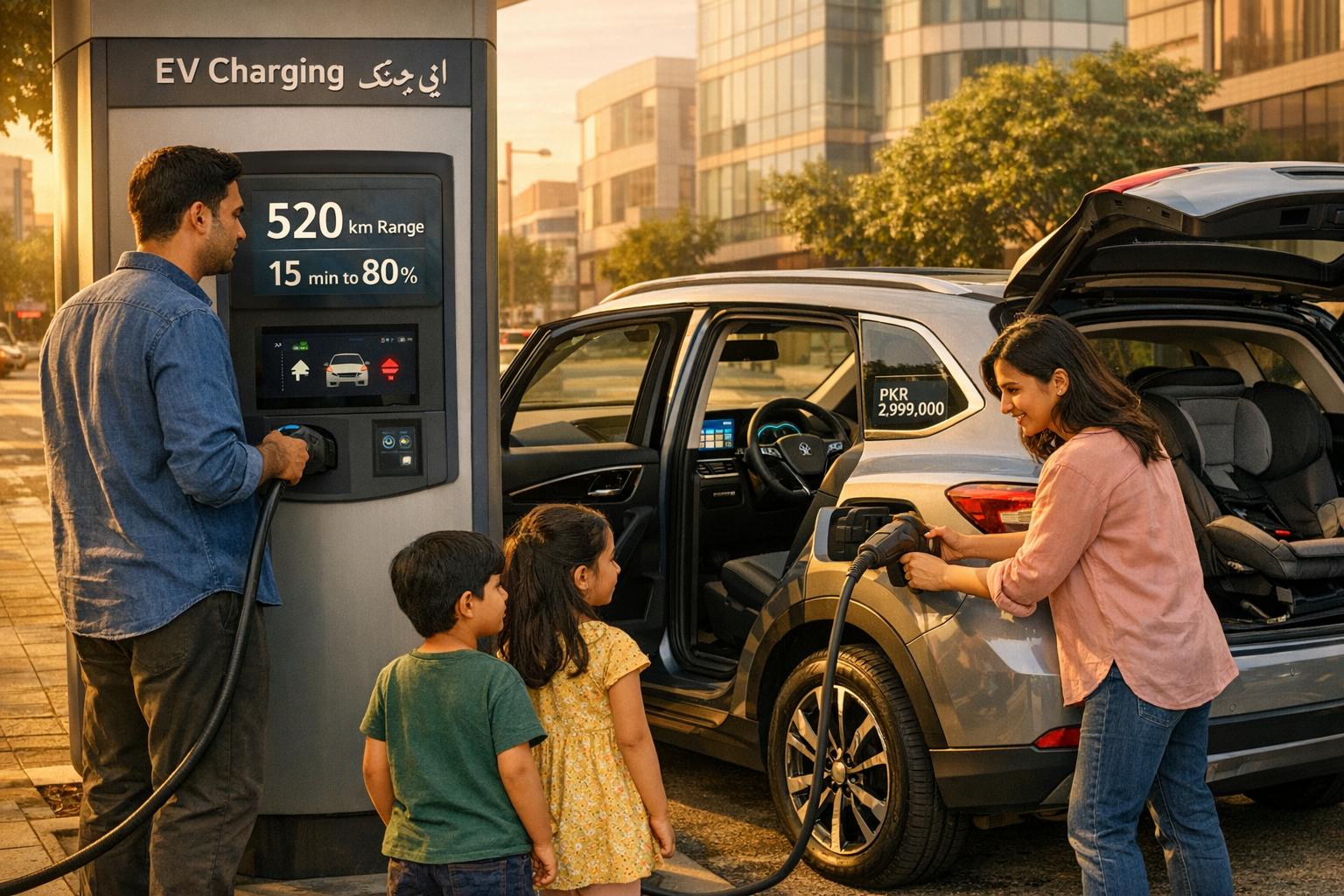
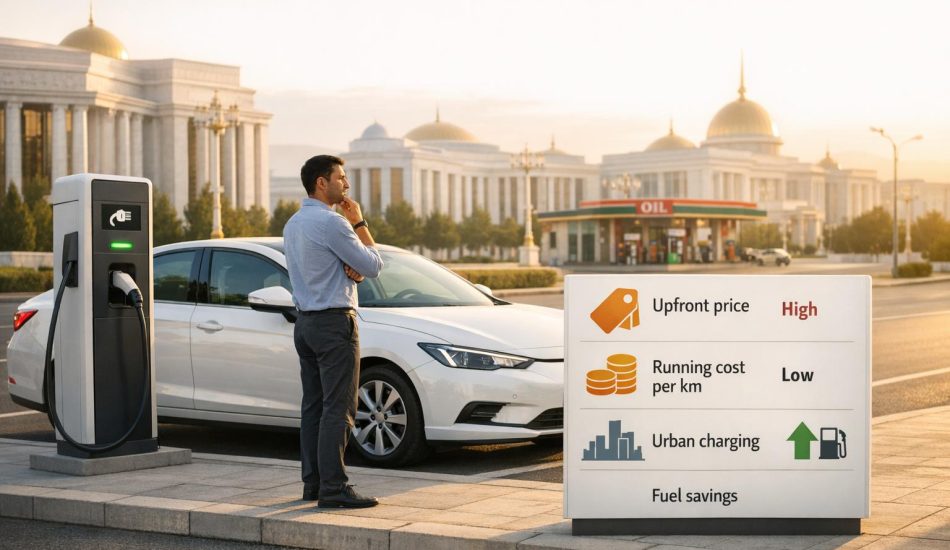
Asian buyers in 2026 are prioritizing electric vehicles (EVs) that combine affordability, practicality, and advanced tech. Here’s what stands out:
- Battery Range: Over 500 km for long trips and weekly charging convenience.
- Fast Charging: Reducing charge times to 20–40 minutes with support for multiple standards like CCS2.
- Affordable Pricing: Models priced under PKR 3,000,000 are key for markets like Pakistan.
- Safety Features: Advanced systems like Automatic Emergency Braking (AEB) and Lane Keeping Assist (LKA) are becoming must-haves.
- Smart Connectivity: Features like voice control in local languages, over-the-air updates, and large touchscreens are in demand.
- Battery Swapping: A practical solution for areas with limited home charging.
- Extended-Range EVs (EREVs): Offering petrol-engine backup for longer journeys.
- Compact Designs: Perfect for navigating crowded urban areas.
- Spacious Interiors: Family-friendly layouts with flexible storage options.
- Premium Features: Mid-range models now include amenities like leather upholstery, panoramic roofs, and advanced tech.
EVs in Asia are evolving to address regional needs, balancing cost, performance, and convenience for city commutes, family trips, and longer journeys. Buyers are looking for more than just transportation – they want vehicles that fit their lifestyles.
Singapore Motor Show 2026: Chinese electric vehicles take centre stage
sbb-itb-5f05a6f
1. Battery Range Over 500 km
In Pakistan, the idea of switching to electric vehicles (EVs) can feel daunting, especially with concerns about range. Charging infrastructure is still in its early stages, making a battery range of over 500 km a must-have for many potential buyers. For long trips, particularly in areas where charging stations are sparse, drivers need the confidence that their EV can go the distance.
For city dwellers, who typically drive about 50 kilometres a day, a range of 500+ km means they could comfortably charge their car just once a week. This level of convenience mirrors the experience of using traditional petrol vehicles. However, it’s worth noting that real-world range often falls short of official ratings. For instance, a car with a 650 km rating might only deliver around 530 km in everyday conditions, especially when factoring in highway speeds and the frequent use of air conditioning to combat Pakistan’s high temperatures. These challenges have pushed manufacturers to develop better solutions.
Take the Xpeng P7+, for example, which boasts a range of up to 725 kilometres and has already sold over 88,000 units in its first year. For those who need even more range, options like the Xpeng G7 extended-range variant offer an impressive 1,704 kilometres. Similarly, BYD’s updated Seal 06 EV achieves 630 kilometres on a single charge while improving efficiency to just 11.4 kWh per 100 kilometres.
Another breakthrough is the use of advanced 800V high-voltage platforms, which enable ultra-fast charging. These systems can add about 300 km of range in just 12 minutes by charging at five times the battery capacity per hour (5C). However, it’s not just about range – sustainability matters too. A significant 62–89% of Southeast Asian consumers express concerns about battery sustainability, making it clear that extended range must go hand-in-hand with responsible battery technology.
2. Fast Charging and Multiple Charging Standards
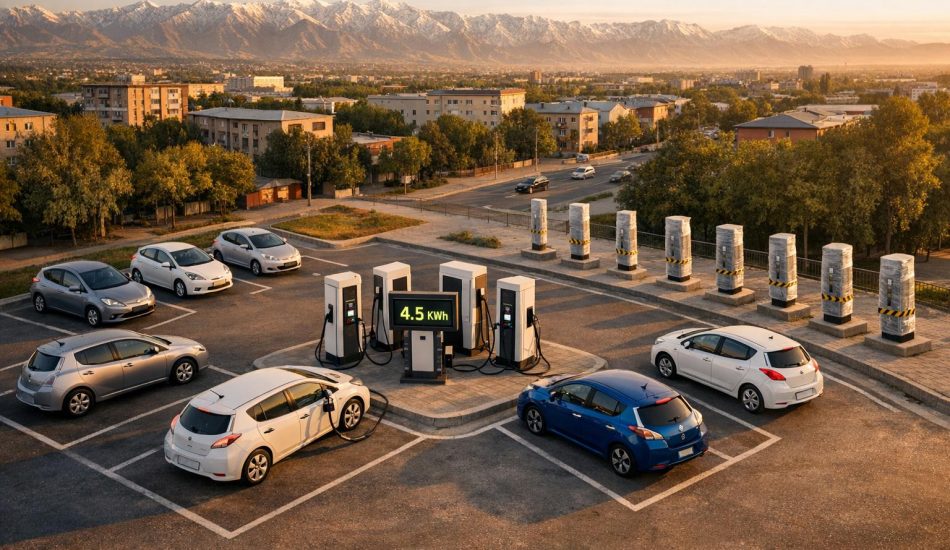
In Pakistan, long charging times simply won’t cut it. Fast charging has become a necessity, allowing drivers to gain significant range in just minutes. Modern DC fast chargers can deliver up to 80% charge in just 20–40 minutes, making electric vehicles (EVs) far more practical for daily use.
However, one of the biggest hurdles across Asia is the lack of uniformity in charging standards. Each country seems to have its own preferred system. For instance, China predominantly uses the GB/T standard, which separates AC and DC charging ports. On the other hand, most of Southeast Asia, India, and Taiwan have opted for CCS2 (Combined Charging System Type 2) as their primary standard. Japan, meanwhile, still relies on CHAdeMO, though it is in the process of shifting to the next-generation ChaoJi standard, which can deliver up to an impressive 1.2 MW of power.
For Pakistani EV buyers, this variability in charging standards can be a headache. A car that charges seamlessly in one country might struggle to find compatible stations in another. Automakers are stepping up to address these issues. In March 2025, BYD introduced its Super e-Platform in China, which features megawatt flash charging technology. This system supports charging speeds of up to 1,000 kW, adding 2 kilometres of range per second, with plans to roll out over 4,000 charging stations nationwide. Similarly, in August 2024, Delta Electronics partnered with Tata Motors to install 250 fast-charging stations for light commercial vehicles across 50 Indian cities, including major hubs like Delhi and Mumbai.
For buyers in Pakistan, the best strategy is to opt for vehicles that align with the dominant local standard – CCS2 in most of Asia outside China – and ensure adapters are available for cross-border travel. Additionally, cars equipped with 800V or 1000V systems offer the advantage of tapping into ultra-fast charging networks. This capability is quickly becoming just as important as affordability for today’s EV buyers in Asia.
3. Price Under PKR 3,000,000
In Pakistan, affordability plays a key role in driving the adoption of electric vehicles (EVs). With petrol costs ranging from PKR 10–15 per kilometre compared to just PKR 1–2 per kilometre for electricity, the financial benefits of switching to EVs are clear. However, the higher upfront cost of EVs remains a challenge. On average, EVs are priced 20% to 64% higher than traditional petrol cars, making the PKR 3,000,000 price point particularly appealing for middle-income buyers.
Fortunately, several EV models now fall within this range. The Alektra Metro, priced at PKR 1,045,000, offers a 100 km range, making it ideal for short city commutes. For those requiring more range, the Prince Pearl EV (PKR 2,200,000–2,800,000) and United Alpha One (PKR 2,500,000–3,000,000) provide ranges of 150–200 km, perfect for daily urban travel. The Rinco Aria, priced at PKR 2,995,000, stands out with a range of 210 km and a 75 hp motor.
The cost savings are substantial. Drivers covering 20,000 km annually can save up to PKR 200,000 on fuel alone. Additionally, EV maintenance costs are about 50% lower than those for petrol vehicles. These savings are particularly attractive in cities like Lahore and Karachi, where heavy traffic often leads to higher fuel consumption.
However, budget EVs do come with limitations. Most are designed for urban use and aren’t suitable for long-distance travel. Buyers should also plan for an additional PKR 50,000 to 100,000 to install a home charging station, as public charging infrastructure is still limited to major cities. For those considering used EVs, models like the 2017–2019 Nissan Leaf occasionally sell for PKR 900,000–1,000,000, but it’s crucial to ensure the battery health is at least 80%.
The EV market in Pakistan is evolving rapidly. By late 2025, EV sales had surged by 200% year-over-year, and local assembly by companies like BYD and Dongfeng is expected to cut prices by up to 20% by mid-2026. This combination of affordability, reduced running costs, and lower maintenance expenses makes EVs an increasingly attractive option for urban drivers. For those exploring electric mobility for the first time, the under-PKR 3,000,000 category offers a practical and cost-effective entry point.
4. Advanced Safety Systems
Safety features have become a key priority for EV buyers in Asia, especially in Pakistan, where bustling cities like Karachi and Lahore are infamous for their chaotic traffic and frequent collision risks. Advanced driver assistance systems (ADAS) play a crucial role in improving road safety. Take Automatic Emergency Braking (AEB), for example – it detects vehicles, pedestrians, and cyclists ahead, applying the brakes automatically if the driver doesn’t respond in time. This feature is a lifesaver in bumper-to-bumper traffic, reducing the likelihood of rear-end collisions.
"Advanced driver assistance systems are evolving from a ‘luxury feature’ available only on a few models to a ‘must-have’ capability across the entire market." – Wu Songquan, Senior Chief Expert, China Automotive Technology and Research Centre
Beyond AEB, other safety tools are boosting driver confidence. Features like Lane Keeping Assist (LKA) help prevent accidental lane drifting, while Adaptive Cruise Control (ACC) with Stop & Go ensures safe distances in heavy traffic. By late 2025, 87% of new energy vehicles in China had Level 2 or higher assisted driving capabilities. This rapid adoption highlights how these systems are no longer optional but expected.
Affordability is improving, too. BYD, for instance, offers its "God’s Eye" ADAS tech in models starting at approximately PKR 2,000,000 (70,000 yuan). Similarly, Huawei is set to launch urban navigation cruise assist in vehicles priced at around PKR 4,300,000 (150,000 yuan) by 2026. Even the more budget-conscious Xpeng G6 includes features like Blind Spot Monitoring and Rear Cross-Traffic Alert, with prices under PKR 10,000,000.
For Pakistani drivers navigating crowded bazaars, jam-packed highways, or tight parking spaces, these systems offer much-needed peace of mind. With the Asia-Pacific ADAS market expected to grow at an annual rate of 16.96% through 2033, more EVs equipped with comprehensive safety features will soon be available. When considering an EV, prioritising models with AEB, ACC, and LKA as standard safety features is a smart move.
5. Smart Connectivity and User Interface
In today’s world, tech-savvy buyers across Asia, including Pakistan, expect electric vehicles (EVs) to function as more than just transport – they want them to be digital ecosystems on wheels. In countries like China and India, the focus has shifted from simply relying on smartphones to demanding EVs with built-in technology that offers seamless connectivity. For Pakistani drivers, this is particularly appealing. Imagine navigating Karachi’s bustling streets, taking work calls, or entertaining the family on a motorway trip – all without needing additional gadgets. This level of integration isn’t just a luxury anymore; it’s becoming a necessity.
One standout feature is voice control in local languages. Whether it’s Urdu, Mandarin, or Hindi, being able to issue voice commands in your native language makes driving safer and more convenient. Combine this with large touchscreens, and you have an interface designed to minimise distractions.
"For many car buyers in China today, the question is not about which new energy vehicle to choose, but regarding the level of intelligence it should come equipped with." – Li Jiaying, China Daily
Manufacturers are also pushing boundaries with remote updates. Over-the-air (OTA) updates allow vehicles to receive new features, improve safety measures, and even enhance performance – all without a trip to the service centre. This is a game-changer for Pakistan, where cars are often kept for decades. These updates can extend a vehicle’s lifespan by up to three years, a feature that’s winning over buyers across Asia who are willing to pay extra for such convenience.
For example, Huawei’s Qiankun ADS Pro offers advanced urban navigation and will be available in vehicles priced around PKR 4,300,000 (150,000 yuan) by 2026. Meanwhile, BYD’s "God’s Eye" system is set to launch in models starting at approximately PKR 2,000,000 (70,000 yuan). Even entry-level EVs now come with features like wireless smartphone integration and digital key functionality as standard. These advancements reflect a growing trend – merging cutting-edge technology with affordability – reshaping what consumers in Asia, including Pakistan, expect from their EVs.
6. Battery Swap Technology
In Pakistan, where home charging options are often out of reach, battery swap technology presents a practical alternative. For many urban residents, setting up personal EV charging stations isn’t a realistic option. Battery swapping solves this by allowing drivers to exchange their drained battery for a fully charged one at a swap station. The entire process takes less than five minutes – about as fast as refuelling a petrol car. This convenience is a cornerstone of the Battery-as-a-Service (BaaS) model, which also helps lower upfront costs for EV owners.
Here’s how the BaaS model works: Instead of purchasing the battery outright, drivers lease it. Considering that batteries make up 30%–40% of an EV’s total cost, this approach significantly reduces the initial price of the vehicle. According to Lulu Xue from the World Resources Institute China, separating the battery cost can bring EV prices closer to those of diesel trucks. In Pakistan, where affordability is critical, this could make EVs far more accessible.
Globally, companies are already proving the potential of battery swap systems:
- Nio in China operates 3,399 swap stations across 550 cities as of July 2025.
- Vietnam’s VinFast has established 4,500 stations by January 2026, with plans to expand to 45,000 cabinets by March 2026. Their swap fee is just 9,000 VND (around PKR 60), coupled with affordable monthly subscription plans.
- In India, Sun Mobility is leading the way with swappable batteries for heavy commercial vehicles, including intercity buses.
- Battery manufacturer CATL has partnered with Sinopec to construct 500 swap stations in China by 2025, aiming for 10,000 in the long term.
Besides speed and affordability, battery swap stations can also improve energy reliability in Pakistan. Given the country’s frequent power outages and underdeveloped grid infrastructure, these stations offer a dual benefit. They charge batteries during off-peak hours, easing pressure on the grid, and can even serve as backup power sources during extreme weather events.
Globally, the battery swapping market is forecasted to grow from $1.46 billion in 2025 to $22.72 billion by 2035. As the technology advances and standards are refined, battery swapping could become the go-to solution for urban EV users in Asia – particularly in countries like Pakistan, where home charging remains a challenge.
7. Extended-Range Electric Vehicles (EREVs)
For drivers in Pakistan who worry about running out of charge mid-journey, Extended-Range Electric Vehicles (EREVs) strike a balance between traditional and electric vehicles. Unlike fully electric cars, EREVs include a small petrol engine that functions solely as a generator to recharge the battery. This setup ensures the smooth, quiet driving experience of an EV while offering extended range for areas where charging stations are scarce. Much like battery swapping, EREVs provide a practical solution to the challenges posed by limited charging infrastructure.
Take the XPeng P7+ EREV, for example, which is set to launch in 36 countries by 2026. It offers an impressive 430 km of electric-only range, with a total range extending to 1,550 km. Similarly, the Li Auto L9 delivers 215 km of electric-only driving and a combined range of 1,315 km.
"EREVs bridge the gap between BEVs and traditional hybrids by combining a battery-electric drivetrain with a small internal combustion engine that acts solely as a generator." – Yves Helven, Global Fleet
One of the biggest draws of EREVs is their cost efficiency. These vehicles use smaller battery packs – typically between 20 and 40 kWh – compared to the larger 60–100+ kWh packs found in long-range EVs. This makes them cheaper to manufacture. In China, where EREV technology has advanced rapidly, Li Auto delivered over 500,000 EREVs in 2024, marking a 33% increase from the previous year. By late 2025, nearly 27% of electrified vehicle buyers in China opted for EREVs instead of fully electric models, showing how much drivers value their flexibility.
For most daily commutes under 100 km, the petrol generator remains unused, keeping running costs low. But for extended trips, refuelling takes just five minutes at any petrol station. However, it’s worth noting that EREVs still require maintenance for both the electric components and the combustion engine, including tasks like oil changes and spark plug replacements when the generator is used.
8. Compact Designs for City Driving
Navigating through Pakistan’s bustling cities with their narrow streets and scarce parking spaces can be quite a challenge. This is where compact electric vehicles (EVs) shine, offering the agility needed for urban life. Unlike bulky SUVs that struggle in tight markets or cramped parking spots, smaller EVs are perfect for daily commutes in these environments. It’s no surprise that compact vehicles are gaining traction across Asia, reflecting these practical needs.
In Southeast Asia, compact SUVs made up 37% of new passenger vehicle registrations by 2026, a significant jump from 22% in 2021. Similarly, in Japan, compact vehicles outsold sedans for the first time in the first quarter of 2026. These smaller EVs generally come with battery packs ranging from 20 to 42 kWh, making them more affordable – an important factor in price-sensitive markets like Pakistan.
Recent model designs highlight this trend. Take the Kia EV2, for example. Introduced in January 2026, it measures 4,060 mm in length and features high-output electric power steering with an optimised ratio, making it ideal for manoeuvring through tight urban streets. Another standout is the Dongfeng Vigo EV, priced between PKR 6,000,000 and PKR 7,000,000. It comes equipped with a 540-degree panoramic view camera, a feature that’s especially helpful for parking in crowded areas.
As Jonathan Lee notes, the EV2’s design – reminiscent of a picnic box – enhances door bin storage and improves outward visibility.
Then there’s the ultra-compact Nissan Sakura, which measures just 3,395 mm in length and 1,475 mm in width. With a range of about 180 km, it’s perfect for tight parking spots and offers substantial savings. In Pakistan, EVs cost only Rs 2–3 per km to run, compared to Rs 10–15 per km for petrol vehicles. In Japan, the Sakura has become the best-selling EV, thanks to tax breaks and lower insurance costs for kei cars. This emphasis on compact, efficient designs aligns with the broader push for affordability and convenience in urban settings across Asia.
9. Spacious Interiors for Families
Compact EVs work well for solo travellers, but families need more room and adaptability. In Asia, where multi-generational living is common, the demand for 7-seater electric MPVs and SUVs has grown considerably, becoming a major trend by 2026.
Smart design innovations are making family EVs more spacious. By pushing wheels to the corners and eliminating transmission tunnels, EV platforms create longer wheelbases – ranging from 2,800 mm to 2,890 mm – and flat floors. A great example is the XPeng G6, which turns its rear area into a "small living room" when not fully occupied.
Storage flexibility is another must-have feature. The BYD M6 offers 180 litres of cargo space with all seats in use, which increases to 580 litres when the third row is folded, and up to 1,780 litres with all rear seats down. Some models, like the Kia Carens Clavis EV, even include a 25-litre "frunk" (front trunk) for smaller items like charging cables. For Pakistani families heading to Murree or Nathia Gali for weekend getaways, the Dongfeng Vigo EV – priced between PKR 6,000,000 and PKR 7,000,000 – offers a generous 500-litre boot capacity that can expand further when the rear seats are folded. These practical designs cater to the needs of families for both everyday use and longer trips.
Mid-range family EVs are also stepping up with premium features. The XPENG X9, for instance, includes electrically foldable third-row seats that create a flat loading area. High-end models now boast amenities like "zero gravity" reclining seats, roof-mounted AC vents for all three rows, and even built-in fridges in the second row. Lounge-style interiors with panoramic glass roofs and large windows are becoming more common, reducing the cramped feel often associated with three-row vehicles.
When choosing a family EV, it’s worth checking if the third row is comfortable for adults. For example, the BYD eMAX 7’s third row is usable but less spacious compared to other options. Also, roof-mounted vents are essential for keeping cool during Pakistan’s hot summers. These thoughtful interior upgrades highlight the growing expectations of family buyers across Asia.
10. Premium Features at Mid-Range Prices
In Asia, mid-range EVs now come with features that were once considered luxury. Buyers expect amenities like Nappa or vegan leather upholstery, panoramic glass roofs, and ambient lighting as standard. These features elevate the driving experience, as Ted Li, Head of Product Experience at Nio, puts it:
"The core and the starting point of this journey is actually marching toward an end point of holistic experience".
Chinese automakers are at the forefront of this shift. Take the BYD Dolphin, which includes ventilated seats and a panoramic roof at around PKR 7,500,000, or the Xiaomi SU7, offering Nappa leather, aluminium trim, and a 16.1-inch touchscreen for approximately PKR 10,100,000. The XPeng G6, starting at PKR 11,500,000, goes even further with a suede-effect ceiling and massaging seats – features that used to be exclusive to high-end models. These mid-range interiors rival European luxury brands, boasting soft-touch surfaces, wood-grain trims, and heated, ventilated, and massaging seats.
Technology is another area where these vehicles shine. The Xiaomi SU7 Max includes a 56-inch head-up display that spans the windscreen, while the XPeng G6 features 800V fast-charging architecture, enabling a 10% to 80% charge in just 12 minutes. Some models, like the MG Cyberster, even offer up to four screens. Health-conscious additions such as PM1.0 air filters and "pet/camping modes" (which maintain cabin temperature while parked) are becoming standard.
How do manufacturers keep these prices competitive? They employ Lithium-Iron Phosphate (LFP) batteries, shared platforms across models, and local production hubs. High-tech features like AI voice assistants, over-the-air updates, and augmented reality displays replace traditional luxury materials, delivering cutting-edge experiences without inflating costs. As Andy An, CEO of Zeekr, remarks:
"Chinese consumers are generally satisfied with the range, speed and charging ability of their EVs. Thus, automakers need to find other draws to bring in consumers".
For Pakistani buyers, these advancements are already accessible. The VinFast VF6, priced between PKR 1,650,000 and PKR 1,830,000, comes with leatherette upholstery, 8-way power-adjustable seats, a 12.9-inch touchscreen, and 360-degree cameras – even in its base trim. Premium features at mid-range prices are no longer a bonus – they’re an expectation.
Comparison Table: Popular EV Models in Asian Markets
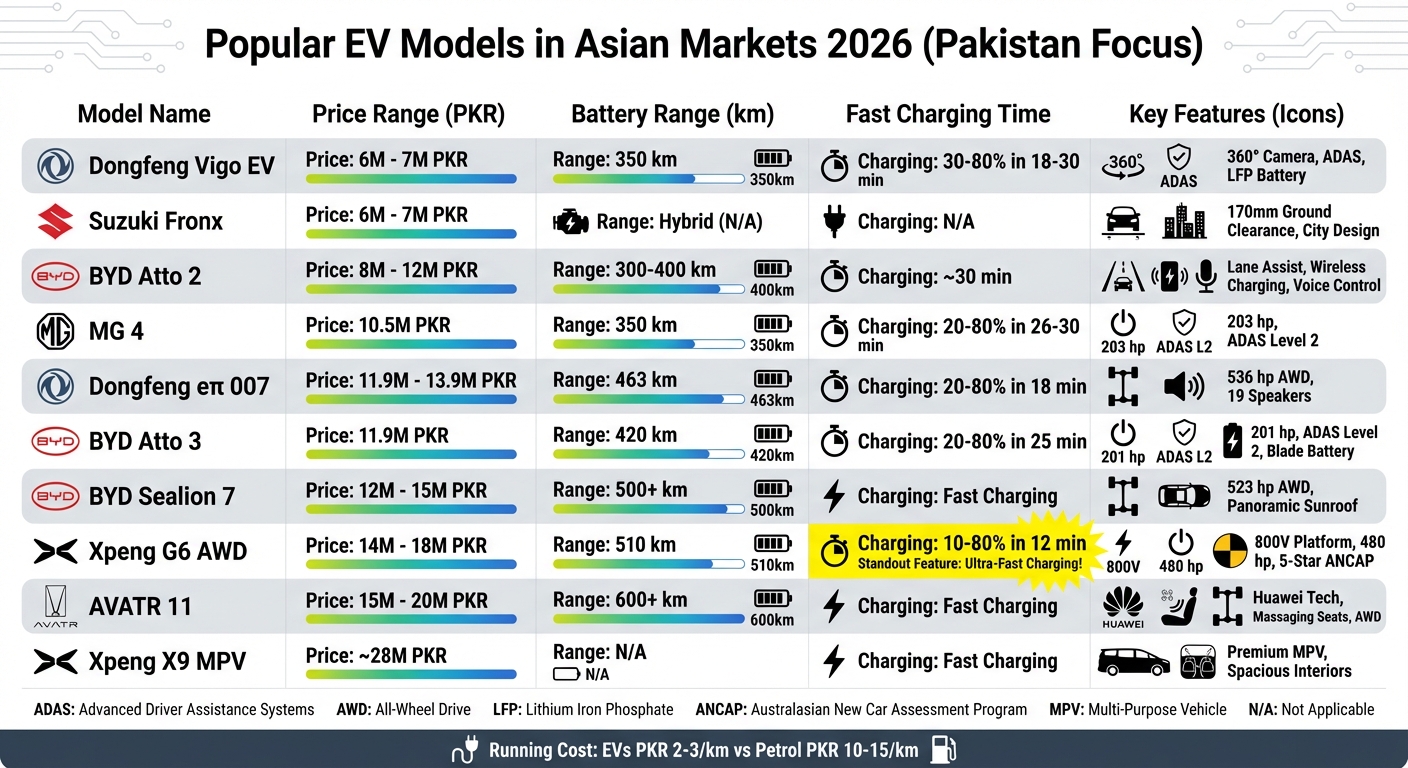
Popular EV Models in Asian Markets 2026: Price, Range & Features Comparison
Here’s a breakdown of the top EV models available in Pakistan and across Asia in 2026. The table below highlights price ranges in PKR, battery range in kilometres, charging capabilities, and standout features to help you evaluate the best options.
| Model | Price Range (PKR) | Battery Range (WLTP) | DC Fast Charging | Key Features |
|---|---|---|---|---|
| Dongfeng Vigo EV | 6,000,000 – 7,000,000 | 350 km | 30%–80% in 18–30 min | Compact SUV, 360-degree camera, ADAS, LFP battery |
| Suzuki Fronx | 6,000,000 – 7,000,000 | N/A (Hybrid) | N/A | 170mm ground clearance, city-friendly design |
| BYD Atto 2 | 8,000,000 – 12,000,000 | 300–400 km | ~30 min | Lane assist, wireless charging, voice control |
| MG 4 | 10,500,000 | 350 km | 26–30 min (20%–80%) | 203 hp, ADAS Level 2, compact crossover |
| Dongfeng eπ 007 (Essence) | 11,900,000 – 13,900,000 | 463 km | 20%–80% in 18 min | 536 hp (AWD), frameless doors, 19 speakers |
| BYD Atto 3 | 11,900,000 | 420 km | 25 min (20%–80%) | 201 hp, ADAS Level 2, Blade battery |
| BYD Sealion 7 | 12,000,000 – 15,000,000 | 500+ km | Fast charging | 523 hp, AWD, panoramic sunroof |
| Xpeng G6 (AWD) | 14,000,000 – 18,000,000 | 510 km | 10%–80% in 12 min | 800V platform, 480 hp, Nappa leather, 5-star ANCAP |
| AVATR 11 | 15,000,000 – 20,000,000 | 600+ km | Fast charging | Huawei tech, massaging seats, AWD |
| Xpeng X9 MPV | ~28,000,000 | N/A | Fast charging | Premium MPV, spacious interiors |
Now, let’s dig into some standout models and trends. The Xpeng G6 is a game-changer with its 800V platform, allowing a 10%–80% charge in just 12 minutes. On the performance side, the Dongfeng eπ 007 boasts an impressive 536 hp, paired with a quick 20%–80% recharge in 18 minutes. For budget-conscious buyers, the Dongfeng Vigo EV offers a dependable range and safety features within a price bracket of PKR 6,000,000–7,000,000.
Many models now include advanced features like Level 2 ADAS and 360-degree cameras, which enhance both safety and convenience. Cost efficiency is another selling point, with EVs running at just PKR 2–3 per kilometre compared to PKR 10–15 for petrol. With the anticipated local assembly of brands like BYD, prices are expected to become even more competitive, making these EVs an attractive choice for Pakistani buyers looking for a mix of range, smart features, and affordability.
Conclusion
By 2026, Asian EV buyers are looking beyond just basic specifications – they’re seeking a well-rounded ownership experience. While essentials like a battery range exceeding 500 km, fast charging capabilities, and affordability under PKR 3,000,000 remain key, there’s a growing appetite for smart connectivity, advanced safety features, and premium touches at competitive prices. Aaron Kee, Group Chief Business Officer at Carsome, highlights this shift:
"Technology integration, cabin experience and feature richness are increasingly embedded into propositions, even within mass-market vehicles".
This reflects a broader expectation among consumers: EVs should go beyond basic mobility and offer solutions that balance performance, comfort, and efficiency.
Regional preferences also play a significant role. Compact designs are ideal for crowded urban areas, while spacious interiors appeal to families. Innovations like Extended-Range Electric Vehicles (EREVs) and battery-swap technologies are addressing infrastructure challenges, particularly in regions where home charging is limited. Platforms like EV24.asia are stepping in to meet these needs, offering transparent pricing, in-depth specifications, and access to popular brands that align with buyer priorities.
Addressing these top 10 priorities ensures EVs provide more than just transportation – they deliver a user-focused experience. With the Asia Pacific EV market projected to reach $927.96 billion by 2030, understanding these evolving preferences is crucial. Whether it’s for city commutes, family trips, or long journeys, choosing the right model with the right features will ensure your EV investment pays off in the long run.
"The core and the starting point of this journey is actually marching toward an end point of holistic experience".
- Ted Li, Head of Product Experience at Nio
FAQs
Is 500+ km range possible in Pakistan’s heat and traffic?
Yes, achieving a range of over 500 km is possible in Pakistan’s heat and traffic, especially with high-performance electric vehicles like the BMW i4 M50, which boasts a range of up to 520 km on a full charge. However, real-world factors such as driving style and extreme weather conditions can influence the actual range.
Which charging plug should I choose for Pakistan and travel?
For travelling within Pakistan, the Type 2 (Mennekes) connector is the go-to option. It’s widely supported across the country and works seamlessly with the majority of public and home charging stations. This makes it a reliable and convenient choice for EV users.
Should I buy a BEV, an EREV, or wait for battery swapping?
Waiting for battery swapping might be a game-changer because it allows for quicker refueling compared to traditional charging methods. Plus, it helps tackle some of the hurdles tied to charging infrastructure. That said, most people today lean towards battery electric vehicles (BEVs) or hybrids, largely based on what charging facilities are accessible and their individual preferences. It’s worth taking a close look at your local charging setup and how you plan to use the vehicle before making a choice.