
 Arka Pratama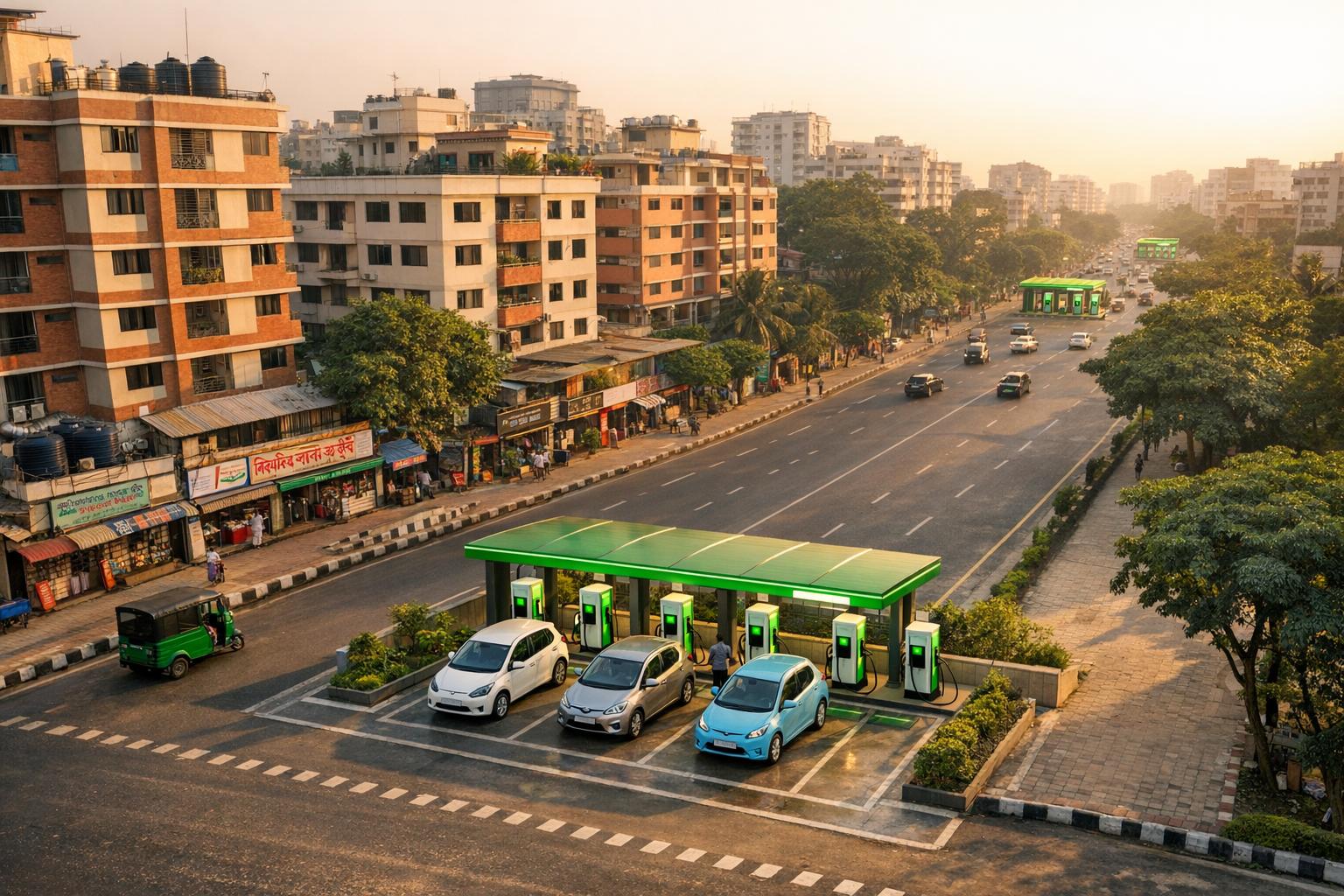
Bangladesh’s electric vehicle (EV) market is evolving with a focus on affordability, infrastructure, and policy support. Here’s what you need to know:
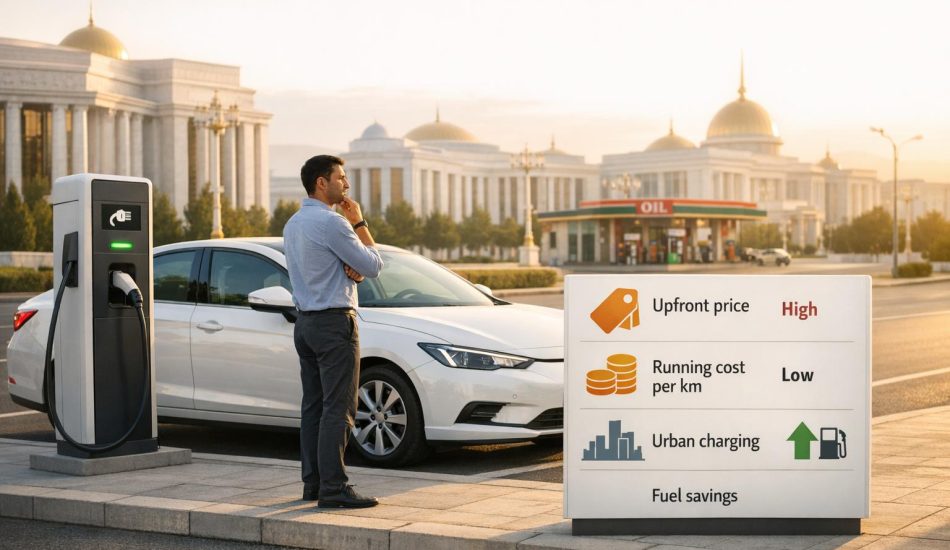
- Affordability: EVs are becoming more accessible with models like the MG 4 EV (Tk 49 lakh) and two-wheelers starting under Tk 1 lakh. Operating costs for EVs are far lower than petrol vehicles, with some bikes costing just 0.10–0.15 BDT/km.
- Charging Network: From under 100 stations in 2025, plans aim for 500–1,000 points in Dhaka by 2030. Private players and government incentives are driving this expansion.
- Import and Local Production: Import duties for EVs are lower (89%) than petrol vehicles (150%–450%), and local assembly benefits from reduced taxes (15.25%). Companies like Bangladesh Auto Industries are setting up manufacturing plants.
- Challenges: High registration fees, limited charging stations, and grid readiness remain barriers. However, battery-swapping models and tax exemptions are helping address these issues.
Bangladesh targets 30% EV adoption by 2030, backed by policies like the Electric Vehicle Industry Development Policy 2025. The shift promises reduced fuel dependency and lower emissions.
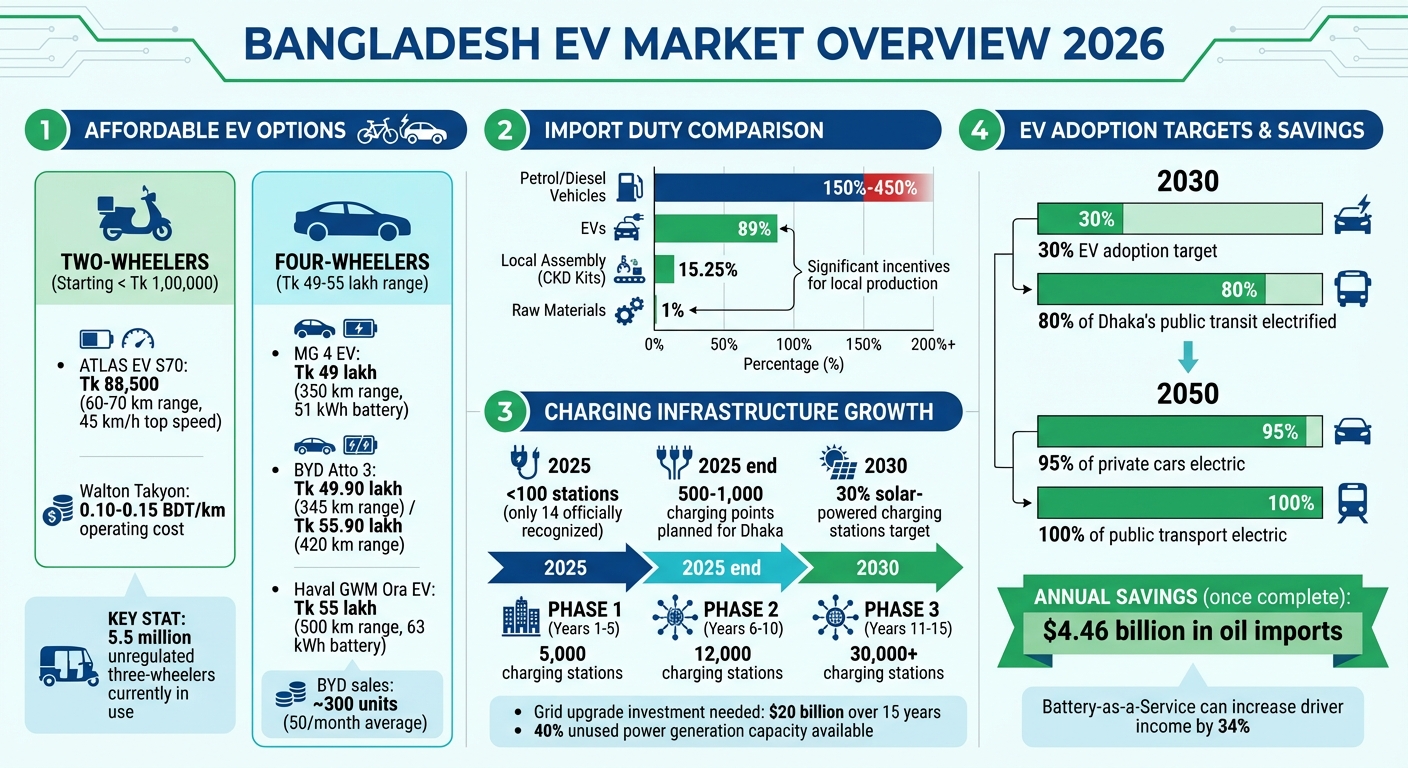
Bangladesh EV Market 2026: Key Statistics, Costs & Growth Targets
Affordable Electric Vehicles for Bangladesh Buyers
Common EV Types in Bangladesh
Bangladesh’s electric vehicle (EV) market offers a variety of options tailored to different transportation needs. Electric two-wheelers are the most accessible, with prices starting below 1,00,000 BDT. These are ideal for short city commutes, typically offering a range of 60–70 km per charge. On the other hand, electric three-wheelers dominate the informal transport sector, with around 5.5 million unregulated units currently in use across the country. Lastly, electric four-wheelers, primarily Chinese-made hatchbacks and crossovers, are becoming increasingly popular among middle-class buyers, with prices capped at 60 lakh BDT. These categories highlight the evolving EV landscape and set the stage for affordable models available in 2026.
Budget-Friendly EV Models in 2026
Chinese manufacturers continue to redefine affordability in the EV market. The MG 4 EV, priced at 49 lakh BDT, offers a 51 kWh battery that delivers a 350 km range and accelerates from 0–100 km/h in just 8 seconds. BYD‘s Atto 3 is available in two versions: the standard model costs 49.90 lakh BDT (49.92 kWh battery, 345 km range), while the extended range variant is priced at 55.90 lakh BDT (60.48 kWh battery, 420 km range). For those prioritising range, the Haval GWM Ora EV provides an impressive 500 km on a single charge, thanks to its 63 kWh battery and 126 kW motor, priced at 55 lakh BDT. BYD has established itself as a market leader, selling about 300 units at an average rate of 50 per month.
For two-wheeler enthusiasts, the ATLAS EV S70 scooter costs 88,500 BDT and offers a top speed of 45 km/h with a range of 60–70 km. It has received a perfect 5/5 rating from user reviews, with buyers praising its stylish design and comfortable ride, especially for city use. The Walton Takyon e-bike stands out for its ultra-low operating cost of just 0.10–0.15 BDT per kilometre, making it an economical choice for daily commutes. These models illustrate how EVs can be both practical and affordable for a wide range of buyers.
EVs vs. Petrol Vehicles: Cost Analysis
Government policies and operational savings make EVs a compelling choice over petrol vehicles. Import duties are a major factor – EVs are taxed at 89%, significantly lower than the 150%–450% tax range for petrol and diesel vehicles. This tax structure often makes EVs more affordable than their internal combustion engine counterparts in several categories. Operational costs further tilt the scales in favour of EVs. For instance, the Walton Takyon’s per-kilometre running cost of 0.10–0.15 BDT is a fraction of what petrol-powered bikes require.
That said, EV buyers face some financial challenges. The current registration fee formula (where 1 kW equals 20 cc) can make registering an EV up to four times more expensive than a petrol vehicle. Additionally, the cost of battery replacement remains a key long-term consideration for EV owners.
sbb-itb-5f05a6f
EV Charging Infrastructure: Growth and Access
Existing Charging Stations in Bangladesh
Bangladesh’s EV charging network is still in its infancy, with fewer than 100 public stations currently available. Of these, only 14 have been officially recognised by the Bangladesh Energy Regulatory Commission. Most of these stations are concentrated in Dhaka and other major cities, leaving rural areas and highways largely overlooked. Additionally, the majority of these stations offer slow-charging facilities, which adds to the challenges for EV users. For drivers planning long-distance trips, especially between cities, this lack of infrastructure creates significant range anxiety.
To address these gaps, the government has laid out plans to install 500 to 1,000 new charging points in Dhaka by the end of 2025. This is part of a broader ambition to achieve 15% to 30% EV penetration by 2030, which would require more than 2 million electric vehicles on the roads. In rural regions, small-scale solar-powered charging stations are beginning to emerge, mainly for three-wheelers. At the same time, innovative solutions like battery swapping services, such as those provided by Cassetex, are gaining popularity among commercial fleets and easy bike operators. Both government and private entities are working on new projects to bridge these infrastructure gaps.
Government and Business Charging Projects
The Electric Vehicle Industry Development Policy 2025 outlines a clear roadmap to accelerate EV adoption. One of its key measures is mandating the registration of all EVs by June 2026. To encourage private investment in charging infrastructure, the policy offers a 10-year income tax exemption for developers and requires new buildings to include EV charging provisions. The government also aims to make 30% of all charging stations solar-powered by 2030, aligning with sustainability goals.
Private companies are stepping up to expand the charging network. For instance, in late 2025, Progress Motors Imports Limited (PMIL), in collaboration with BYD Bangladesh, launched a 180kW DC fast-charging station at Kabab Express in Cheora, Cumilla, along the Dhaka-Chattogram highway. This advanced station can charge compatible EVs in just 25 minutes. Md Hasib Uddin, Director (Finance) at Progress Motors, highlighted the station’s efficiency:
"A car will need only 20-30 minutes to fully charge with these charging points. On one full charge, a car would run for 500 kilometres".
He further noted:
"Bangladesh is an ideal country for these EVs because our maximum routes are not more than 500km, so one charge will be enough".
Charging at Home and Work
Home and workplace charging solutions are becoming more prominent, offering convenience for daily EV users. Home charging is particularly appealing, with basic AC chargers, including professional installation, costing between BDT 55,000 and BDT 145,000. For those seeking advanced features, smart chargers with Wi-Fi connectivity start at around BDT 90,000.
However, electricity for charging is billed at commercial rates, which can increase costs for residential users. Before installing a home charger, it’s essential to check if the home’s electrical panel can handle the additional load, as upgrades might be required for high-voltage equipment. Workplace charging is also gaining traction, with private companies like Kempower offering 0% interest financing for businesses installing DC fast chargers. Mobile apps simplify the process by helping users locate stations, reserve charging slots, and make digital payments in advance, making EV charging more accessible and user-friendly.
EV Import Costs: Complete Financial Breakdown
Import Duty Rules for EVs
In Bangladesh, importing electric vehicles (EVs) comes with an 89% import duty, which includes a 20% supplementary duty. On the other hand, hybrid vehicles enjoy a much lower tariff structure, with just 10% Customs Duty and 30% Supplementary Duty. To encourage local EV assembly and manufacturing, the government plans to introduce tiered customs duty structures in 2030, 2035, and 2041. Additionally, a tax holiday has been proposed for locally manufactured EVs, extending until 2040.
The Bangladesh Road Transport Authority (BRTA) calculates registration fees for EVs based on motor capacity, equating 1 kW to 20cc. For example, a 150-kW EV is treated as a 3,000cc luxury vehicle for registration purposes. Electric motorcycles with a 5 kW capacity require a registration fee of Tk 2,000, while EVs with a capacity of up to 30 kW are charged Tk 9,000. However, fees rise sharply for vehicles exceeding 100 kW, aligning them with the rates for petrol vehicles over 2,000cc. These regulations significantly impact the total cost of owning an EV, as outlined in the detailed cost breakdown below.
Complete Import Cost Breakdown
The import cost of an EV begins with the CIF (Cost, Insurance, and Freight) value, where insurance is usually calculated as 1% of the vehicle’s purchase price. Other taxes include:
- 15% VAT
- 3% Regulatory Duty (RD)
- 5% Advance Income Tax (AIT)
- 4% Advance Trade VAT (ATV)
All of these are applied on top of the 89% import duty. Registration fees for EVs typically range between Tk 3 lakh and Tk 4 lakh, with an additional one-time Advance Income Tax of at least Tk 1.5 lakh during registration. Owners of EVs who already possess an internal combustion engine vehicle are subject to an annual surcharge of Tk 1 lakh. High-end EVs, such as those from Audi, are priced locally between Tk 1.69 crore and Tk 2.25 crore.
Saad Khan, the Managing Director of Audi Bangladesh, has expressed concerns about the current fee structure:
"Even though EVs are highly economical and environmentally friendly, the BRTA method of calculating EV registration fees is impractical and discourages EV purchases."
Despite these high costs, various payment and financing options are available to help mitigate the financial burden.
Payment and Financing Options
Financing schemes play a crucial role in reducing the impact of high import and registration costs. The Draft Electric Vehicle Industry Development Policy 2025 includes measures such as concessional bank financing, reduced customs duties, and tax exemptions to boost EV demand. However, as of late 2024, LC (Letter of Credit) margins remain fixed at 100% due to foreign exchange constraints. Industry dealers have suggested lifting these restrictions to ease the import process.
Another cost-saving option is Battery-as-a-Service (BaaS), which allows drivers to lease or swap lithium-ion batteries for a small daily or weekly fee. This approach significantly lowers upfront costs. According to LightCastle Analytics Wing:
"Leasing or swapping lithium-ion batteries provides the most practical path for EV adoption. This approach removes high upfront costs, lowers operating expenses, and can increase daily income for drivers by up to 34%."
In 2024, the "Road to a Green Bangladesh" project, led by Ricardo Energy and Environment in collaboration with IDCOL and LightCastle Partners, introduced an inclusive EV financing tool. This initiative supported investments for MSMEs and trained rural women entrepreneurs to manage micro-credit loans for EV purchases. Micro-credit institutions often provide partial loans to rural entrepreneurs, particularly those in the three-wheeler market segment. Furthermore, green financing mechanisms are being developed to reduce payback periods for EV charging infrastructure and fleet investments.
Challenges and Growth Opportunities
Main Obstacles to EV Adoption
Bangladesh faces several hurdles that make adopting electric vehicles (EVs) a tough sell. For starters, the cost of owning an EV is steep due to high registration fees. These fees are calculated by equating 1 kW to 20 cc, which inflates costs even for smaller EVs. On top of that, anyone who already owns a vehicle has to pay an annual surcharge of Tk 1 lakh.
Then there’s the issue of charging infrastructure – or rather, the lack of it. By mid-2025, the country had only 14 operational EV charging stations, and most of these were located in major urban areas. For potential buyers outside these hubs, the limited availability of charging points is a major deterrent.
Importing EVs doesn’t make things any easier. Fully built EVs face an import duty of 89.1%, and banks require a 100% letter of credit margin due to foreign exchange issues. On top of that, the national electricity grid isn’t ready to handle the increased load that widespread EV use would bring. Experts estimate that upgrading the grid for full EV adoption would require over $20 billion in investment spread over 15 years.
Despite these obstacles, there’s plenty of room for growth with the right strategies in place.
Investment and Business Opportunities
Amid these challenges, creative business models and investment opportunities are starting to reshape the EV landscape. One promising avenue is local assembly. Companies that import completely knocked-down (CKD) kits benefit from a much lower tax burden – just 15.25% compared to the 89.1% duty on fully built vehicles. This tax incentive will remain in place until 2035. A notable example is Bangladesh Auto Industries Limited, which began setting up the country’s first full-scale EV manufacturing plant in Mirsarai, Chattogram, in October 2025. This move aims to reduce reliance on imports by producing vehicles locally.
Another exciting prospect is the Battery-as-a-Service (BaaS) model. This approach allows drivers to lease or swap lithium-ion batteries for a small daily or weekly fee, cutting down on the hefty upfront costs of EV ownership. According to LightCastle Analytics Wing, adopting this model could increase the daily income of three-wheeler drivers by up to 34%. Considering there are around 5.5 million vehicles in the informal three-wheeler sector, the potential for battery-swapping networks is massive.
The government is also encouraging private investment in charging infrastructure. Operators of charging networks are being offered 10-year income tax holidays, making this a lucrative opportunity. Companies like Palki Motors are already taking advantage by building battery-swapping networks for commercial and delivery vehicles. Additionally, there’s significant potential in battery recycling facilities. The three-wheeler sector alone generates 3,000 tonnes of hazardous waste daily from lead-acid batteries. Establishing recycling plants for lithium-ion batteries could create a more sustainable system while reducing the need for imported raw materials.
Local production of EV components is another area ripe for development. The government has imposed only a 1% customs duty on raw materials imported for local manufacturing. Moreover, a mandate requires that by 2030, at least 30% of vehicles purchased by government and semi-government agencies must be electric, ensuring steady demand for locally made components.
Together, these challenges and opportunities highlight the evolving nature of Bangladesh’s EV market as it moves toward a more sustainable future.
Conclusion: Bangladesh’s EV Future
Summary of Main Points
Bangladesh’s electric vehicle (EV) market is undergoing a significant transformation, driven by three key trends. First, affordable EV options are becoming more accessible, especially in the two-wheeler and three-wheeler categories, with operating costs as low as 0.10–0.15 BDT/km. The government’s decision to slash import duties on e-bike raw materials from 60% to just 1% has made local assembly a cost-effective option. Second, the country is rapidly expanding its charging infrastructure, which currently includes 14 operational stations. Third, EVs benefit from lower import duties compared to petrol vehicles, while local assembly using CKD kits offers a more economical solution for manufacturers and consumers alike.
These trends, combined with supportive policies, infrastructure expansion, and industry advancements, are paving the way for significant growth in Bangladesh’s EV sector.
What to Expect for EV Growth
The future of EVs in Bangladesh looks promising with ambitious targets. By 2030, the government aims for 30% of all vehicles to be electric, with 80% of Dhaka’s public transit electrified during the same period. Looking further ahead, by 2050, the vision includes 95% of private cars and 100% of public transport running on electricity. These goals are backed by robust policies, such as the Draft Electric Vehicle Industry Development Policy 2025, which outlines a roadmap through 2040. The policy includes incentives like full income tax exemptions for EV manufacturers and VAT waivers across all production stages.
"The future of the low-cost EV market in Bangladesh is undeniably bright. With the right mix of policy support, infrastructure development, and industry innovation, Bangladesh has the potential to emerge as a regional leader." – Md Sofiqul Islam et al., International Journal of Engineering and Advanced Technology Studies
The transition to EVs is planned in three phases. Phase 1 (Years 1–5) focuses on imports and establishing 5,000 charging stations. Phase 2 (Years 6–10) shifts towards local assembly and foreign direct investment, with plans to increase charging stations to 12,000. Phase 3 (Years 11–15) sets a target of 90% EV fleet adoption, supported by over 30,000 charging stations and advanced battery recycling facilities. Additionally, the government aims to power 30% of EV charging stations with solar energy by 2030, capitalising on the country’s 40% unused power generation capacity. This strategy could save Bangladesh approximately $4.46 billion annually in oil import costs once the transition is complete.
New electric bike price in bd 2026, electric scooter price in bd, bike price in bd, low price bike
FAQs
What’s the real total cost of importing an EV to Bangladesh?
Importing an electric vehicle (EV) to Bangladesh comes with a hefty price tag – about 89% of the vehicle’s value. This steep cost is due to a combination of taxes and duties, including:
- 72% customs duty
- 20% supplementary duty
- 25% import duty
- 5% regulatory duty
- 15% VAT
These charges add up quickly, making the process of bringing EVs into the country a costly endeavour.
Can I rely on charging outside Dhaka for intercity trips?
Charging for intercity trips outside Dhaka in Bangladesh presents a tough challenge due to the limited infrastructure. Currently, there are fewer than 100 public charging stations, with most of them concentrated in Dhaka. While the government has ambitious plans to expand the network by 2030, the present situation requires EV owners to plan their journeys carefully. A few solar-powered and private charging stations are starting to appear, but for now, intercity travel remains far less dependable compared to the options available within Dhaka.
Is a battery-swapping plan cheaper than buying the battery?
A battery-swapping plan offers a cost-effective alternative to buying a new battery. In Pakistan, such initiatives aim to make owning an electric vehicle (EV) more accessible by cutting down the hefty upfront cost. Similarly, Bangladesh is also working on developing battery-swapping infrastructure to achieve the same goal. This approach allows users to replace their depleted batteries with fully charged ones at a fraction of the cost, eliminating the need for a significant investment in expensive batteries.