
 Arka Pratama
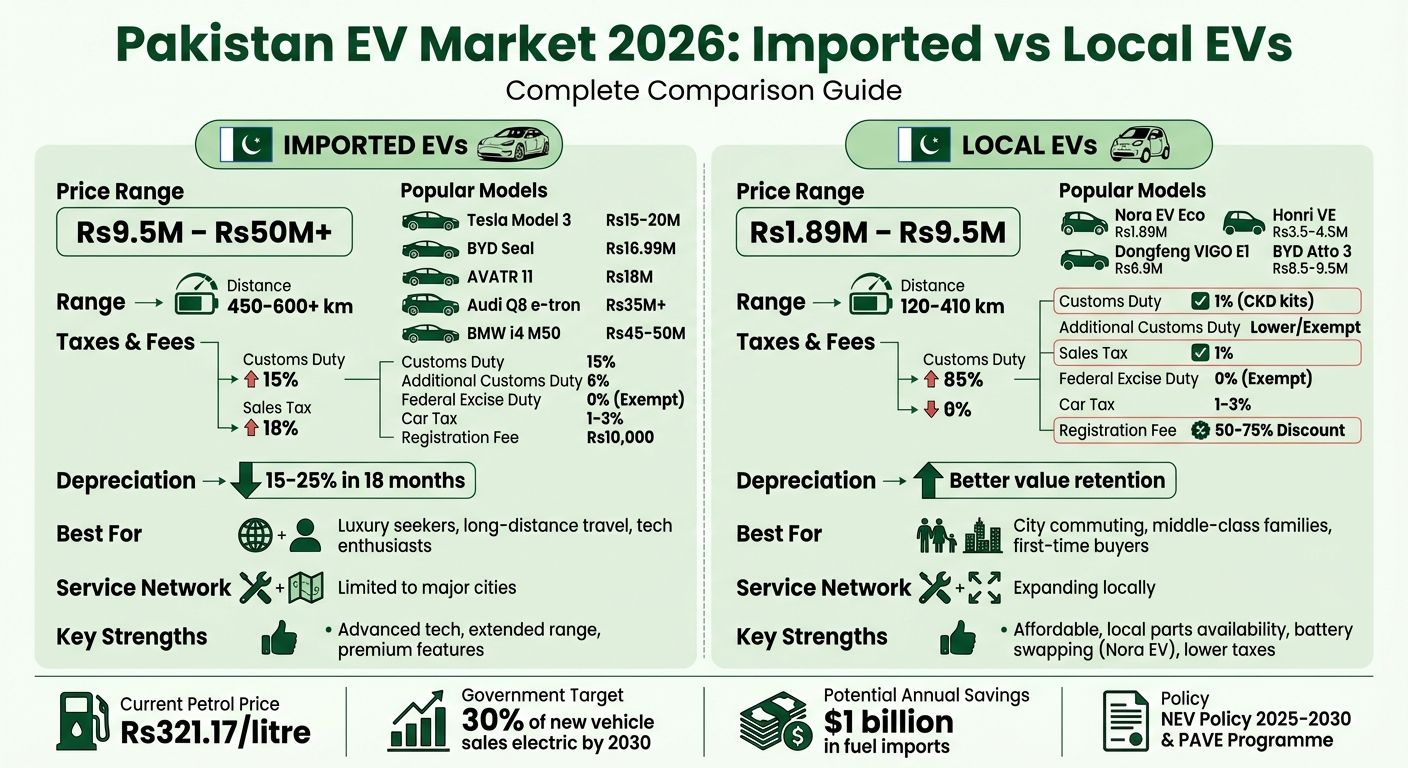
Pakistan’s electric vehicle (EV) market is transforming rapidly in 2026, driven by rising fuel prices, government incentives, and a focus on reducing fuel imports. With petrol now at Rs321.17 per litre, EVs are becoming a cost-effective alternative. The National Electric Vehicle (NEV) Policy 2025-2030 aims to make 30% of new vehicle sales electric by 2030, offering tax cuts, subsidies, and toll exemptions to encourage adoption.
Here’s a quick breakdown:
- Imported EVs: Luxurious but expensive, with prices ranging from Rs9.5 million to over Rs50 million. They face high import duties (15%) and limited local support.
- Local EVs: Affordable and practical, priced between Rs1.89 million and Rs9.5 million, with tax benefits like 1% sales tax and reduced customs duties. Models like the Nora EV and BYD Atto 3 cater to middle-class buyers.
Quick Comparison
| Feature | Imported EVs | Local EVs |
|---|---|---|
| Price | Rs9.5M – Rs50M+ | Rs1.89M – Rs9.5M |
| Taxes | High import duties (15%) | Lower duties (1% on kits) |
| Range | 450–600+ km | 120–410 km |
| Best For | Luxury, long trips | City commutes, affordability |
| Service Network | Limited | Expanding locally |
The decision boils down to your budget and needs: imported EVs offer advanced features and extended range, while local EVs provide affordability and better long-term support. With government incentives and growing infrastructure, 2026 is shaping up to be a pivotal year for EV adoption in Pakistan.
Imported vs Local EVs in Pakistan 2026: Price, Tax & Features Comparison
Pricing Comparison: Imported vs Local EVs
What Imported EVs Cost in Pakistan
Imported electric vehicles cater to upper-middle-class and luxury buyers in Pakistan. For instance, the Audi Q8 e-tron comes with a hefty price tag exceeding Rs35 million. Mid-range imported SUVs like the MG ZS EV fall between Rs9.5 million and Rs9.69 million, while the Tesla Model 3 is available in the Rs15 million to Rs20 million range. Premium models such as the BYD Seal are priced at Rs16.99 million, and the Deepal S07 is offered around Rs15.5 million. These vehicles boast advanced features and impressive ranges of 400 km to over 600 km, reflecting their global reputation. However, their high prices keep them out of reach for the majority of buyers in Pakistan.
What Local EVs Cost in Pakistan
Locally produced and assembled EVs are significantly more affordable, targeting a much broader market. The Nora EV Eco variant starts at just Rs1.89 million, making it cheaper than popular petrol cars like the Suzuki Alto, which costs between Rs2.2 million and Rs2.6 million. The Honri VE hatchback is available in the Rs3.5 million to Rs4.5 million range, while the Dongfeng VIGO E1 budget SUV is priced at Rs6.9 million. Additionally, the BYD Atto 3 is expected to cost between Rs8.5 million and Rs9.5 million. There’s also buzz around a new local electric car priced at approximately Rs1 million, poised to hit the market soon. These prices make local EVs a more accessible choice for everyday buyers.
Why Prices Differ Between Imported and Local EVs
The price gap between imported and local EVs stems from several factors. Imported vehicles are subject to high import duties, shipping costs, and currency fluctuations, all of which inflate their prices. The weakening Pakistani rupee further drives up costs for imported EVs and their components. On the other hand, locally manufactured EVs benefit from revised customs duties for FY26 and incentives under the NEV Policy 2025–2030 and the PAVE programme.
As Danish Khaliq, BYD’s Vice President of Sales and Strategy, stated:
their factory will initially assemble imported components and produce some non-electric parts locally.
Additionally, lower labour costs in Pakistan help reduce production expenses. Imported EVs also face rapid depreciation – losing 15–25% of their value within 18 months – due to limited local support and resale challenges. This makes locally produced EVs a more practical and budget-friendly option for many buyers.
sbb-itb-5f05a6f
Taxes and Import Duties on EVs in Pakistan
Import Duties and Taxes on Foreign EVs
When it comes to imported electric vehicles, various taxes significantly inflate their final price. For fully built units (CBUs) with batteries up to 50 kWh, the Customs Duty is set at 15% of the CIF (Cost, Insurance, and Freight) value. On top of this, a 6% Additional Customs Duty (ACD) applies for the fiscal year 2025–26. The Sales Tax (GST) adds another 18%, calculated on the CIF value plus all duties.
However, imported EVs are exempt from the Federal Excise Duty (FED), which petrol cars typically pay at rates between 7% and 10%. They also avoid the New Energy Vehicles Adoption Levy, which applies to internal combustion engine (ICE) vehicles at rates of 1% to 3%, depending on engine size. Starting 1st July 2025, a new Car Tax of 1% to 3% on the vehicle’s value will also apply. As for registration, the fee is fixed at Rs10,000, though non-filers face nearly double the cost compared to tax filers.
Tax Benefits for Locally Made EVs
Locally manufactured EVs enjoy a much friendlier tax regime, making them a more affordable option for buyers.
For starters, the Customs Duty on CKD (Completely Knocked Down) kits for local assembly is just 1%, a big difference compared to the 15% duty on imported CBUs. For parts used in assembling vehicles under 1000 cc, the duty is reduced even further to 0%. Additionally, the Sales Tax for locally produced EVs has been slashed from 17% to just 1%, as per the AIDEP 2021–26 policy.
Local EVs are also exempt from the Federal Excise Duty and the New Energy Vehicles Adoption Levy. Manufacturers benefit from duty-free imports of lithium-ion batteries and EV charging equipment, cutting production costs significantly. Buyers, in turn, enjoy perks like 50% to 75% lower registration fees, and in many provinces, a lifetime exemption from the annual token tax. Moreover, EVs with batteries under 50 kWh can qualify for 0% sales tax, potentially saving buyers between Rs300,000 and Rs800,000.
Tax Comparison Table: Imported vs Local
| Component | Imported (CBU) EV | Locally Manufactured (CKD) EV | ICE Vehicles |
|---|---|---|---|
| Customs Duty | 15% | 1% | Higher Rates |
| Additional Customs Duty | 6% | Lower/Exempt on kits | 6% |
| Sales Tax (GST) | 18% | 1% | 18% |
| Federal Excise Duty | 0% (Exempt) | 0% (Exempt) | 7% – 10% |
| Adoption Levy | Exempt | Exempt | 1% – 3% |
| Car Tax (on value) | 1% – 3% | 1% – 3% | 1% – 3% |
| Registration Fee | Rs10,000 | 50–75% Discount | Rs10,000 |
These policies clearly reflect the government’s aim to make locally assembled EVs more affordable for buyers in Pakistan. By encouraging domestic production, the country also hopes to cut its fuel import bill, potentially saving an estimated $1 billion annually.
Best EVs to Buy in Pakistan (2026)
With a mix of pricing and tax considerations, these electric vehicles (EVs) stand out as top choices for Pakistani buyers in 2026. Whether you’re looking at imported luxury models or locally produced options, there’s something for everyone based on affordability, features, and specific needs.
Best Imported EVs Available in Pakistan
The imported EV market in 2026 is all about cutting-edge technology, impressive range, and luxury. Leading the pack is the AVATR 11, a premium SUV priced at Rs18.0 million. It boasts a real-world range of over 600 km, Level-2 autonomous driving, and a Huawei-powered digital cockpit – perfect for those who value technology and comfort.
For fans of German engineering, the Audi Q8 e-tron offers unmatched refinement and build quality. In the sedan category, the Hyundai Ioniq 6 impresses with its sleek design and efficient powertrain, priced between Rs18 million and Rs22 million. Meanwhile, the Deepal S07 combines luxury features with a practical range of 450–500 km.
If performance is your priority, the BMW i4 M50 is a standout choice. With sports car-like acceleration and a 520 km range, it’s priced between Rs45 million and Rs50 million, catering to those who seek speed and style.
Best Locally Made EVs in Pakistan
Locally assembled EVs are redefining affordability and practicality in Pakistan. The BYD Atto 3 has become a family favourite, thanks to its fire-resistant Blade Battery (LFP technology), a 12.8-inch rotating touchscreen, and a real-world range of 410 km. BYD’s $150 million factory near Karachi, with an annual production target of 25,000 units, ensures better availability of parts and service across major cities.
A game-changer in the local market is the Nora EV, launched in March 2026. It’s Pakistan’s first battery-swappable electric car, allowing users to replace batteries at petrol pumps in under three minutes. This innovation addresses range anxiety, making EVs more practical for everyday use. As one industry expert put it:
The Nora EV Pakistan price is not just a number. It is a declaration that the electric transition can happen from below – not from the top down.
For budget-conscious buyers, options like the Alektra Metro EV (Rs1.095 million to Rs1.395 million) and the Dongfeng VIGO E1 make electric mobility accessible. The Dongfeng VIGO E1, in particular, stands out as Pakistan’s first truly middle-class EV SUV.
Imported vs Local EVs: Pros and Cons
Here’s a quick comparison of the advantages of imported and locally assembled EVs:
| Feature | Locally Assembled EVs | Imported EVs |
|---|---|---|
| Price Range | Rs1.89M – Rs9M | Rs15M – Rs50M+ |
| Real-World Range | 120 km – 410 km | 450 km – 600+ km |
| Key Strengths | Affordable, locally available parts, battery swapping, lower registration fees | Extended range, advanced tech, luxury features, high-quality build |
| Best For | City commuting, middle-class families, first-time buyers | Long-distance travel, tech enthusiasts, luxury seekers |
| Service Network | Expanding (e.g., BYD, MG) | Limited to major cities |
| Charging Options | Home AC charging, battery swap stations | DC fast charging (10–80% in ~30 mins), home charging |
The choice between imported and locally assembled EVs ultimately depends on your budget and how you plan to use the vehicle. Local EVs are ideal for city commutes and home charging, while imported models shine on long motorway trips, offering superior range and premium features.
How to Choose Between Imported and Local EVs
Main Differences at a Glance
When deciding between imported and locally assembled EVs in Pakistan, the key factors to weigh are upfront cost, long-term support, and intended usage. Locally assembled options, like those from BYD, MG, and Sazgar, benefit from the PAVE Scheme (2025–2030). This scheme provides perks such as reduced registration taxes and better access to spare parts through service centres in major cities like Karachi, Lahore, and Islamabad. On the other hand, imported EVs often face a depreciation rate of 15–25% within just 18 months, largely due to limited warranty coverage. In comparison, local models tend to retain their value better over time.
Service infrastructure is another crucial consideration. Locally supported brands come with extended battery warranties and dedicated service centres. Imported EVs, however, often depend on third-party mechanics who may struggle to source genuine parts. Additionally, imported models must comply with local charging standards, requiring Type 2 (AC) and CCS2 (DC) charging ports. Grey imports should be avoided entirely, as they often lack proper charging compatibility and come with no local warranty.
Tax implications also play a significant role in overall costs. Your filer status can greatly impact registration fees, with non-filers facing much higher costs – even under the reduced EV tax schemes. Understanding these distinctions can help you make a more informed decision.
Buying Tips for Pakistani EV Shoppers
Start by ensuring your home charging setup is ready. Since public charging infrastructure in Pakistan is still developing, having a reliable home charging solution is critical. A dedicated parking spot with proper wiring for a wallbox charger is essential, and integrating it with a solar net-metering system can further reduce costs. As Ahsan Tahir from PakWheels notes:
For the next several years, Pakistani EV ownership will be built around home charging rather than public chargers.
Pick an EV that matches your driving habits. For daily city commutes, locally assembled models like the BYD Atto 3, which offers a real-world range of around 410 km, or the Nora EV, known for its quick battery-swapping feature, are excellent choices. If you frequently take long motorway trips, a range-extended EV like the Deepal S05 REEV, which combines over 1,000 km of range with a small petrol generator, may be a better fit.
Pakistan’s hot summers demand EVs with effective thermal management systems. Look for models with liquid-cooled battery packs to ensure durability and performance. For instance, BYD’s Blade Battery, built on LFP technology, is specifically designed to handle heat stress while also being fire-resistant – an important feature for local conditions.
Lastly, consider resale value from the start. Brands like BYD, MG, and Deepal are known for holding their value better due to their local assembly and established service networks. If you’re opting for an imported EV, make sure to get a credible battery health test and verify that the charging port is compatible with local standards before sealing the deal.
FAQs
Which EV is cheaper overall in Pakistan: imported or locally assembled?
Imported electric vehicles (EVs) tend to be more affordable in Pakistan compared to locally assembled ones, even as of 2026. Take the Alektra Metro EV, for example – a micro-EV available at a price range of Rs 10.95 lakh to Rs 13.95 lakh. On the other hand, locally assembled options like the BYD Atto 3 come with a much heftier price tag, starting at around Rs 8.9 million or more. The higher costs of local EVs can largely be attributed to increased import duties on components and elevated manufacturing expenses.
What taxes and duties will I pay on an imported EV in 2026?
In 2026, imported electric vehicles (EVs) in Pakistan will face several customs duties and taxes. These include a 10% duty on the vehicle’s CIF (Cost, Insurance, and Freight) value, a 15% sales tax, an additional 5% customs duty for engines exceeding 1001cc, and a 10% excise duty. On top of that, a fixed registration fee of Rs. 10,000 will be applicable. Together, these charges can substantially increase the overall cost of importing EVs.
Can I rely on home charging in Pakistan, or do I need fast chargers?
Home charging is a practical solution for daily EV use in Pakistan, especially in cities where residential charging points are accessible. While fast chargers are gradually becoming more common and are perfect for long trips or quick top-ups, home charging stands out as a dependable and convenient choice for regular city commutes. With the growth of EV infrastructure, combining home charging with fast chargers will provide more flexibility and reduce charging times.