
 Arka Pratama
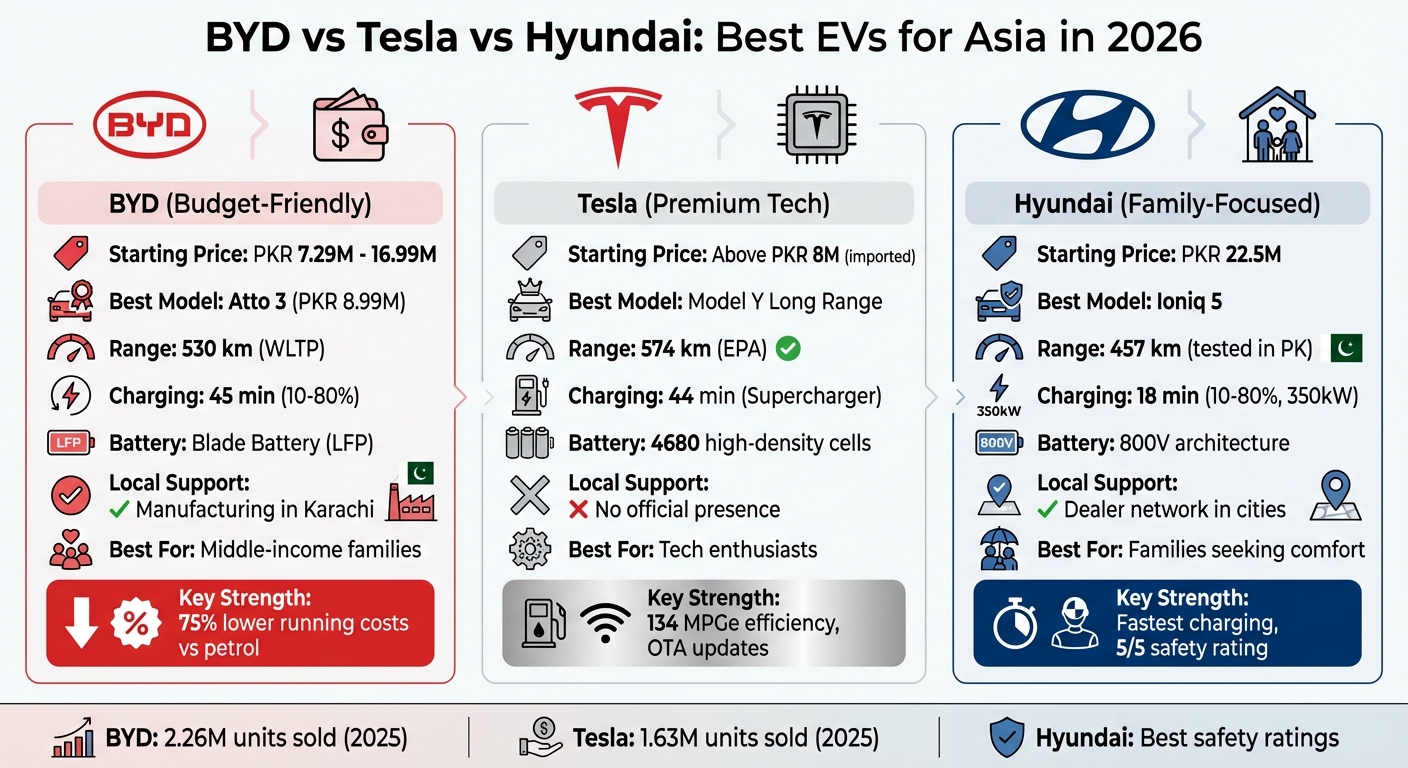
BYD, Tesla, and Hyundai dominate Asia’s 2026 EV market, each targeting distinct needs. BYD excels in affordability and local support, Tesla leads in cutting-edge technology and range, while Hyundai balances family-friendly features with fast charging. Here’s a quick breakdown:
- BYD: Budget-friendly, starting at PKR 7.29 million, with reliable Blade Battery technology and local production plans in Karachi. Ideal for middle-income families.
- Tesla: Premium EVs with advanced software and a range of up to 574 km. High price and limited infrastructure in Pakistan make it a luxury choice.
- Hyundai: Family-focused, with fast charging (10–80% in 18 minutes) and spacious designs. Priced around PKR 22.5 million, it offers practicality and strong safety ratings.
Quick Comparison
| Feature | BYD Atto 3 | Tesla Model Y | Hyundai Ioniq 5 |
|---|---|---|---|
| Starting Price (PKR) | 8,990,000 | Not officially available | 22,500,000 |
| Range (km) | 530 (WLTP) | 574 (EPA) | 457 (Tested in PK) |
| Charging Time (10–80%) | ~45 min (DC) | ~44 min (Supercharger) | ~18 min (350 kW DC) |
| Local Support | Manufacturing in PK | No official presence | Dealer network in cities |
For Pakistani buyers, BYD offers the best value with affordable pricing and local support. Hyundai suits families seeking comfort and fast charging, while Tesla appeals to tech enthusiasts willing to invest in luxury. Each brand caters to specific needs, ensuring a tailored EV experience in 2026.
BYD vs Tesla vs Hyundai EV Comparison 2026: Price, Range, Charging Speed
New Tesla Model Y vs BYD + 4 STRONG Competitors!
sbb-itb-5f05a6f
BYD: Budget-Friendly EVs for Asian Markets
BYD made its entry into Pakistan in 2026 by teaming up with Mega Motor Company, launching four models: the Atto 2 (compact SUV), Atto 3 (C-segment SUV), Seal (luxury sedan), and Sealion 7 (premium SUV). With a focus on competitive pricing, BYD offers some of the most affordable EVs in the market, with the Atto 2 starting at PKR 7.29 million.
Popular Models and Specifications
The Atto 2, BYD’s entry-level model in Pakistan, is priced at PKR 7.29 million with a booking amount of PKR 1.4 million. This compact SUV features a 45.12 kWh Blade Battery, offering a range of 323 km (WLTP) and a power output of 174 hp. Its compact 4.3 m length and 360° camera system make it ideal for navigating crowded city streets.
The 2026 Atto 3 introduces an 800-volt electrical system, boosting DC fast-charging speeds from 88 kW to 150 kW. Its battery capacity has been increased by 24% to 74.88 kWh, providing a range of 530 km (WLTP). With 230 kW of power and 360 Nm of torque, it is priced at PKR 8.99 million.
At the luxury end, the Seal sedan comes in two variants: the Dynamic at PKR 14.79 million and the Premium at PKR 16.99 million. The Premium version boasts an 82.5 kWh battery, delivering a range of 570 km (WLTP) and a 0–100 km/h acceleration time of 5.9 seconds. Meanwhile, the Sealion 7, priced at PKR 15.49 million, is designed for families with an 82.56 kWh battery, a range of 482 km (WLTP), and a power output of 308 hp.
| Model | Battery Capacity | Range (WLTP) | Power/Torque | Price (PKR) |
|---|---|---|---|---|
| Atto 2 | 45.12 kWh | 323 km | 174 hp / 290 Nm | 7.29 million |
| Atto 3 (2026) | 74.88 kWh | 530 km | 230 kW / 360 Nm | 8.99 million |
| Seal (Premium) | 82.5 kWh | 570 km | 230 kW / 360 Nm | 16.99 million |
| Sealion 7 | 82.56 kWh | 482 km | 308 hp / 380 Nm | 15.49 million |
All models feature BYD’s Blade Battery technology, utilising Lithium Iron Phosphate (LFP) chemistry. This battery has been rigorously tested and maintains temperatures below 60°C even under extreme conditions. In Pakistan, where summer temperatures can soar to 50°C, this thermal stability helps extend battery life and ensures reliable performance.
Strengths and Weaknesses
One of BYD’s standout strengths is its vertical integration, allowing it to produce its own batteries and offer competitive pricing. For instance, the Atto 2’s running and maintenance costs are reported to be up to 75% lower than comparable petrol vehicles. Its Blade Battery, featuring LFP chemistry, is designed to last up to 1.2 million km, and BYD backs this with a 10-year warranty for the Atto 2’s low-voltage battery.
Safety is another highlight, with all models earning 5-star NCAP safety ratings. Practical features such as Vehicle-to-Load (V2L) technology in the Atto 2 and Sealion 7 allow users to power household appliances during frequent power outages. However, there are some drawbacks. The bold interior design of the Atto 3 has divided opinions, though updates in the 2026 model have addressed many concerns. Additionally, high-torque front-wheel-drive versions, like the Atto 3’s 313 PS variant, can experience torque steer. Finally, while BYD focuses on affordability, this sometimes means fewer luxury features and less premium cabin materials compared to higher-end competitors .
Performance in Pakistan and Asia
BYD has tailored its approach to meet local challenges, making strategic moves to strengthen its presence. In collaboration with HubcoGreen, the company is working on a 1,300-km charging corridor from Karachi to Peshawar, aimed at supporting intercity EV travel. Plans for local vehicle assembly near Karachi are also in the works, with operations expected to begin by mid-2026. BYD is targeting a 30–35% share of Pakistan’s EV market by the same time. The company’s success in emerging markets is evident, as BYD models accounted for approximately 60% of EV sales in Brazil in 2024 .
The Atto 2’s compact design and competitive pricing make it a strong contender against petrol SUVs like the Kia Sportage, especially for urban commuters. With significantly lower running costs – often just a fraction of what petrol vehicles require – it’s an appealing choice for those looking to cut down on daily expenses. By focusing on smaller, cost-effective batteries in models like the Atto 2, BYD manages to keep initial costs reasonable while still delivering sufficient range for city driving.
Tesla: High-End EVs with Advanced Technology
Tesla has carved out a niche for itself in the premium EV market across Asia, appealing to buyers who prioritise cutting-edge technology and high performance. In Pakistan, Tesla vehicles come with a hefty price tag – above PKR 8 million after import duties – cementing their status as luxury items. These vehicles primarily attract tech-savvy professionals and early adopters who value innovation and exclusivity.
Popular Models and Specifications
The 2026 Tesla Model 3 and Model Y continue to dominate Tesla’s offerings in Asian markets. Globally, the Model 3 starts at USD 36,990 for the Standard RWD variant, while the Performance AWD version is priced at USD 54,990. The Performance model boasts an impressive 0–60 mph acceleration in just 2.9 seconds.
The Model Y, which became the world’s bestselling vehicle in 2023, offers a range of up to 357 miles (approximately 574 km) in its Premium RWD version. It matches the range of competitors like the BYD Seal but stands out with 71 cubic feet of cargo space. The 2026 refresh introduces premium features like wood trim, faux suede, ventilated front seats, and an 8-inch rear passenger display, enhancing its appeal [9,28].
| Model | Range (EPA Est.) | 0–60 MPH Time | Drivetrain | Global Price (USD) |
|---|---|---|---|---|
| Model 3 Standard RWD | 584 km | 5.8 sec | RWD | 36,990 |
| Model 3 Performance | 497 km | 2.9 sec | AWD | 54,990 |
| Model Y Premium RWD | 574 km | 5.1 sec | RWD | 41,630 |
| Model Y Performance | 492 km | 3.3 sec | AWD | 61,630 |
These prices increase significantly when adjusted for import duties and taxes in Pakistan.
Both the Model 3 and Model Y feature a 15-inch central touchscreen that controls nearly all vehicle functions, from adjusting mirrors to managing climate settings. Tesla’s Full Self-Driving (Supervised) system, available as an USD 8,000 upgrade, offers advanced capabilities like navigating traffic circles and executing turn-by-turn directions autonomously. This places it ahead of competitors like BYD and Hyundai, which offer more basic Level 2 ADAS systems [3,9,24].
Strengths and Weaknesses
Tesla’s technology and design come with both advantages and challenges. The brand’s over-the-air (OTA) updates ensure constant software improvements, while its Supercharger network delivers peak charging speeds of 250 kW, adding up to 293 km of range in just 15 minutes [9,25,26,28]. These features highlight Tesla’s focus on convenience and innovation.
Safety is another strong suit, with standard features like Sentry Mode, which provides 360-degree camera surveillance when parked, and an integrated dashcam. The 2026 Model Y Premium RWD also boasts a combined EPA rating of 134 MPGe, outperforming rivals like the Hyundai Ioniq 5, which achieves 98 MPGe [9,24].
However, Tesla’s heavy reliance on touchscreen controls can be a drawback, especially for drivers accustomed to traditional buttons. Tasks like adjusting air vents or mirrors require navigating the screen, which may frustrate some users. The minimalist design, while sleek, isn’t always practical, and the ride quality can feel harsh on Pakistan’s uneven roads. Additionally, reports of issues with motors and power electronics in newer models (0–4 years old) have raised reliability concerns [22,27,9].
Performance in Pakistan and Asia
In Pakistan, Tesla’s appeal lies more in its brand prestige and technological sophistication than in its practicality. The lack of an official Supercharger network forces owners to rely on home charging or limited third-party DC fast chargers, making long-distance travel challenging [22,25]. Maintenance is another hurdle, as servicing is typically handled by independent importers or specialised workshops rather than official Tesla centres.
Despite these challenges, Tesla has a loyal customer base among affluent buyers who value its seamless software experience and the continuous improvements provided by OTA updates. For example, in Australia – a key Asia-Pacific market – the Model Y remained the top-selling EV through late 2025, even as Tesla’s overall sales dropped by 24.4% year-on-year.
For Pakistani buyers, the decision to invest in a Tesla often comes down to whether its advanced features and performance outweigh the premium price and infrastructure limitations.
Hyundai: Mid-Range EVs for Families
Hyundai has carved out a niche for itself by offering electric vehicles (EVs) that strike a balance between affordability and premium features, making them an appealing choice for families. Positioned between BYD’s budget-friendly models and Tesla’s high-end offerings, Hyundai’s Ioniq lineup – featuring the Ioniq 5, Ioniq 6, and the upcoming Ioniq 9 – focuses on practicality, quick charging, and family-oriented design. Here’s a closer look at how Hyundai’s EVs cater to families in Pakistan.
Popular Models and Specifications
The Ioniq 5 is Hyundai’s flagship family EV and starts at around PKR 22,500,000 in Pakistan, making it a competitive option between luxury and budget EVs. It features a spacious cabin with a 3,000 mm wheelbase and a flat floor, ensuring ample legroom for passengers. Its 800-volt charging system allows the battery to go from 10% to 80% in just 18 minutes using a 350 kW DC fast charger. Depending on the variant, the Ioniq 5 offers a driving range of 394–512 km and cargo space that expands from 30 to 59 cubic feet when the rear seats are folded.
The Ioniq 6 sedan, priced at PKR 23,000,000, provides a sleek, aerodynamic alternative for families who prefer a traditional sedan design. It shares many safety features with the Ioniq 5, such as Forward Collision-Avoidance Assist and Highway Driving Assist 2, and has also earned a perfect 5/5 safety rating from Consumer Reports.
For larger families, the Ioniq 9 offers a roomy three-row SUV configuration with seating for seven. It features a 110.3 kWh battery, delivering a range of 500–562 km. The cargo space can expand to an impressive 86.9 cubic feet when the seats are folded. Additional highlights include "Relaxation Seats" with reclining and massage functions, as well as the same rapid-charging 800V technology seen in the Ioniq 5.
| Model | Battery Size | Range (EPA Est.) | Seating | Pakistan Price (PKR) |
|---|---|---|---|---|
| Ioniq 5 | 84.0 kWh | 394–512 km | 5 | 22,500,000 |
| Ioniq 6 | 77.4 kWh | 435–581 km | 5 | 23,000,000 |
| Ioniq 9 | 110.3 kWh | 500–562 km | 7 | Call for Price |
Strengths and Weaknesses
Hyundai’s pricing strategy has become more competitive globally. For instance, the Ioniq 5’s Limited AWD variant saw a price cut of over USD 9,000, bringing it down to USD 50,575. In India, it is priced significantly lower than the BYD Sealion 7, making it one of the most affordable premium EVs in South Asia.
"The Ioniq 5 stands out as the most approachable and well-rounded package. It’s no wonder then that the Ioniq 5 won our Car of the Year 2024 award."
- Soham Thakur, Autocar India
Hyundai’s SmartSense safety suite, which comes standard across the lineup, adds peace of mind for family buyers. Features like a sliding centre console and Vehicle-to-Load (V2L) capability make the vehicles practical for everyday use.
However, Hyundai’s EVs fall short when it comes to performance metrics compared to Tesla. The Ioniq 5’s acceleration and efficiency lag behind the Model Y, and its steering has been criticised for being too light. Additionally, the front trunk is quite small, described by Car and Driver as an "afterthought", which limits storage options. In tests on Indian roads, the Ioniq 5 achieved a range of 457 km, outperforming the BYD Sealion 7 (371 km) but still falling short of Tesla’s efficiency benchmarks.
Performance in Pakistan and Asia
Hyundai has tailored its EV offerings to meet the needs of local markets. Through Hyundai Nishat Motor (Private) Limited, the company has established a robust dealer network across major cities in Pakistan, including Lahore, giving it an edge over Tesla in terms of service accessibility. This network ensures reliable maintenance and repair options for families, eliminating the need to rely on independent workshops.
In urban areas of Pakistan, the Ioniq lineup’s lower running costs and efficient charging systems are practical solutions to rising fuel prices. To enhance security, especially given the vehicles’ premium price tags, integrating GPS tracking systems is advisable. The 800V charging architecture also adds value as Pakistan’s DC fast-charging infrastructure continues to grow.
Safety ratings further bolster Hyundai’s appeal. Consumer Reports awarded both the Ioniq 5 and Ioniq 6 perfect 5/5 scores, while Car and Driver gave the Ioniq 5 a 10/10 rating, ranking it among the top electric compact SUVs. This combination of safety, family-friendly features, and competitive pricing makes Hyundai a practical choice for middle-income families in Asia who want more than just basic functionality in an EV.
BYD vs Tesla vs Hyundai: Direct Comparison
Specifications Table
Here’s a quick look at how the flagship models from BYD, Tesla, and Hyundai stack up against each other:
| Feature | BYD Atto 3 | Tesla Model Y (Long Range RWD) | Hyundai Ioniq 5 |
|---|---|---|---|
| Starting Price (PKR) | 8,990,000 | Not officially available | 15,500,000 (est.) |
| Battery Type | LFP Blade Battery | 4680 cells (High-density) | Lithium-ion (E-GMP) |
| Range | 410 km | 574 km (EPA) | 432 km (EPA) / 631 km (NEDC) |
| Charging (10-80%) | ~45 minutes (DC) | ~44 minutes (Supercharger) | ~18 minutes (350kW) |
| ADAS Level | Level 2 | Level 2 / FSD Optional | Level 2 SmartSense |
| Local Presence | Manufacturing in Karachi | No official sales | Limited dealer network |
BYD has leveraged its vertical integration to keep costs down, allowing it to sell 2.26 million battery electric vehicles in 2025 – outperforming Tesla’s 1.63 million units. Tesla, however, leads in real-world efficiency, with the Model Y achieving 134 MPGe compared to the Hyundai Ioniq 5’s 98 MPGe.
"They’re really looking to take hold of markets where other electric vehicle manufacturers are not yet expanding into – that seems to be their top priority." – George Whitcombe, Analyst, Rho Motion
Hyundai’s advanced 800V architecture sets the Ioniq 5 apart, enabling it to charge from 10-80% in just 18 minutes using a 350kW charger. Meanwhile, BYD is gearing up to introduce a 1,000V charging system in its 2026 lineup, which will reportedly add 480 km of range in just five minutes. Additionally, BYD’s planned manufacturing facility in Karachi is expected to lower costs by reducing import duties and improving after-sales services – a clear advantage for local buyers.
Each brand brings unique strengths to the table, catering to different consumer needs.
Which Brand Fits Your Needs
The comparison above makes it easier to decide which EV suits your lifestyle and priorities.
Pick BYD if affordability and local support are your main concerns. With a starting price of PKR 8,990,000 for the Atto 3, BYD offers a budget-friendly option. The Blade Battery, with its LFP chemistry, is designed to endure Pakistan’s intense summer heat, and local manufacturing ensures better service availability. BYD’s focus on expanding in South Asia makes it an appealing choice for middle-income households.
Go for Tesla if cutting-edge features and maximum range are your priorities. The Model Y’s impressive 574 km EPA range and Tesla’s integrated Supercharger network make it ideal for long trips. While Tesla’s unmatched software integration and futuristic design are standout features, its high price and reliance on screen-based controls might require getting used to.
Opt for Hyundai if you’re looking for a family-friendly vehicle with fast charging. The Ioniq 5 combines a roomy interior, smooth handling on bumpy roads, and a growing dealer network in cities like Lahore. Estimated at PKR 15,500,000, it sits in the mid-range category, offering excellent safety ratings (5/5 from Consumer Reports) and rapid charging to minimise downtime.
Conclusion: Top EV Choice for Asia in 2026
The analysis above highlights the strengths of each brand, helping buyers make informed decisions. BYD emerges as the top value leader for 2026, thanks to its affordability, reliable performance, and local support. Selling 2.26 million battery electric vehicles in 2025, BYD stands out with its competitive pricing and vertical integration. In Pakistan, its lineup – ranging from the PKR 7.29 million Atto 2 to the PKR 16.99 million Seal – provides dependable EV options for middle-income families, featuring the trusted Blade Battery technology for enhanced safety.
Hyundai’s Ioniq 5 shines as the best family-friendly option, offering an excellent mix of features, including a tested range of 457 km and ultra-fast charging that takes the battery from 10% to 80% in just 18 minutes. With a price tag of approximately PKR 22,500,000, it balances premium features with practicality, supported by a growing dealer network in Pakistan’s major cities.
Tesla appeals to tech enthusiasts, delivering cutting-edge software and access to the Supercharger network. However, its higher price and the absence of an official presence in Pakistan make it less accessible for local buyers.
For Pakistani consumers exploring EV ownership in 2026, EV24.asia simplifies the journey. From transparent pricing to handling import documentation, customs clearance, and local registration, the platform ensures a smooth process. Whether you’re drawn to BYD’s cost-effectiveness, Hyundai’s practicality, or Tesla’s advanced technology, EV24.asia offers the expertise to match you with the ideal electric vehicle for your lifestyle and budget.
FAQs
Why is BYD a smart choice for middle-income families in Pakistan?
BYD has emerged as a sensible choice for middle-income families in Pakistan, thanks to its budget-friendly pricing and increasing presence in the market. In just six months, the brand has managed to sell over 2,000 vehicles, showcasing its growing reputation for reliability and trustworthiness.
From 2026, BYD plans to start assembling vehicles locally, which could drive prices down further, making their electric vehicles even more affordable. With its emphasis on advanced technology, cost efficiency, and meeting local needs, BYD provides an attractive option for families looking for reliable, reasonably priced EVs in Pakistan.
How does the Hyundai Ioniq 5 compare to Tesla for family use in Asia?
The Hyundai Ioniq 5 is a fantastic option for families, thanks to its spacious interior, adaptable seating arrangements, and generous boot space. Whether it’s for daily errands or longer family trips, it’s designed to prioritise comfort and practicality, ensuring a smooth ride for everyone – especially larger families.
On the other hand, Tesla models, such as the Model Y, focus heavily on performance and cutting-edge technology, which tends to attract tech-savvy buyers. However, Tesla’s minimalist interiors might not provide the flexibility that families often look for. The Ioniq 5, with its family-friendly design and practical features, becomes a more suitable choice for households in diverse Asian markets, including Pakistan.
What challenges do Tesla EV owners face in Pakistan?
Tesla owners in Pakistan face some tough hurdles, with the lack of charging infrastructure being a major one. Charging stations are scarce, which can cause serious range anxiety, particularly for those planning long trips. Unlike other regions where Tesla’s Supercharger network is well-established, Pakistan doesn’t yet have access to this convenient setup, making charging even trickier.
Another challenge is the availability of spare parts and servicing. Tesla’s service network is still growing worldwide, and for owners in Pakistan, this can mean delays and higher costs when it comes to repairs or maintenance. On top of that, importing Tesla-compatible charging gear or spare parts can be both a logistical headache and an expensive affair. These factors combine to make owning a Tesla in Pakistan less straightforward compared to countries with more developed EV support systems.