
 Arka Pratama
Chinese electric cars are dominating the EV market in Asia with advanced features and competitive pricing. In Pakistan, models like the BYD Dolphin (PKR 9.2–9.5 million) and XPeng G6 (PKR 9.7 million) offer cutting-edge battery technology and ultra-fast charging. The NIO ET7 and XPeng P7 cater to luxury and tech enthusiasts, while the MG4 Electric provides affordability and practicality. For those seeking premium SUVs, the Li Auto L9 combines extended range with a luxurious interior.
Here’s a quick breakdown:
- BYD Dolphin: Compact, 520 km range, Blade Battery, priced PKR 9.2–9.5 million.
- NIO ET7: Premium sedan, 1,050 km range, battery swap tech, priced PKR 19.5–23 million.
- XPeng P7: Tech-forward sedan, 820 km range, fast charging, priced PKR 8.3–14.7 million.
- MG4 Electric: Affordable hatchback, 435 km range, priced PKR 8.5–9.7 million.
- Li Auto L9: Luxury SUV, 1,412 km range (hybrid), priced around PKR 16.5–17.5 million.
Chinese EVs are shaping Pakistan’s automotive landscape with a mix of affordability, innovation, and luxury options.
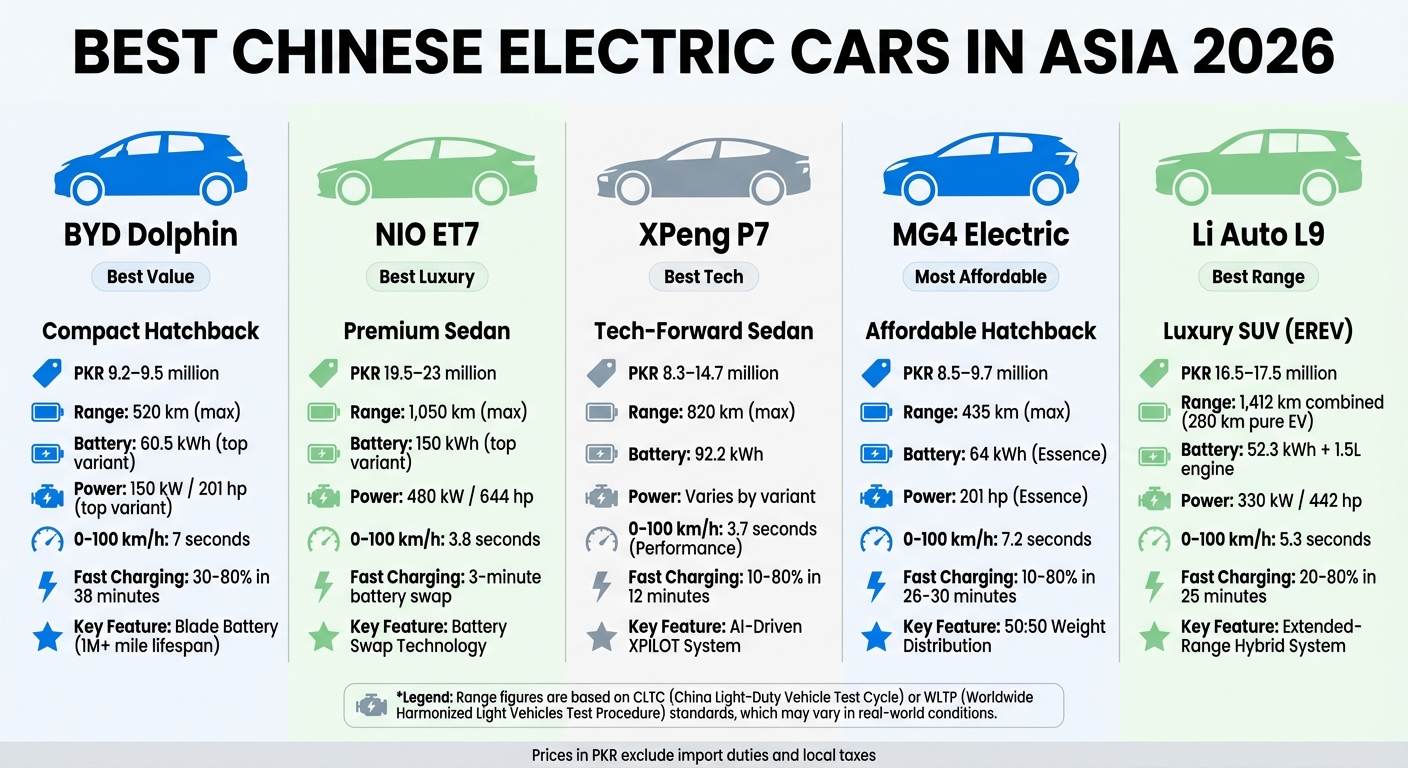
Comparison of Top 5 Chinese Electric Cars in Asia 2026: Price, Range, and Features
The TOP 5 Chinese EVs in 2025 that CHANGED the game…
1. BYD Dolphin
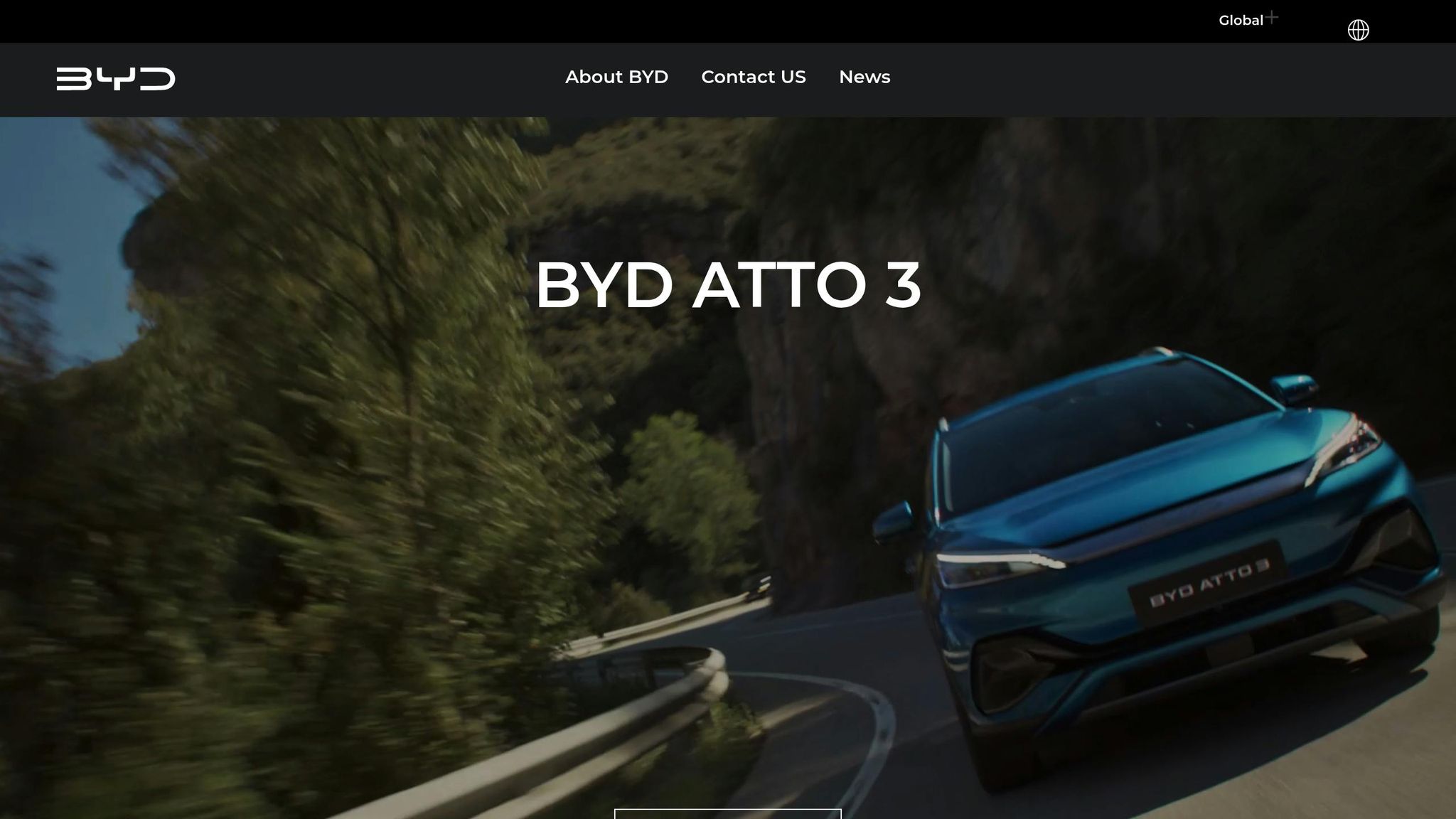
The BYD Dolphin is a compact, tech-savvy electric vehicle (EV) tailored for city driving. Built on BYD’s e-Platform 3.0, this hatchback measures 4,290 mm in length with a 2,700 mm wheelbase, making it a perfect fit for Pakistan’s crowded streets and tight parking spaces.
Performance and Range
The 2026 facelift brings three motor options, catering to different driving preferences. The base model features a 70 kW (95 hp) motor paired with a 44.9 kWh battery, offering a CLTC range of 420 km. A mid-tier version, with a 130 kW (174 hp) motor, provides a range of 410 km. The top-end variant packs a 150 kW (201 hp) motor and a 60.5 kWh battery, delivering an impressive 520 km range and accelerating from 0–100 km/h in just 7 seconds. Energy consumption across these models varies between 10.9 and 13.9 kWh per 100 km. Additionally, the larger battery supports DC fast charging at speeds of up to 110 kW, allowing a 30% to 80% charge in just 38 minutes.
Features and Technology
The Dolphin isn’t just about performance; it’s loaded with features to enhance everyday usability. A standout is its 12.8-inch rotating touchscreen that switches effortlessly between landscape mode for navigation and portrait mode for apps. The digital instrument cluster has been upgraded from 5.0 inches to 8.8 inches, offering improved visibility. New for 2026, the Dolphin includes ‘God’s Eye’ driver assistance and a high-efficiency heat pump for better performance in colder weather. Other highlights include a PM2.5 air filtration system to combat urban pollution, Vehicle-to-Load (V2L) functionality for powering external devices, and BYD’s Blade Battery technology, known for its safety and a lifespan exceeding 1 million miles.
Affordability (Price in PKR)
In Pakistan, the Dolphin is priced between PKR 9,200,000 and PKR 9,500,000. The Long Range model is positioned at the lower end of this range, while the Design variant sits at the higher end. BYD is also planning to establish a local manufacturing facility in Karachi by late 2026, which is expected to make the Dolphin even more competitively priced.
Market Availability in Asia
After its launch in China, the 2026 facelift will expand to right-hand drive markets, including Pakistan, Malaysia, and Australia, within 12–24 months. For instance, in Malaysia, the Dolphin is priced between RM 100,530 and RM 125,530. Pakistan’s launch is expected by mid-to-late 2025, with future models benefiting from a growing network of fast-charging stations.
2. NIO ET7
The NIO ET7 is a high-end electric sedan designed to compete with models like the Tesla Model S and Mercedes EQS. Built on NIO’s NT2.0 platform, this full-size EV combines forward-thinking technology with outstanding performance. Featuring a sleek ‘watchtower’ LiDAR design and an ultra-low drag coefficient of 0.208 Cd, the ET7 stands out as a premium option for electric vehicle enthusiasts across Asia.
Performance and Range
Equipped with a dual-motor all-wheel-drive system, the ET7 delivers a remarkable 480 kW (644 HP) and 850 N·m of torque, allowing it to accelerate from 0 to 100 km/h in just 3.8 seconds. It boasts a top speed of 200 km/h, making it not only powerful but also thrilling to drive.
The sedan offers three battery options: 75 kWh, 100 kWh, and a 150 kWh ultra-long-range pack. With the largest battery, the ET7 can achieve over 1,000 km in real-world conditions, offering a CLTC range of 1,050 km and an energy density of 360 Wh/kg [27,33].
One of the standout features is NIO’s Power Swap technology. This allows drivers to replace a drained battery with a fully charged one in about 3 minutes at automated swap stations, effectively eliminating the need for lengthy charging sessions.
"NIO is currently the only manufacturer to rely on battery replacement and therefore ‘charges’ as fast as combustion engines refuel".
Features and Technology
The NIO ET7 is packed with advanced technology that underlines its premium appeal. Its Aquila super-sensing system includes 33 high-performance components, such as an ultra-long-range LiDAR with a 500-metre reach, seven 8-megapixel cameras, and multiple radars. All this data is processed by the Adam platform, which is powered by four Nvidia Orin X chips delivering a combined 1,016 TOPS. This system processes around 8 gigabytes of data every second, ensuring a seamless driving experience [27,33].
Inside, the ET7 offers a luxurious and tech-forward cabin. The PanoCinema 2.0 digital cockpit includes a 12.8-inch AMOLED central screen, a 16.3-inch enhanced heads-up display, and a 23-speaker Dolby Atmos system with 1,000-watt output. Adding to the convenience is the NOMI GPT voice assistant, which can handle multiple commands without requiring repeated wake-up prompts.
The car’s AI-driven chassis system uses sensors to ‘read’ the road ahead, adjusting active damping and air suspension up to 500 times per second for a smooth and comfortable ride. Rear passengers are also pampered with adjustable seats, zoned heating, and massage functions. Safety-wise, the ET7 earned a five-star Euro NCAP rating in 2022, scoring 91% for adult occupant protection and 95% for safety assist features. The combination of cutting-edge technology and luxurious features firmly establishes the ET7 as a leader in the premium EV market.
Affordability (Price in PKR)
In Pakistan, the NIO ET7 is estimated to cost between PKR 19,500,000 and PKR 23,000,000, excluding import duties and local taxes. In China, its MSRP ranges from ¥428,000 to ¥458,000. For added flexibility, NIO offers a Battery as a Service (BaaS) subscription in some markets. This option lowers the upfront cost by approximately US$11,000 (around PKR 3,100,000) while requiring a monthly battery rental fee of about US$150 (approximately PKR 42,000).
Market Availability in Asia
By 2026, NIO has expanded its reach to several Asian markets, including China, the UAE, Singapore, and Uzbekistan. The company is also exploring opportunities in other South Asian markets, though specific launch dates for Pakistan have yet to be announced [27,34]. With its exceptional range and advanced features, the ET7 has cemented its position as a strong contender in the premium electric sedan category across Asia.
3. XPeng P7
The XPeng P7 stands out in the premium electric sedan market by offering a blend of advanced tech features and competitive pricing. Competing directly with the Tesla Model 3 and BYD Seal, this Chinese electric vehicle has undergone significant updates. The latest second-generation model, along with its upgraded sibling, the P7+, showcases notable advancements in performance and autonomous driving technology, making it a strong contender in its segment.
Performance and Range
The second-generation XPeng P7 delivers impressive performance across its variants. The top-tier Performance model accelerates from 0 to 100 km/h in just 3.7 seconds, while the rear-wheel-drive Ultra Long Range version takes 5.9 seconds. All models share a top speed of 230 km/h, ensuring a balance of power and practicality for highway driving.
When it comes to range, the XPeng P7 offers options to suit different needs. Equipped with a 92.2 kWh NMC battery, the second-generation model provides up to 820 km on the CLTC cycle. The P7+, fitted with a 76.3 kWh LFP battery, delivers a range of 725 km. The 2026 Range Extended Electric Vehicle (REEV) variant takes it to another level, offering a combined range of 1,550 km, including 430 km of pure electric driving.
Thanks to its 800V silicon carbide platform and 5C charging capability, the P7 can add 525 km of range in just 10 minutes. It also charges from 10% to 80% in only 12 minutes, addressing concerns about range and charging time.
Features and Technology
The XPeng P7 goes beyond performance with its cutting-edge technology. The P7+ is billed as the world’s first "AI-defined" vehicle, featuring the Turing AI Driving System and the "AI Hawkeye" visual solution. Unlike earlier models that relied on LiDAR, the new system uses a combination of 11 cameras, 3 millimetre-wave radars, and 12 ultrasonic sensors, all powered by dual Nvidia Orin X chips. The 2026 top-tier variants take it further with three Turing AI chips, delivering a combined 2,250 TOPS of computing power for advanced autopilot capabilities on both urban roads and highways.
"The P7+ marks a complete reset. Gone are the expensive Lidar units, and yet from launch Xpeng claimed the P7+ was capable of the same level of driving assistance." – Mark Andrews, Automotive Writer, WIRED
Inside, the cabin is packed with tech and luxury. A 29-inch augmented reality head-up display and a 15.6-inch central touchscreen with 3-axis movement provide a futuristic experience. The XOS 5.4/5.5 operating system, powered by a Qualcomm Snapdragon 8295P chipset, delivers 50% better performance compared to earlier versions. Features like the "Xiao P" AI assistant, a 20-speaker high-fidelity audio system, zero-gravity passenger seats, and active noise cancellation make the ride both smart and comfortable.
Safety is another highlight. The P7 earned a five-star Euro NCAP rating in 2023, with an 87% score for adult occupant protection. Its body structure, made from ultra-high-strength steel-aluminium, incorporates 14 active safety features. The car’s ultra-low drag coefficient of 0.206 Cd enhances energy efficiency, with an average consumption of just 11.6 kWh/100 km.
Affordability (Price in PKR)
In Pakistan, the XPeng P7 is expected to be priced between PKR 8,300,000 and PKR 14,700,000, excluding import duties and local taxes. In its home market of China, the P7+ starts at ¥186,800 (around PKR 7,300,000) and goes up to ¥218,800 (approximately PKR 8,500,000) for premium versions. Export models range from $44,590 (roughly PKR 12,400,000) to $67,490 (approximately PKR 18,800,000), depending on the trim.
This pricing strategy positions the P7 as a more accessible alternative to high-end German electric vehicles, offering similar luxury features at a fraction of the cost. The strong market response is evident from the 31,000 firm orders received within 24 hours of the P7+ launch in November 2024.
Market Availability in Asia
By 2026, XPeng had expanded the P7’s availability to 36 countries worldwide, including key Asian markets like China, Malaysia, Thailand, Singapore, and Cambodia. While the company is actively considering entry into other South Asian markets, specific launch dates for Pakistan are yet to be announced. The 2026 P7+ global version, designed for right-hand drive markets, is well-suited for broader regional expansion across Asia.
sbb-itb-5f05a6f
4. MG4 Electric
The MG4 Electric is one of the standout Chinese EVs making its mark in Asia, including Pakistan’s growing EV market. With a focus on performance, cutting-edge features, and competitive pricing, this electric hatchback is built on SAIC’s Modular Scalable Platform (MSP). Its 50:50 weight distribution and rear-wheel drive setup not only improve handling and stability but also optimise cabin space and maintain a low centre of gravity – perfect for urban and highway driving alike. Let’s dive into its performance, technology, and pricing details.
Performance and Range
In Pakistan, the MG4 Electric is offered in two variants:
- Excite: Equipped with a 51 kWh battery, it delivers 168 hp, goes from 0 to 100 km/h in 7.7 seconds, and offers a WLTP range of 350 km.
- Essence: This version features a larger 64 kWh battery, 201 hp, a 0–100 km/h time of 7.2 seconds, and a WLTP range of 435 km.
Both variants support DC fast charging up to 150 kW, allowing the battery to charge from 10% to 80% in just 26–30 minutes. While higher-performance versions like the XPower, capable of producing 435 PS (320 kW) and a 0–100 km/h time of 3.8 seconds, are available globally, this variant has yet to reach the Pakistani market.
Features and Technology
Inside the MG4 Electric, you’ll find a 10.25-inch touchscreen paired with a 7-inch digital instrument cluster. Its MG iSMART system brings a host of conveniences, including:
- Remote climate control via smartphone
- Bluetooth key access
- Real-time navigation with charging station information
- Voice command functionality
The 2026 models take things up a notch with advanced chips like the Snapdragon 8155 for smoother infotainment and the Horizon Journey J6e for intelligent navigation and parking. The MG4 also includes Vehicle-to-Load (V2L) technology, which allows the car to power external devices – a handy feature during Pakistan’s frequent power outages. Additionally, the one-pedal driving mode enhances efficiency by letting drivers control both acceleration and deceleration with a single pedal.
Pricing in Pakistan
The MG4 Electric is priced competitively in Pakistan:
- Excite: PKR 8,490,000
- Essence: PKR 9,690,000
Financing options start at approximately PKR 71,694 per month, making it a strong contender against rivals like the Seres 3 (around PKR 8,390,000 but with lower power) and the Ora 03 (about PKR 9,000,000 with a shorter range).
Market Availability in Asia
The MG4 Electric is part of MG Motor‘s broader push across Asia, including Pakistan, Malaysia, China, and other Southeast Asian markets. In Pakistan, the car can be ordered through authorised MG dealerships, with an estimated delivery time of three months. Buyers can choose from seven exterior colours, including standout options like Volcano Orange Metallic, Black Pearl Metallic, and Brixton Blue Metallic.
MG Motor’s regional growth is evident, with the company registering 78,505 new vehicles in Europe during the first quarter of 2025 – a 33.5% year-over-year increase. The MG4 Electric has played a significant role in this success, further solidifying its reputation as a game-changer in the EV market.
5. Li Auto L9
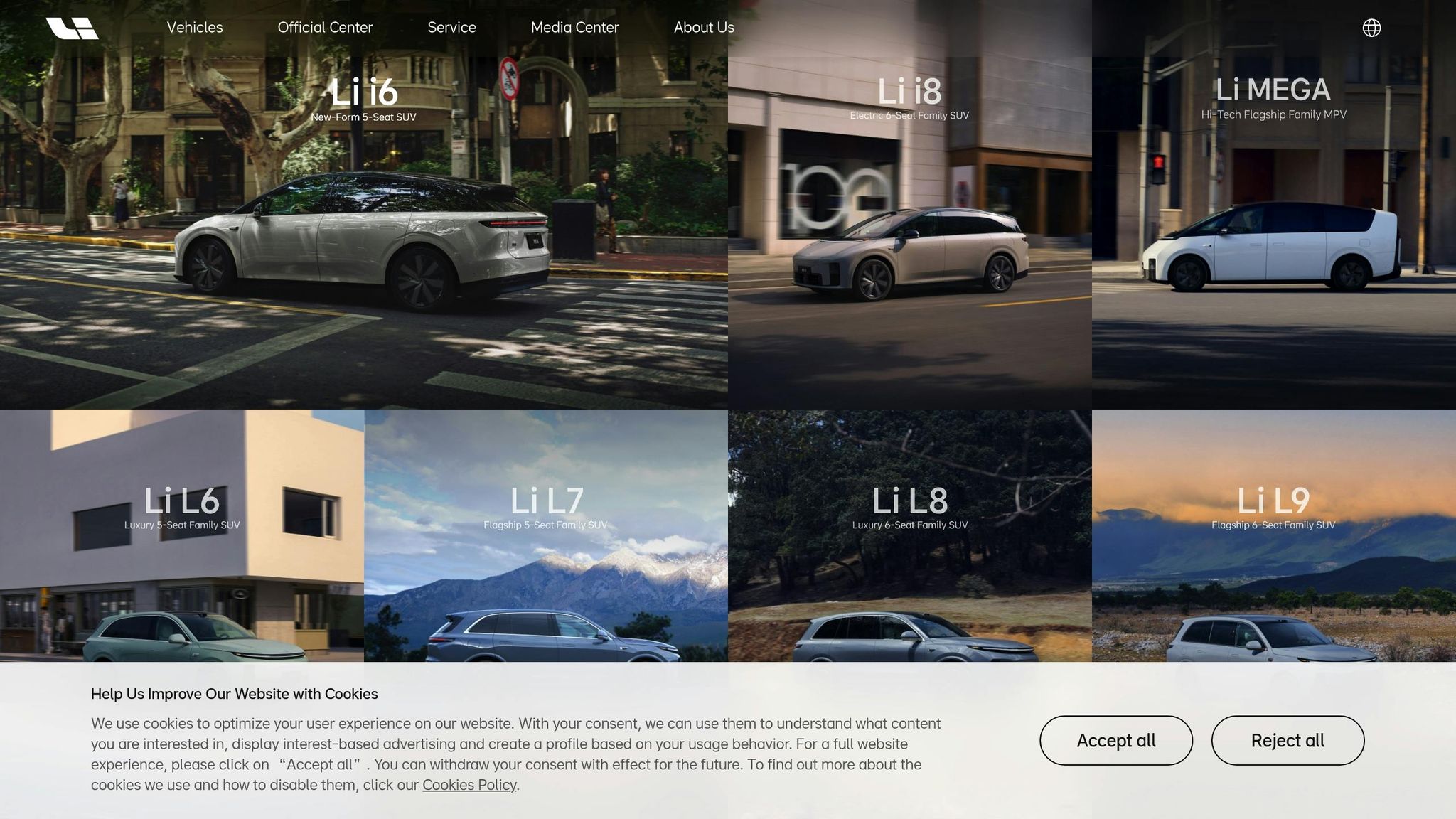
The Li Auto L9 is a full-size luxury SUV that combines an Extended-Range Electric Vehicle (EREV) system with premium features. Its setup includes a 1.5L turbocharged engine acting as a generator and a 52.3 kWh battery. This hybrid system addresses range concerns, particularly in regions where charging infrastructure is still evolving. The SUV also boasts a dual-motor all-wheel-drive system producing 330 kW (442 hp) and 620 Nm of torque, allowing it to accelerate from 0 to 100 km/h in just 5.3 seconds, despite its hefty weight of approximately 2,570 kg [59, 61, 64].
Performance and Range
The L9 offers an impressive combined CLTC range of 1,412 km (1,176 km WLTP) and a pure-electric range of 280 km (235 km WLTP) [59, 64]. It includes a 65-litre fuel tank and supports DC fast charging, which can replenish the battery from 20% to 80% in just 25 minutes. Its top speed is electronically capped at 180 km/h [59, 64].
Features and Technology
Step inside, and the L9 impresses with a five-screen cockpit powered by dual Snapdragon 8155 chips, featuring three 15.7-inch 3K OLED displays [61, 64]. The interior is designed for luxury, with a 2-2-2 six-seat configuration, Nappa leather upholstery, 16-point massage seats, and a 21-speaker Dolby Atmos audio system delivering 2,160W. It even includes a built-in refrigerator and warmer [62, 64].
The ride quality is enhanced by the "Magic Carpet" air suspension system, which adjusts in milliseconds using continuous damping control. Top Gear’s Ollie Marriage likened its smoothness to "one of the best riding SUVs this side of a Rolls-Royce Cullinan". For advanced driver assistance, the Li Pilot AD Max system is equipped with dual NVIDIA Orin-X chips offering 508 TOPS of computing power, complemented by a 128-line LiDAR and 11 cameras [61, 64].
Affordability (Price in PKR)
In China, the Li Auto L9 is priced between 409,800 and 429,800 yuan (approximately USD 58,850–61,720). Using January 2026 exchange rates, this translates to roughly PKR 16,500,000 to PKR 17,500,000 for the base models. However, if introduced in Pakistan, import duties and taxes would likely increase the price further. This positions the L9 as a competitor to luxury SUVs like the Porsche Cayenne and BMW XM.
Market Availability in Asia
The Li Auto L9 continues to build on the success of its predecessors, showcasing the growing influence of Chinese EVs in Asia. Li Auto entered Southeast Asia through the Philippines in May 2025 and is now expanding into Kazakhstan, Azerbaijan, and Egypt [60, 62]. While the L9 has yet to reach Pakistan, the brand’s regional growth suggests it could enter the market in the future. Additionally, a 2026 facelift is expected to feature a larger 73 kWh 5C-rate battery, which would improve both the pure electric range and charging speeds.
Advantages and Disadvantages
Here’s a quick look at the main strengths and compromises of each model:
The BYD Dolphin stands out for its accessibility, featuring the reliable Blade Battery that lasts over 1 million miles and standard perks like adaptive cruise control. On the downside, its DC charging tops out at 88 kW, and while its performance is decent, it doesn’t offer thrilling acceleration.
The NIO ET7 is all about luxury and performance. It boasts a 5-minute battery swap system, premium materials like Nappa leather, and renewable rattan. However, it comes with a hefty price tag – starting at around PKR 23,000,000 (roughly £65,000) – and its battery swap stations are mostly limited to major cities.
The XPeng P7 focuses on efficiency and tech, offering advanced XPILOT autonomous driving features. Its fastback design improves aerodynamics but compromises rear headroom, and the minimalist interior relies heavily on touchscreen controls, which may not appeal to everyone.
The MG4 Electric is a practical choice, delivering excellent value with its European-style chassis tuning and 50:50 weight distribution for better handling. It’s well-suited for urban Pakistani roads, thanks to its nimble handling and affordable pricing. However, entry-level trims have basic interiors, and the infotainment system isn’t as refined as those found in higher-end competitors.
The Li Auto L9 addresses range concerns with its Extended-Range system, combining electric motors with a petrol generator. This makes it a good option for areas where charging infrastructure is sparse. It also offers a luxurious six-seat cabin. That said, it’s not a fully zero-emission vehicle, and its large size can make navigating tight urban spaces tricky.
Conclusion
Selecting the right Chinese electric vehicle comes down to your priorities and budget. For those keeping an eye on affordability, the MG4 EV offers incredible value. Carwow even named it "Car of the Year 2023", giving it an 8/10 rating and highlighting that "the MG4 might be the best value for money, as it’s very affordable and great fun to drive". With its CTB (Cell-to-Body) design, the MG4 boasts a body stiffness of 31,000 N·m/deg – about 50% higher than the class average. Another strong contender for families is the BYD Dolphin, which combines spacious interiors with features like a 12.8-inch rotating touchscreen and Blade Battery technology, all at a reasonable price.
For buyers drawn to cutting-edge technology, models with advanced autonomous features stand out. The XPeng P7, for instance, is a great pick for tech enthusiasts. Its XPILOT autonomous driving system and 800V architecture enable ultra-fast charging, making it an excellent choice for reducing range anxiety.
If luxury and performance are at the top of your list, the NIO ET7 delivers a premium experience. It features a 5-minute battery swap system, an executive-level interior with Nappa leather, and renewable rattan accents. Similarly, the Li Auto L9 combines high-performance capabilities with an Extended-Range system, offering a blend of luxury and practicality for those who value comfort and versatility.
With Pakistan’s EV market growing rapidly and Asia’s automotive landscape evolving, these Chinese brands offer a mix of world-class technology and accessible pricing. Whether you’re looking for affordability, advanced tech features, or premium comfort, the 2026 lineup has something to meet the diverse needs of buyers across the region.
FAQs
What makes the NIO ET7 a top choice among luxury electric sedans in Asia?
The NIO ET7 is a luxury electric sedan that combines impressive range, advanced technology, and high-end features. Its standout 150 kWh semi-solid-state battery delivers a range of over 1,000 km on a single charge. For those looking for other options, the 100 kWh and 75 kWh batteries provide ranges of up to 580 km and 445 km, respectively. With a sleek design and a low drag coefficient of 0.20, the ET7 offers a smooth ride, reaching speeds of up to 200 km/h and going from 0 to 100 km/h in just 3 seconds.
Equipped with a dual-motor all-wheel-drive system, the ET7 generates an impressive 653 hp and 850 Nm of torque, ensuring powerful yet controlled performance. NIO’s battery-swap technology adds convenience, enabling battery replacements in less than 5 minutes. The car also features an advanced autonomous driving system, enhancing both safety and ease of use.
Inside, the ET7 exudes luxury with its premium materials, dual rear screens, and state-of-the-art digital services. This combination of performance, technology, and comfort makes the ET7 an attractive option for those seeking a refined and capable electric vehicle.
How does the XPeng P7’s autonomous driving system compare to other electric vehicles?
The XPeng P7 is equipped with a vision-based autonomous driving system that runs on a Qualcomm 8295P chip paired with dual Nvidia Orin X processors. This powerful combination ensures a seamless driving experience, with noticeable advancements in lane-changing precision and overall driver assistance compared to XPeng’s earlier models.
Instead of relying on expensive LiDAR technology like some competitors, the P7 employs a mix of 12 cameras, 12 ultrasonic sensors, and 3 mmWave radars to achieve its Level-2-plus autonomous driving capabilities. This setup mirrors Tesla’s camera-based Autopilot system but is often praised for delivering a more polished experience. When compared to other Chinese electric vehicles like Nio’s ET7, which incorporates LiDAR, or BYD’s Dolphin, which focuses on more basic driver assistance, the P7 sets itself apart with its higher sensor count, over-the-air updates, and AI-driven improvements.
In essence, the XPeng P7 combines advanced technology with cost-efficient design, offering an autonomous driving experience that competes with high-end EVs without breaking the bank.
Will assembling the BYD Dolphin in Pakistan lower its price?
Currently, there’s no official word on whether assembling the BYD Dolphin locally in Pakistan will result in a price drop. While local production can sometimes cut costs by reducing import duties and shipping expenses, no specific pricing details for the BYD Dolphin in Pakistan have been shared yet.
As Pakistan’s electric vehicle market continues to grow, any potential price changes or benefits from local production will likely hinge on factors like government policies, tax incentives, and the scale of production.