
 Arka Pratama
It seems there was an error in your request’s headline and content alignment. The article you shared discusses Tesla and BYD in Pakistan, not India. Here’s a concise summary based on the content:
If you’re deciding between Tesla and BYD in Pakistan, the choice largely depends on your priorities:
- BYD: Offers lower prices, local assembly plans in Karachi (2026), and a strong service network in 40 cities. Ideal for budget-conscious buyers seeking reliable support and affordability. BYD’s Blade Battery also performs better in Pakistan’s hot climate.
- Tesla: Known for cutting-edge tech like Autopilot and longer driving ranges. However, it’s more expensive due to import-only availability, with limited service options and no official Supercharger network.
Quick Comparison
| Feature | Tesla | BYD |
|---|---|---|
| Price (PKR) | Higher (e.g., Model 3: 1.04 crore) | Lower (e.g., Atto 3: 89 lakh) |
| Local Assembly | No | Yes (Karachi, 2026) |
| Service Network | Limited | 40 cities |
| Driving Range | Up to 622 km (Model Y) | Up to 650 km (Seal Premium) |
| Battery Tech | High energy density (NMC811) | Long lifespan, safer (LFP) |
| Charging Infrastructure | No official Superchargers | Dedicated network planned |
BYD is better suited for most Pakistani buyers due to affordability and local support. Tesla appeals to those prioritising premium performance and advanced features, despite higher costs and limited infrastructure.
Tesla vs BYD Electric Cars Comparison for Pakistan: Price, Range, Features & Charging
Price Comparison and Affordability
Entry-Level Models
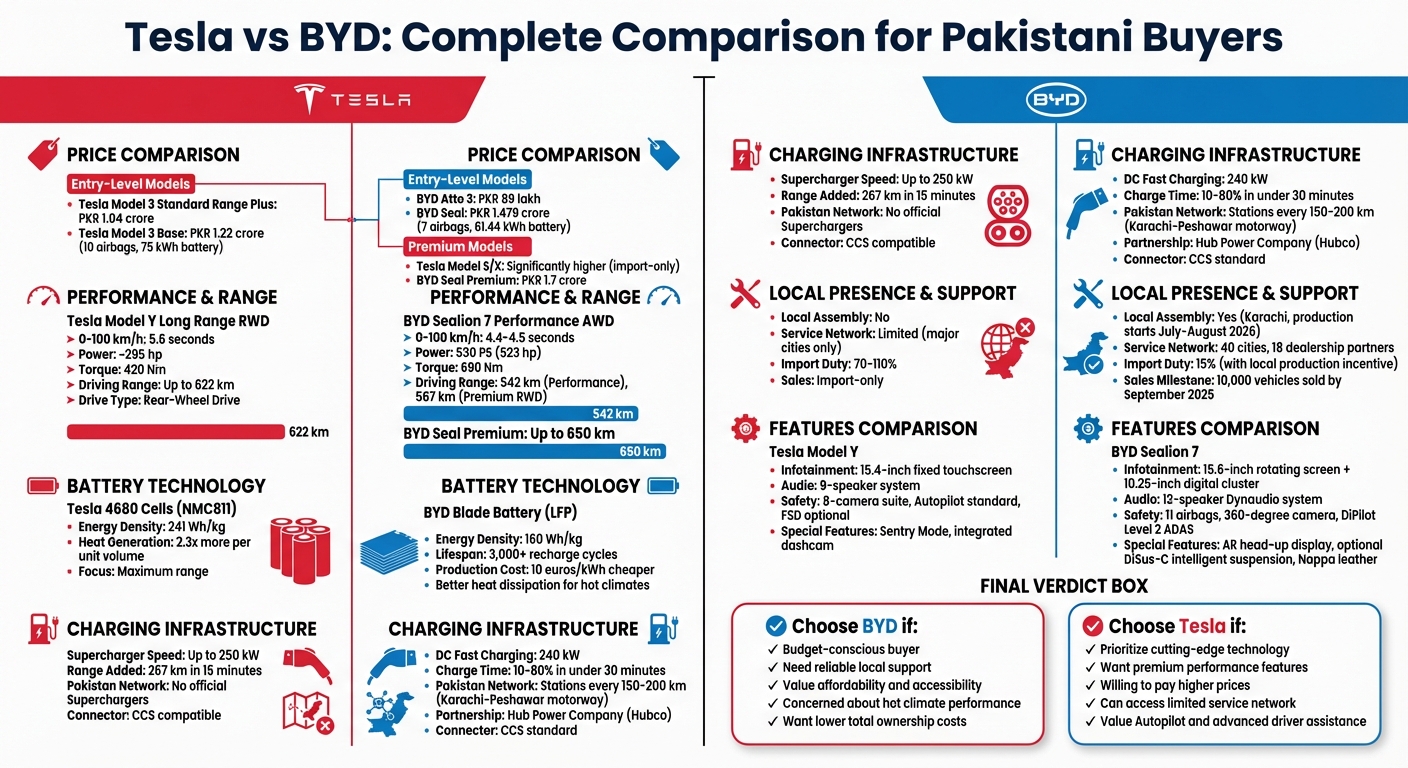
Pakistan’s electric vehicle (EV) market is steadily growing, and the entry-level options showcase some clear contrasts. For instance, the Tesla Model 3 Standard Range Plus is priced at around PKR 1.04 crore, while the BYD Atto 3 – one of the more economical battery-powered SUVs – comes in at approximately PKR 89 lakh.
For sedan enthusiasts, the Tesla Model 3 base variant is available for about PKR 1.22 crore, making it roughly PKR 25.9 lakh cheaper than the BYD Seal, which starts at PKR 1.479 crore. The Tesla Model 3 also offers additional features like 10 airbags and a 75 kWh battery, compared to the Seal’s 7 airbags and 61.44 kWh battery.
Now let’s shift gears to see how the premium models stack up in terms of price and features.
Premium Models
In the premium category, BYD positions itself as a luxury contender. The BYD Seal Premium is priced at about PKR 1.7 crore. This model caters to buyers looking for sophisticated features and upscale interiors, including high-quality materials like Nappa leather.
On the other hand, Tesla’s premium offerings, such as the Model S and Model X, command significantly higher prices due to their import-only status, which adds a hefty premium.
Total Ownership Costs
When considering the overall cost of ownership, the differences between the two brands become more apparent. BYD benefits from in-house Blade Battery production, which helps keep maintenance costs relatively low. In contrast, Tesla’s status as a luxury brand often means higher maintenance expenses, on par with other high-end vehicles. However, both brands offer substantial savings on fuel and maintenance compared to traditional petrol-powered cars.
BYD’s plans to establish local assembly operations in Karachi could further reduce costs by improving access to parts and services. On the insurance front, companies are adapting to EV-specific needs. For instance, Policybazaar has introduced tailored insurance products aimed at Tesla owners.
Charging infrastructure also plays a crucial role in ownership costs and convenience. BYD supports a variety of public charging standards, giving it a practical edge. Tesla, while boasting a globally renowned Supercharger network capable of adding 267 km of range in just 15 minutes, faces challenges in South Asia due to its limited local presence.
Performance and Features Comparison
Acceleration and Power Output
The BYD Sealion 7 Performance variant outpaces the Tesla Model Y Long Range, accelerating from 0–100 km/h in just 4.4–4.5 seconds compared to Tesla’s 5.6 seconds. The Sealion 7’s all-wheel drive system delivers an impressive 530 PS and 690 Nm of torque, while the Model Y’s rear-wheel drive provides about 295 hp and 420 Nm. Both vehicles share a top speed of approximately 201 km/h. Dimensionally, the Sealion 7 is slightly larger, measuring 4,830 mm in length with a 2,930 mm wheelbase, offering potentially more rear-seat space than the Model Y, which measures 4,751 mm in length and has a 2,891 mm wheelbase.
Driving Experience and Comfort
Tesla Model Y opts for a minimalist cabin design, centred around a 15.4-inch touchscreen. In contrast, the Sealion 7 leans towards a more traditional luxury approach, featuring premium Nappa leather upholstery, a 15.6-inch rotating touchscreen, and a 10.25-inch digital instrument cluster. The Sealion 7 also ups the ante with a 12-speaker Dynaudio sound system and an optional DiSus-C intelligent suspension system, while the Model Y includes a 9-speaker audio setup. Tesla is actively testing its Autopilot system in cities like Mumbai and Delhi to adapt the technology for local road conditions.
Safety Features and Technology
Safety is a key focus for both models. The Sealion 7 is equipped with 11 airbags and a 360-degree camera system, while Tesla relies on an 8-camera suite to power its active safety features and standard Autopilot capabilities. Tesla also offers Full Self-Driving (FSD) as an optional premium feature.
| Feature | Tesla Model Y (Long Range RWD) | BYD Sealion 7 (Performance AWD) |
|---|---|---|
| 0–100 km/h | 5.6 seconds | 4.4–4.5 seconds |
| Power | ~295 hp | 530 PS (523 hp) |
| Torque | 420 Nm | 690 Nm |
| Drive Type | Rear-Wheel Drive | All-Wheel Drive |
| Infotainment | 15.4-inch fixed screen | 15.6-inch rotating screen + 10.25-inch cluster |
| Speakers | 9-speaker system | 12-speaker Dynaudio |
Tesla’s Sentry Mode and integrated dashcam provide added safety and convenience by recording events while the car is parked or in motion. BYD, on the other hand, includes augmented reality support for its head-up display and the DiPilot Level 2 ADAS suite, which offers adaptive cruise control and lane-keep assist.
Next, we’ll dive into battery performance and charging compatibility to further explore these two vehicles.
Battery Range and Charging
Battery Capacity and Driving Range
The Tesla Model Y Long Range boasts an impressive driving range of up to 622 km (based on WLTP standards). For those seeking a smaller option, the RWD variant offers approximately 500 km of range. On the other hand, BYD’s Sealion 7 stands out with its 82.56 kWh Blade Battery available in both Premium RWD and Performance AWD versions. The Premium RWD delivers 567 km, while the Performance AWD offers 542 km. For Pakistani buyers planning long motorway trips between cities, Tesla’s extended range provides a clear advantage. However, BYD also offers an extended range option with the BYD Seal Premium variant, which can cover up to 650 km. These figures set the stage for a deeper look into how charging infrastructure supports such capabilities.
Charging Infrastructure Compatibility
In Pakistan, BYD holds a clear edge when it comes to charging infrastructure. Thanks to its partnership with Hub Power Company (Hubco), charging stations are being installed every 150–200 kilometres along the Karachi–Peshawar motorway. This dedicated network makes long-distance travel much more feasible for BYD owners. Tesla, meanwhile, faces a challenge in this area, as there is currently no official Tesla Supercharger network in the country. Tesla users must rely on third-party charging stations or private home setups.
Both Tesla and BYD vehicles support the CCS connector, which has become the standard for Pakistan’s public charging network. Tesla’s Superchargers offer impressive speeds of up to 250 kW, allowing drivers to add 267 km of range in just 15 minutes. Meanwhile, BYD’s Sealion 7 supports 240 kW DC fast charging, enabling a 10–80% charge in under 30 minutes.
"EV charging stations become financially viable with usage of three cars per day." – Hub Power Company (Hubco)
Battery Technology and Lifespan
Beyond range and charging speed, the underlying battery technology plays a critical role in performance and durability. Tesla’s 4680 cells utilise Nickel-Manganese-Cobalt (NMC811) chemistry, which prioritises high energy density – achieving 241 Wh/kg for maximum range. In contrast, BYD’s Blade Battery, built on Lithium Iron Phosphate (LFP) chemistry, delivers 160 Wh/kg. While it sacrifices some energy density, it focuses on safety and a longer lifespan. The Blade Battery is designed to last for over 3,000 recharge cycles, roughly double the lifespan of the average EV battery.
Given Pakistan’s hot climate, thermal management is a critical factor. Tesla’s 4680 cells generate 2.3 times more heat per unit volume compared to BYD’s Blade cells under the same load, necessitating advanced cooling solutions. BYD’s Blade Battery, with its superior heat dissipation design, may offer better reliability during the intense summer months. Additionally, the Blade Battery is more cost-efficient, with production costs approximately 10 euros per kilowatt-hour cheaper than Tesla’s cells.
"BYD’s chief advantages… include having control over its own technology, predominantly having control over producing, developing and manufacturing batteries of its own, which in turn allows it to lower costs." – Parth Charan, Independent Automotive Journalist
sbb-itb-5f05a6f
Availability and Import Process
Available Models in Pakistan
Tesla officially made its entry into Pakistan in July 2025, introducing the Model Y SUV as its first offering. These vehicles were initially imported from Tesla’s Shanghai plant [14,17]. On the other hand, BYD has been more active in the market, offering a wider range of models, including the Sealion 7, Seal, and eMAX 7. By September 2025, BYD had already sold its 10,000th vehicle in the region, showcasing its strong presence.
Tesla has also expanded its footprint in South Asia, opening its first Experience Centre in Mumbai (BKC) with plans for another in New Delhi [17,24]. Meanwhile, BYD operates through an extensive network of 18 dealership partners, covering 40 cities. These distribution networks highlight the contrasting approaches of the two brands in reaching Pakistani consumers.
Import Duties and Costs
Import duties play a major role in determining electric vehicle (EV) prices in Pakistan. Fully built imported cars face standard tariffs ranging from 70% to 110%. However, a new EV policy has introduced a significant incentive: manufacturers who invest at least ₹4,150 crore (approximately $500 million) in local production facilities can benefit from a reduced customs duty of 15% [33,35]. This concessional rate, valid for five years, makes locally assembled EVs far more affordable compared to direct imports. For Pakistani buyers, this policy could make EVs a more budget-friendly option.
Service Network and Support
Pricing aside, after-sales support is a key factor for EV owners. BYD has an advantage here, with a well-established service network that spans 40 cities through its 18 dealership partners. This network handles everything from sales to maintenance and spare parts. Tesla, however, has a more limited infrastructure in Pakistan, with service hubs only available in major cities. This can make routine maintenance a challenge for Tesla owners in less accessible areas.
How BYD overtook Tesla
Conclusion: Which Brand Suits Pakistani Buyers?
For buyers in Pakistan, the choice between BYD and Tesla boils down to priorities like affordability, accessibility, and advanced tech. BYD stands out with its practical pricing and local support. Its collaboration with Mega Motor Company to set up a local assembly plant near Karachi – set to begin production by July or August 2026 – means more competitive pricing, easier access to spare parts, and a network of trained service personnel. This local manufacturing edge makes BYD a sensible option for those seeking affordability without sacrificing key features.
When it comes to performance and technology, Tesla takes the lead for tech enthusiasts. With its cutting-edge Autopilot system and exclusive Supercharger network, Tesla offers unmatched convenience for those willing to pay a premium. However, Tesla’s reliance on private imports in Pakistan creates challenges, including limited after-sales support and higher maintenance costs. While Tesla excels in advanced technology and performance, these factors make it less accessible for the average buyer.
BYD also has a strong case in terms of long-term value. Its Blade Battery, capable of over 3,000 recharge cycles, coupled with government incentives that reduce operating costs by 45%, ensures durability and cost efficiency – especially important in Pakistan’s diverse climate conditions. For budget-conscious buyers who value reliable local support, BYD is the logical choice. On the other hand, Tesla caters to those who prioritise premium performance and are willing to navigate higher ownership costs and a limited service network.
FAQs
Why might BYD be a better choice than Tesla for buyers in Pakistan?
BYD brings some clear advantages to the table for Pakistani buyers, particularly in terms of cost-effectiveness and usability. Unlike Tesla’s high-end models, BYD’s electric vehicles are easier on the wallet, making them a smart choice for price-conscious consumers. Considering the hefty import duties and taxes in Pakistan, BYD’s lower starting prices translate to a much more manageable overall cost of ownership.
Another practical perk of BYD’s vehicles, like the Atto 3, is their better ground clearance – about 175 mm compared to Tesla Model Y’s 167 mm. This extra clearance is a big deal for handling Pakistan’s bumpy roads and frequent speed breakers. On top of that, BYD’s plans to set up production facilities in South Asia could help cut down on import expenses and make service centres more accessible, making their vehicles even more appealing to local buyers.
Does BYD’s local assembly in Karachi make their cars more affordable in Pakistan?
Currently, there’s no confirmed information about BYD setting up a local assembly plant in Karachi or anywhere else in Pakistan. In the absence of such a facility, it’s likely that BYD vehicles are imported, which naturally drives up costs due to import duties, taxes, and logistical expenses.
If BYD were to establish a local assembly plant in the future, it might help lower prices by cutting down these extra costs. However, this is purely hypothetical for now. At present, the affordability of their cars mainly hinges on Pakistan’s import policies and the overall market conditions.
How do Tesla and BYD compare in terms of charging infrastructure in Pakistan?
BYD is taking active steps to establish a dedicated charging network in Pakistan. Their local partner is working on installing fast-charging stations along important routes, including the Karachi-Peshawar motorway. The goal is to have this backbone network operational within six months. By using cost-efficient Chinese equipment, BYD is aiming to make charging more affordable and accessible for electric vehicle (EV) owners.
Tesla, however, does not currently offer a dedicated charging network in Pakistan. Potential Tesla owners will need to depend on third-party or public charging stations that are compatible with Tesla vehicles. Unfortunately, details about the availability and compatibility of such facilities remain uncertain.
Key takeaway: While BYD is making strides in creating a robust EV charging infrastructure, Tesla’s charging options in Pakistan are still undefined.