
 Arka Pratama
Importing an electric vehicle (EV) into India comes with high customs duties, ranging from 70% to 110%, depending on the car’s value. For example, a $50,000 EV could double in cost due to these duties. However, the SPMEPCI scheme offers a reduced duty of 15% for manufacturers meeting strict criteria, such as investing ₹4,150 crore (approx. $500 million) in local production. Brands like Hyundai, Kia, and Mercedes-Benz benefit from this, while Tesla has opted out.
Here’s a quick breakdown:
- Standard Duty: 70% (CIF ≤ $40,000) or 110% (CIF > $40,000)
- SPMEPCI Scheme: 15% duty for approved manufacturers, with a $35,000 minimum CIF value
- CKD Kits: 15%-35% duty depending on assembly type
To save on costs, buyers can import via RoRo shipping for affordability or container shipping for added protection. State-level tax exemptions and incentives further reduce EV ownership costs. Understanding these policies is key to making informed decisions.
Govt Weighs 15% Import Duty On Electric Cars With Riders I N18V I CNBCTV18
Customs Duty Rates for EVs in India
EV Import Duty Rates in India: Standard vs SPMEPCI Scheme Comparison
Standard and Reduced Duty Rates
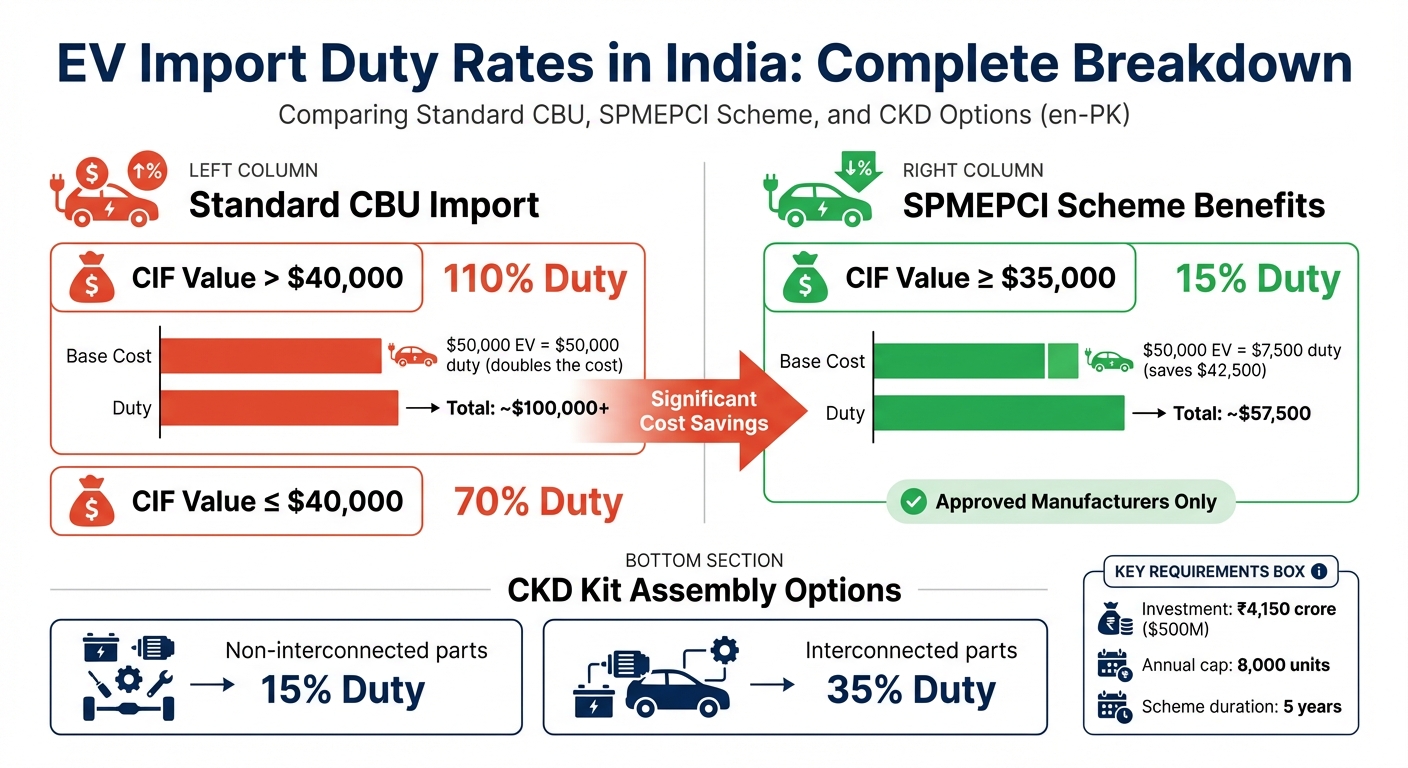
India imposes some of the highest customs duties on imported electric vehicles in the world. For a Completely Built Unit (CBU) – a fully assembled car – the standard customs duty is 110% for vehicles with a Cost, Insurance, and Freight (CIF) value exceeding $40,000. For EVs with a CIF value of $40,000 or less, the duty is 70%. To put this into perspective, a $50,000 electric car could end up costing over $100,000 after duties are applied.
However, the Scheme to Promote Manufacturing of Electric Passenger Cars in India (SPMEPCI) offers a significant reduction in these costs. Under this scheme, manufacturers who meet specific criteria can import EVs with a minimum CIF value of $35,000 at a reduced customs duty of 15% for a period of five years. Below is a summary of the applicable duty rates based on import categories:
| Import Category | Vehicle Specification | Customs Duty Rate |
|---|---|---|
| Standard CBU | CIF value > $40,000 | 110% |
| Standard CBU | CIF value ≤ $40,000 | 70% |
| SPMEPCI Scheme | CIF value ≥ $35,000 (Approved Manufacturers) | 15% |
| CKD Kit (Non-interconnected) | Parts not interconnected, not on chassis | 15% |
| CKD Kit (Interconnected) | Parts interconnected, not on chassis | 35% |
Now, let’s dive into the factors that influence these duty rates.
What Affects Your Duty Rate
The customs duty rate for EVs is determined by three main factors: the type of vehicle, the declared CIF value (which includes the car’s cost, insurance, and freight charges), and whether the manufacturer qualifies under the SPMEPCI scheme. For instance, if you’re importing a vehicle valued at $36,000 through an SPMEPCI-approved manufacturer, you’d benefit from the reduced 15% duty rate. On the other hand, the same car imported by a non-approved manufacturer would be subject to the standard 70% rate.
To qualify for the SPMEPCI scheme, manufacturers must meet stringent requirements. These include investing at least ₹4,150 crore (around $500 million) in local production within three years and achieving 25% domestic value addition by the third year, increasing to 50% by the fifth year. Additionally, there’s an annual cap of 8,000 units per manufacturer eligible for the reduced rate, with any unused quota allowed to roll over to the next year.
For those considering importing a Completely Knocked Down (CKD) kit for local assembly, the customs duty varies based on the nature of the components. Non-interconnected parts are taxed at 15%, while interconnected components attract a higher rate of 35%.
Government Policies and Tax Benefits
SPMEPCI Policy Explained
The SPMEPCI scheme offers global automakers a chance to import premium electric vehicles (EVs) at a significantly reduced duty rate of 15% for five years, compared to the standard 110% rate. However, this benefit comes with conditions – manufacturers must commit to establishing local production facilities.
To qualify for the scheme, companies are required to meet several criteria: an investment of at least ₹4,150 crore within three years, global automotive revenue of ₹10,000 crore, fixed assets worth ₹3,000 crore, and adherence to an annual import cap of 8,000 units (with rollover). Additionally, they must pay a non-refundable fee of ₹5,00,000.
The policy also sets clear localisation milestones. By the third year, 25% of the vehicle’s content must be sourced locally, increasing to 50% by the fifth year. Duty savings per applicant are capped at ₹6,484 crore, and companies need to provide a bank guarantee equivalent to the duty amount saved.
As of June 2025, major automakers like Mercedes-Benz, Volkswagen, Skoda, Hyundai, and Kia have shown interest in the scheme. However, according to HD Kumaraswamy, the Minister of Heavy Industries, Tesla seems more focused on setting up showrooms rather than committing to local manufacturing. This policy not only reduces import costs but also paves the way for additional incentives at the state and component levels.
Available Tax Exemptions and Incentives
In addition to the SPMEPCI scheme, the government has introduced several measures to make EV ownership more accessible in India. For instance, Basic Customs Duty (BCD) exemptions for key EV components – like Brushless Direct Current (BLDC) motors – have been extended until 31 March 2026.
State-level initiatives play a significant role too. The Maharashtra EV Policy 2025 has allocated ₹1,993 crore over five years to promote electric mobility through subsidies and toll waivers. Many states also offer road tax waivers, reducing registration costs for EV buyers. On top of that, individual buyers can benefit from tax deductions under Section 80EEB of the Income Tax Act, which allows for deductions on interest paid for EV loans.
sbb-itb-5f05a6f
How to Import an EV into India
Required Documents and Compliance
To import an electric vehicle (EV) into India smoothly, you’ll need to prepare several key documents. These include a signed invoice, a packing list, a Bill of Lading, Delivery Order, or Airway Bill, a GATT declaration, and insurance papers. If you’re seeking preferential duty rates, you’ll also require a Certificate of Origin.
For those applying under the SPMEPCI scheme, additional documentation is necessary. Specifically, you must obtain a certificate from a Joint Secretary or higher official at the Ministry of Heavy Industries. This certificate confirms that your EV meets the approved quota requirements and has a minimum CIF (Cost, Insurance, and Freight) value of $35,000. Additionally, the manufacturer must provide a bank guarantee equivalent to the customs duty being waived. This guarantee ensures compliance with investment commitments, as the government can invoke it if those commitments are not fulfilled.
To expedite the process, you can file your Bill of Entry up to 30 days before the vehicle arrives. If you’re using a port equipped with Electronic Data Interchange (EDI) facilities, the system automatically calculates duties and applies the current exchange rates, minimising manual errors. In cases where the vehicle description is unclear, you can request a "First Appraisement" for a preliminary assessment. These steps ensure a smoother customs clearance process.
Customs Clearance and Cost Examples
Once your EV arrives, the carrier must file the Import General Manifest within 24 hours for vessels or 12 hours for aircraft. After processing your Bill of Entry, an assessing officer reviews the vehicle’s classification, valuation, and any applicable exemptions. The EV will then undergo a physical inspection – either partial or complete – before the Shed Appraiser issues the final "Out of Charge" clearance.
Duty costs vary based on the vehicle’s value and eligibility for schemes like SPMEPCI. For instance:
- A premium EV valued at $50,000 incurs standard customs duty of $50,000, but only $7,500 under the SPMEPCI scheme.
- A mid-range EV priced at $38,000 would face $26,600 in standard duty, compared to $5,700 with scheme approval.
- Entry-level EVs priced below $35,000 are subject to a 70% duty rate and are not eligible for reduced rates under the scheme.
Major importers may benefit from the Green Channel facility, which allows clearance without routine physical inspections. However, the marks and numbers on the shipment are still verified. These measures streamline the import process while ensuring compliance with regulations.
How to Reduce Import Costs
Using EV24.asia for Your Import
EV24.asia simplifies the entire import process by handling paperwork, logistics, customs clearance, and even local registration. They provide transparent pricing and flexible shipping options, making the process smoother. Whether you choose RoRo or container shipping, EV24.asia ensures your EV is ready for the road, supporting you every step of the way.
RoRo vs. Container Shipping
Once EV24.asia takes care of the logistics, choosing the right shipping method can help you cut costs further. Your shipping choice has a big impact on overall expenses. For EV imports to India, sea freight is the most cost-effective option, with major ports like Mumbai, Chennai, and Kolkata handling most shipments. Air freight, available via Delhi, is typically reserved for urgent or high-value vehicles due to its higher costs.
Sea freight offers two main options:
- RoRo Shipping: Vehicles are driven directly onto specialised ships. This method is faster and more affordable for single vehicles or standard models.
- Container Shipping: EVs are loaded into standard shipping containers. While this option is more expensive and takes longer, it provides extra protection against weather and transit damage, making it ideal for premium or multiple vehicles.
| Shipping Method | Cost | Transit Time | Best For |
|---|---|---|---|
| RoRo (Sea) | Lower | 3–6 weeks | Single vehicles, standard models |
| Container (Sea) | Higher | 4–8 weeks | Premium EVs, multiple vehicles, extra protection |
| Air Freight | Significantly Higher | 1–2 weeks | Urgent shipments, high-value vehicles |
For bulk imports or assembly purposes, consider shipping vehicles in CKD (Completely Knocked Down) or SKD (Semi-Knocked Down) formats. These disassembled shipments save space, reduce freight costs, and attract a lower Basic Customs Duty of 15% compared to 70% for fully assembled units. Additionally, a 1% landing charge is applied to the CIF (Cost, Insurance, and Freight) value .
Summary
Bringing an electric vehicle (EV) into India means dealing with a complicated duty structure that can heavily influence the overall cost. Standard import duties are high, but the Scheme to Promote Manufacturing of Electric Passenger Cars in India (SPMEPCI) offers some relief. Under this scheme, premium EVs with a CIF value of at least $35,000 are eligible for a reduced 15% duty – provided the manufacturer commits to investing at least ₹4,150 crore ($500 million) in local production facilities.
Brands like Hyundai, Kia, Mercedes‑Benz, Skoda, and Volkswagen benefit from this scheme, while Tesla is subject to the full 110% tariff. However, the 15% duty is limited to 8,000 vehicles per manufacturer annually, with unused quotas carried forward to future years.
Your choice of shipping method also plays a big role in managing costs. For individual vehicles, RoRo (Roll-on/Roll-off) shipping is a quicker and more affordable option, while container shipping – though pricier – offers better protection for premium models. For bulk imports, opting for CKD (Completely Knocked Down) format can significantly lower duties compared to importing fully assembled vehicles. Navigating these options requires careful planning, making expert advice highly valuable.
To make the process easier, EV24.asia offers end-to-end support. From handling paperwork and customs clearance to ensuring smooth local registration, they provide transparent pricing, flexible shipping choices, and guidance tailored to SPMEPCI requirements, helping you stay compliant with regulations.
Whether you’re importing a single EV or a fleet, understanding the duty structure and leveraging professional expertise can lead to considerable cost savings.
FAQs
What are the key advantages of the SPMEPCI scheme for EV importers in India?
The Scheme to Promote Manufacturing of Electric Passenger Cars in India (SPMEPCI) has introduced a game-changing opportunity for EV importers. It slashes customs duty on fully built electric cars from a hefty 110% to just 15% of the CIF value, provided the vehicle’s price is at least USD 35,000. This reduction significantly lowers the cost of imported EVs, making them more accessible and competitive in the Indian market.
Under this scheme, approved importers can bring in up to 8,000 fully built electric cars annually at the reduced duty rate. This allowance enables companies to plan large-scale launches and gain a foothold in the market. However, the scheme comes with conditions: manufacturers must commit to a minimum investment of PKR 14 billion (approximately USD 500 million) and adhere to localisation targets. These requirements aim to balance market entry with long-term investment in local production.
The SPMEPCI scheme delivers three key benefits: reduced customs duty, a manageable import quota, and a structured route to market entry that aligns with investment and localisation goals.
What are the requirements for a manufacturer to qualify for reduced customs duty on EV imports in Pakistan?
To benefit from the reduced 15% customs duty on electric vehicle (EV) imports, manufacturers must fulfil certain conditions. These include an investment commitment of at least ₨125 billion (around $500 million) and setting up a local EV production facility within three years. Additionally, manufacturers must achieve domestic value addition targets – 25% within three years and 50% within five years. The imported EVs under this scheme must also carry a CIF (Cost, Insurance, and Freight) value of $35,000 or more. These steps are designed to boost local manufacturing and attract investment in Pakistan’s EV industry.
What is the difference between RoRo and container shipping for importing EVs?
When it comes to bringing electric vehicles (EVs) into the country, you’ll generally have two main shipping methods to choose from: RoRo (Roll-on/Roll-off) and container shipping.
RoRo shipping is a straightforward process where vehicles are driven directly onto a specialised ship, secured for the journey, and then driven off at the destination. This method is often the more economical option, making it ideal for standard-sized EVs.
Container shipping, however, involves placing the EV inside a sealed container. This approach provides an added layer of protection, shielding the vehicle from harsh weather conditions and minimising the risk of damage during transit. It’s a popular choice for higher-value EVs or those that require extra care.
Ultimately, the decision comes down to your priorities – whether it’s keeping costs low with RoRo or opting for the added safety and protection of container shipping for more expensive or delicate vehicles.