
 Arka Pratama
Importing an electric car to India has become simpler and more affordable, thanks to the 2025 SPMEPCI policy. This guide explains the process, from selecting a model to customs clearance and registration. Key highlights:
- Reduced Import Duties: Premium EVs (USD 35,000+) qualify for a 15% duty if manufacturers invest ₹4,150 crore in local production.
- Eligibility: Only right-hand drive (RHD) EVs with km/h speedometers and left-side headlights are allowed. Used EVs must be under 3 years old.
- Key Steps:
- Choose a compliant EV model.
- Obtain required approvals (IEC, GST, homologation).
- Ship to authorised ports (Mumbai, Chennai, Kolkata).
- File customs documents and pay duties.
- Register with the local RTO.
With proper planning and documentation, the process can be smooth. Platforms like EV24.asia can help manage logistics, compliance, and registration efficiently.
Govt Weighs 15% Import Duty On Electric Cars With Riders I N18V I CNBCTV18

India’s EV Import Policies Explained
Understanding India’s EV import policies is essential for anyone looking to navigate the complexities of bringing electric vehicles into the country.
In June 2025, the Indian government introduced the Scheme to Promote Manufacturing of Electric Passenger Cars in India (SPMEPCI). This initiative significantly reduced customs duties on electric vehicle imports from a steep 70%–110% to 15% – but only for manufacturers committed to local production.
The scheme is tied to production targets and requires companies to invest at least Rs 4,150 crore (around $500 million) in local manufacturing facilities within three years. In exchange, eligible manufacturers can import up to 8,000 EVs annually at the reduced duty rate, with a total cap of 40,000 units over five years. Unused quotas can roll over to subsequent years.
Main Policy Points
The reduced 15% duty is applicable only to electric vehicles with a minimum CIF (Cost, Insurance, and Freight) value of $35,000.
Participating manufacturers must meet strict localisation and turnover benchmarks. By year three, they must achieve 25% Domestic Value Addition, increasing to 50% by year five. Turnover targets are set at Rs 2,500 crore, Rs 5,000 crore, and Rs 7,500 crore at the first, second, and third checkpoints, respectively. Duty savings are capped at Rs 6,484 crore or the amount invested, whichever is lower.
A bank guarantee is required to cover the customs duty savings. This guarantee can be invoked if the company fails to meet its investment or localisation commitments. The guidelines also allow for brownfield investments – using existing facilities – but costs related to land and buildings are excluded from the Rs 4,150 crore investment requirement.
"This (new policy) will provide Indian consumers with access to the latest technology, boost the Make in India initiative, strengthen the EV ecosystem by promoting healthy competition among EV players."
- Government of India Statement
Who Can Import EVs
Not every automaker is eligible for the SPMEPCI scheme. Companies must meet stringent financial criteria, including a minimum annual global revenue of Rs 10,000 crore from automotive manufacturing and global fixed assets worth at least Rs 3,000 crore.
The Rs 4,150 crore investment requirement includes more than just manufacturing equipment. Spending on R&D facilities and charging infrastructure (up to 5% of the total commitment) also counts toward the total. These strict benchmarks ensure only serious players can participate. By August 2025, major automakers such as Mercedes-Benz, Volkswagen, Skoda, Hyundai, and Kia had expressed interest in the scheme.
Interestingly, Minister of Heavy Industries HD Kumaraswamy noted that while Tesla has plans to set up showrooms in India, it is not expected to begin manufacturing in the country anytime soon.
Additionally, manufacturers approved under the scheme are prohibited from diluting their shareholding during its tenure. This ensures long-term commitment and stability within the programme.
Required Documents and Compliance
When it comes to importing electric vehicles (EVs) into India, having the right paperwork and meeting regulatory requirements are non-negotiable. India’s EV import policies demand meticulous documentation and adherence to specific certifications to ensure a seamless process.
Documents You Need
Before you even begin the import process, you must secure two key registrations: a 10-digit Import Export Code (IEC) issued by the Directorate General of Foreign Trade (DGFT) and GST registration. These identifiers are essential for navigating the regulatory framework.
Your shipment must include the following core documents:
- Commercial Invoice
- Bill of Lading (or Sea Waybill)
- Packing List
- Certificate of Insurance.
Additionally, you’ll need to file a Bill of Entry with the Customs department via the Electronic Data Interchange (EDI) system. This system streamlines the process by calculating duties and applying the correct exchange rates automatically. Remember, the Bill of Entry can be submitted up to 30 days before the arrival of your shipment.
For new EVs, a certificate of compliance with the Central Motor Vehicle Rules (CMVR), particularly Rule 126, is required. If you’re importing used vehicles (not older than three years), a certificate of roadworthiness issued by an authorised testing agency in the country of origin must be submitted. You’ll also need a Phytosanitary Certificate, which confirms that the consignment is free from pests and diseases.
If you’re leveraging the SPMEPCI scheme to benefit from the concessional 15% duty rate, an approval letter from the Ministry of Heavy Industries is mandatory. Depending on your case, you might also need a GATT declaration and a Certificate of Origin.
These documents are critical for the homologation process, which ensures your EV meets India’s stringent standards. But documentation is just the first step – your EV also needs to comply with Indian safety and environmental regulations.
Meeting Indian Standards
All imported EVs must go through a homologation process conducted by either the Automotive Research Association of India (ARAI) or the Vehicle Research and Development Establishment (VRDE). This process certifies that the vehicle adheres to India’s safety and environmental norms. As explained by Bajaj General Insurance:
"Homologation is the process of certifying that a vehicle meets the required safety and environmental standards in a particular country".
ARAI has developed AIS-XXX standards, which lay out detailed safety and roadworthiness regulations. Before shipping your EV, make sure it is:
- Right-hand drive (RHD)
- Equipped with a speedometer calibrated in km/h
- Fitted with left-side headlights.
For EV batteries, compliance with Bureau of Indian Standards (BIS) specifications is essential to ensure safety under India’s climatic conditions. Additionally, the Central Electricity Authority (CEA) has set technical requirements for charging infrastructure and grid safety.
How to Import an Electric Car: Step-by-Step
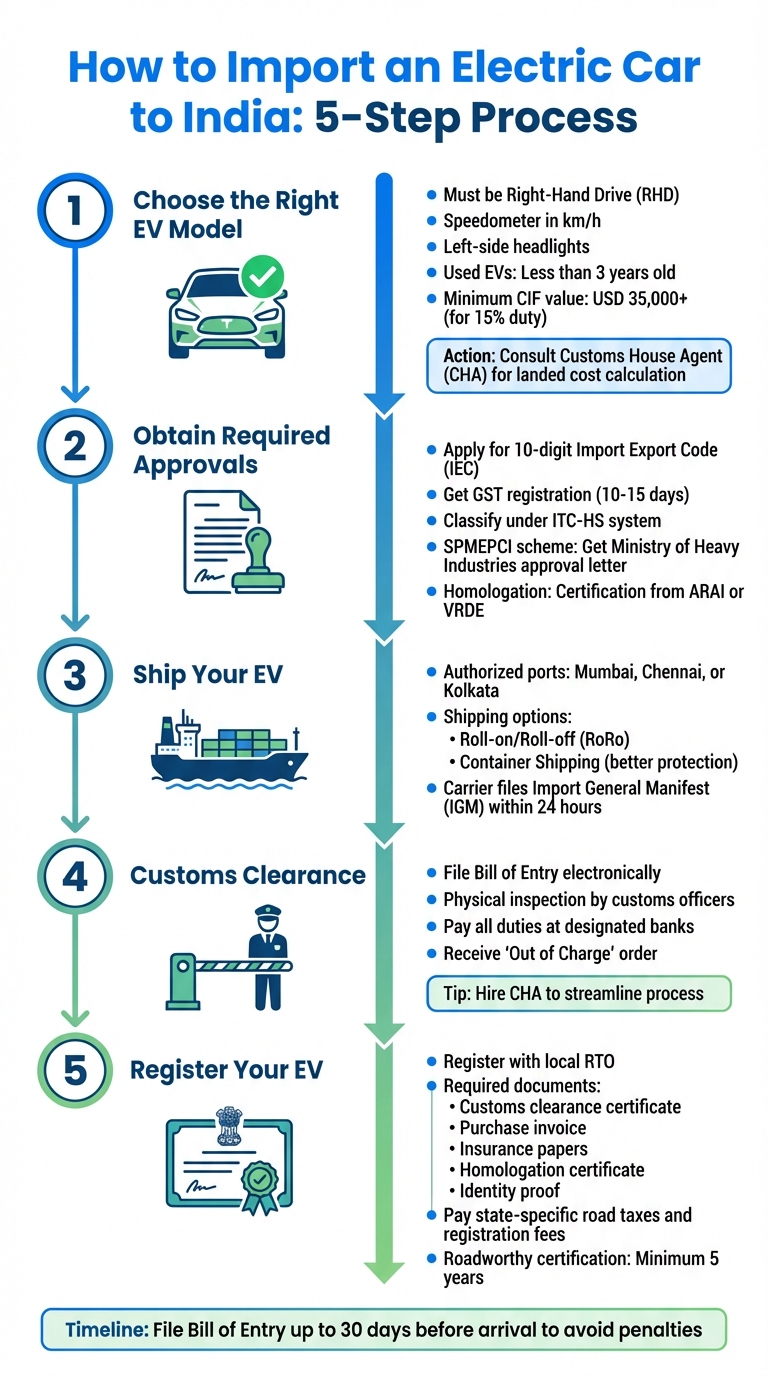
5-Step Process to Import Electric Cars to India in 2025
Now that you’re familiar with the paperwork and compliance requirements, let’s dive into the actual process of importing an electric vehicle (EV). Each step demands careful attention to ensure your EV arrives legally and without unnecessary delays.
Step 1: Choose the Right EV Model
Start by selecting a right-hand drive (RHD) EV equipped with a speedometer in km/h and left-side headlights. If you’re importing a used EV, it must be less than three years old. For new EVs, they should be unused and manufactured abroad.
Important: Only premium EVs with a CIF (Cost, Insurance, and Freight) value of USD 35,000 or more are eligible for the reduced 15% duty under the SPMEPCI scheme.
Before committing to your purchase, consult a Customs House Agent (CHA) to calculate the total landed cost, which includes Basic Customs Duty, Social Welfare Surcharge, and Integrated GST. This helps avoid surprises at the port.
Once your model is finalised, the next step is obtaining the necessary approvals.
Step 2: Obtain Required Approvals
After choosing your EV, secure all the regulatory approvals needed for the import. Start by applying online for your 10-digit Importer Exporter Code (IEC) and valid GST registration. This process typically takes 10–15 days.
Classify your EV under the ITC-HS system to determine if additional permits are required.
If you’re using the SPMEPCI scheme to benefit from the concessional duty, you’ll need an approval letter from the Ministry of Heavy Industries. To qualify, manufacturers must pledge to invest at least Rs 4,150 crore (about $500 million) in local manufacturing within three years. Keep in mind, the concessional duty quota is limited to 8,000 premium EVs per year per approved manufacturer.
As discussed earlier, homologation (type approval) is crucial. Your EV must meet Indian safety and environmental standards, certified by authorised agencies like the Automotive Research Association of India (ARAI) or the Vehicle Research and Development Establishment (VRDE).
Step 3: Ship Your EV
Ship your EV to one of the authorised ports – Mumbai, Chennai, or Kolkata. You’ll have two shipping options:
- Roll-on/Roll-off (RoRo): The vehicle is driven directly onto the ship.
- Container Shipping: Offers extra protection against weather and other potential damage.
Ensure all required documents mentioned in the documentation section accompany your shipment. The carrier must also file an Import General Manifest (IGM) within 24 hours of the vessel’s arrival.
Step 4: Customs Clearance
To clear customs, file your Bill of Entry electronically. Customs officers will evaluate your duty liability based on the vehicle’s classification, valuation, and any applicable exemptions, such as the SPMEPCI concessional rate. A physical inspection will also be conducted to verify the vehicle’s details against your declaration.
Pay all duties at designated banks before receiving the "Out of Charge" order, which allows your vehicle to be delivered. Keep in mind, importing a luxury car without concessional schemes can nearly triple its original price due to taxes and duties. Hiring a Customs House Agent (CHA) can streamline this complicated process.
Step 5: Register Your EV
Once your EV clears customs, register it with your local RTO. You’ll need to provide the following documents:
- Customs clearance certificate
- Purchase invoice
- Insurance papers
- Homologation certificate
- Identity proof
Additionally, you’ll need to pay state-specific road taxes and registration fees, which are calculated as a percentage of the vehicle’s value. Some states may have additional conditions or higher road taxes for imported vehicles, so it’s essential to check these details in advance.
Lastly, your imported EV must be certified as roadworthy for a minimum of five years. With the registration complete, you’re all set to hit the road with your electric vehicle!
sbb-itb-5f05a6f
Import Costs: Duties and Taxes
Understanding your import costs is crucial before making any commitments. The total landed cost of importing depends on whether you qualify for the concessional duty scheme or are subject to standard import rates.
The Basic Customs Duty (BCD) forms the largest portion of import expenses. Under the SPMEPCI scheme, eligible manufacturers pay a reduced BCD of 15% on premium electric vehicles (EVs) with a minimum CIF (Cost, Insurance, and Freight) value of USD 35,000, provided they invest Rs 4,150 crore in local manufacturing.
For regular imports, the BCD is set at 70% for vehicles with a CIF value below USD 40,000 and 100% for vehicles above USD 40,000 CIF. Additionally, the Social Welfare Surcharge (SWS), calculated at 10% of the BCD, along with Integrated GST (IGST) and compensation cess, often pushes the effective duty up to an eye-watering 110%.
"The lower import duty will be applicable for up to 8,000 premium EVs (priced above USD 35,000) annually, beyond which the current 110 per cent duty will be levied." – Viraaj Bhatnagar, Autocar India
Under the SPMEPCI scheme, duty savings are capped at Rs 6,484 crore or the actual investment made, whichever is lower. Below, we break down and compare the duty rates for different import categories.
Cost Comparison
| Import Category | CIF Value Requirement | Customs Duty Rate |
|---|---|---|
| SPMEPCI Scheme (CBU) | Minimum USD 35,000 | 15% |
| Standard Import (CBU) | Above USD 40,000 | 100% |
| Standard Import (CBU) | Below USD 40,000 | 70% |
| Knocked Down Kit (CKD) | N/A | 15% to 35% |
The calculation begins with your CIF value as the assessable base. From there, BCD is applied, followed by the SWS (10% of BCD). Finally, IGST and any applicable cess are calculated on the sum of the assessable value, BCD, and SWS. This breakdown highlights the cost differences across various import categories, helping you plan better.
Tips for a Smooth Import
Bringing an electric car into India requires careful planning and strict adherence to regulations. One of the smartest moves you can make is hiring a Customs House Agent (CHA). These professionals handle the intricate filings, duty calculations, and communications with customs officials via the Electronic Data Interchange (EDI) system and the faceless "Turant Customs" programme.
To avoid hefty daily penalties, take advantage of the "Prior Entry" facility and file your Bill of Entry up to 30 days before your car’s arrival. Work with a customs broker to calculate your total landed costs in advance. This way, you’ll know exactly what to expect when duties, cess, and GST are applied – no unpleasant surprises.
Before shipping, check with your local RTO for any state-specific registration rules or additional road taxes on imported vehicles. Ensure your car is shipped through authorised ports like Mumbai, Chennai, or Kolkata. To avoid delays, your shipping partner should prepare a complete set of documents, including all necessary certifications.
If you’re importing a used car, make sure it’s no older than three years from its manufacturing date. Additionally, obtain a pre-shipment roadworthiness certificate if required by the current DGFT policy.
Following these steps can make the process much smoother, especially when guided by experienced professionals.
Why Use EV24.asia
To simplify the complexities of importing an electric vehicle, EV24.asia offers a comprehensive solution. Their platform provides upfront, transparent pricing that includes all duties and taxes, helping you plan your budget without any guesswork.
EV24.asia takes care of logistics from start to finish. They manage shipping, customs clearance through seasoned CHAs who are well-versed in the ICEGATE portal, and handle paperless documentation via the e-Sanchit system. Their team ensures your imported EV complies with Indian standards, including Right-Hand Drive configuration, kilometre-calibrated speedometers, and suitable headlights.
Additionally, they handle the homologation process with agencies like the Automotive Research Association of India (ARAI), securing the necessary certificates to meet the Central Motor Vehicle Rules (CMVR) 1989. With flexible payment methods and expert assistance for RTO registration, EV24.asia turns what could be a daunting process into a hassle-free experience.
Conclusion
Bringing an electric vehicle (EV) into India involves a series of critical steps, each requiring careful attention. From choosing the right EV to securing approvals, navigating customs, and completing the registration process, every stage demands thorough preparation and adherence to regulations. For instance, imported vehicles must be right-hand drive, feature a speedometer in km/h, and have left-side headlights. Additionally, imports are limited to ports in Mumbai, Chennai, or Kolkata [15,25,26]. These technical requirements are just the beginning of managing the financial and procedural challenges that follow.
On the financial side, customs duties can be steep, with standard rates reaching up to 110%, which can push the total cost to about 165% of the vehicle’s value [2,25,26]. However, under the 2025 SPMEPCI policy, manufacturers investing at least Rs 4,150 crore in local production can benefit from a reduced duty rate of 15%, though this is capped at 8,000 premium EVs annually.
The documentation process is just as demanding. Key documents include the Bill of Lading, GATT declaration, insurance policy, import licence, and technical test reports [7,15,26]. Be aware that mis-declarations can lead to confiscation of the vehicle and penalties under Sections 111 and 112 of the Customs Act. To avoid delays and extra storage charges, you can file your Bill of Entry up to 30 days before the vehicle’s arrival using the Prior Entry facility.
Once customs clearance is complete, the next step is registering your EV with the Regional Transport Office (RTO) and obtaining homologation from the Automotive Research Association of India (ARAI) to ensure compliance with national vehicle standards [5,15]. For used EVs, keep in mind the three-year age limit and the necessity of a valid roadworthiness certificate [15,25,26].
For a smoother experience, platforms like EV24.asia offer end-to-end solutions, covering everything from shipping and customs clearance to compliance and RTO registration. With transparent pricing, they simplify what can otherwise be a daunting process, helping you complete your EV import journey efficiently.
FAQs
What are the eligibility criteria for importing an electric car into India?
To bring an electric car into India, you need to meet specific vehicle requirements and ensure you qualify under the importer eligibility criteria.
The car must be a right-hand drive model, less than three years old from its manufacturing date, and adhere to Indian standards. It must not have been previously rented, leased, or sold. The headlights should be adjusted for left-hand traffic, and a valid road-worthiness certificate (minimum five years) is mandatory. Additionally, the speedometer must display readings in kilometres per hour.
As for eligibility, importers can include multinational companies with Indian offices, individuals with physical disabilities, honorary consulate members (with approval from the Ministry of External Affairs), and non-resident Indians (NRIs) who have lived in India for at least two years before the import. Other eligible groups are Indian companies with foreign equity, journalists accredited by the Ministry of Information and Broadcasting, and registered religious or charitable organisations.
Meeting these requirements is essential before moving forward with customs clearance, paying the applicable duties (currently a reduced 15% for qualifying EVs), and registering the vehicle in India.
How does the SPMEPCI policy affect the cost of importing electric cars to India?
The SPMEPCI policy has brought a major change by slashing import duties on electric vehicles. Previously set at approximately 110%, the duty has now been reduced to a much lower 15%. This dramatic cut makes importing electric vehicles significantly more affordable for both individuals and businesses.
This move is designed to promote the use of electric vehicles, aligning with efforts to shift towards cleaner and greener transportation options. However, to take advantage of these reduced duties, it’s crucial to meet all the necessary regulatory requirements.
What documents are needed for customs clearance when importing an electric car?
To get an imported electric car through customs in Pakistan, you’ll need to have the following documents ready:
- Import-Export Code (IEC)
- A properly filed electronic Bill of Entry
- The vehicle’s import manifest or report
- Commercial invoice and packing list
- The car’s original registration certificate or road-worthiness certificate
- Any required import licence
Make sure every document is accurate and complete. Missing or incorrect paperwork can lead to delays or even penalties. To navigate the process smoothly, it’s wise to seek advice from a customs expert.