
 Arka Pratama
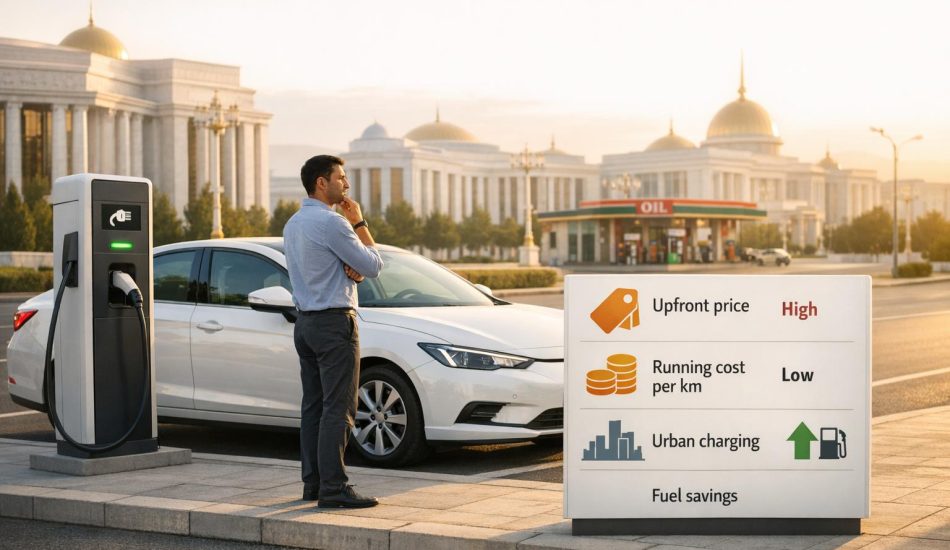
With rising fuel costs and urban pollution, Pakistan is embracing electric vehicles (EVs) as a cleaner, cost-effective alternative. The government’s EV-friendly policies, including reduced import duties and tax exemptions, make importing EVs a smart choice. Here’s why:
- Lower Import Duties: Customs duty on EVs is as low as 1%, compared to 50%-75% for petrol cars.
- Access to Global Brands: Tesla, BYD, Audi, and other international models are now within reach.
- Advanced Features: Imported EVs come with cutting-edge tech like rapid charging and autonomous driving.
- Cost Transparency: Platforms like PSW simplify import costs with clear pricing.
- Simplified Shipping: Choose between cost-effective RoRo or secure container shipping.
- Hassle-Free Customs Clearance: Professional services streamline documentation and approvals.
- Easy Registration: Digital systems like PSW and NADRA make local registration smoother.
- Latest Tech: From LFP batteries to bi-directional charging, imported EVs offer superior technology.
- Tax Benefits: VAT exemptions and reduced duties make EVs more affordable.
- Expert Assistance: Platforms like EV24.asia handle the entire import process, saving time and effort.
Quick Tip: Importing an EV before 30 June 2026 ensures you benefit from current tax breaks and reduced duties. Whether you’re looking for budget-friendly options or luxury models, the time to switch is now.
The DEFINITIVE Guide to Import Your Car (Tesla EV) from USA to Portugal – TAX FREE!!!
sbb-itb-5f05a6f
1. Lower Costs Through Reduced Import Duties
Pakistan’s Electric Vehicle Policy 2020 has introduced customs duty concessions that make importing electric vehicles (EVs) more affordable compared to petrol or diesel-powered cars. For instance, customs duty on 4-wheeler EVs priced under USD 50,000 is capped at 25% until 30th June 2026. In comparison, traditional vehicles face fixed-rate duties based on engine size. For example, importing a petrol car with an engine capacity of 1,001cc to 1,300cc incurs duties of around USD 13,200, while a 1,301cc to 1,500cc model costs nearly USD 18,590 in duties. These incentives are not limited to private vehicles but also extend to commercial ones.
The benefits are even more striking for commercial EVs. Electric buses, trucks, and prime movers enjoy a flat customs duty of just 1%. This makes fleet electrification a more economical option by significantly reducing both fuel expenses and tax obligations.
Other incentives further improve affordability. EVs are exempt from Regulatory Duty (RD) and Additional Customs Duty (ACD), while smaller EVs with battery capacities up to 50 kWh qualify for a VAT exemption until 30th June 2026. These combined measures can drastically reduce the total landed cost of an imported EV when compared to conventional vehicles.
Local assemblers also benefit from reduced duties. They are permitted to import up to 100 Completely Built Units (CBUs) of the same variant at half the standard duty rate – lowering it to 12.5% until 30th June 2026. Even electric auto-rickshaws and motorcycles see reduced duties, set at 50% of the standard tariff, making two- and three-wheeler EVs more accessible for commercial use.
"These significant policy adjustments are aligned with Pakistan’s Electric Vehicle Policy 2020 and the Auto Industry Development and Export Policy (AIDEP) 2021–26, signaling a strong commitment to fostering a sustainable and locally driven automotive industry." – Federal Board of Revenue (FBR)
2. Access to More EV Brands and Models
The local automotive market in Pakistan offers a fairly limited range of electric vehicles, mainly because most global EV manufacturers have yet to establish official operations in the country. However, importing EVs opens up access to renowned international brands like Tesla, BYD, Volkswagen, and XPeng – brands that aren’t available through local dealerships. Challenges like insufficient charging infrastructure and the high cost of battery technology have kept these global players from officially launching in Pakistan. As a result, importing remains the primary way for buyers to get their hands on these advanced vehicles.
Importing EVs also allows buyers to explore a variety of models across different price ranges. For luxury enthusiasts, high-end options like the Audi e-Tron (priced between PKR 58–81 million) and the BMW iX (starting at PKR 73 million) are popular choices. The BMW iX, for instance, features a 100 kWh battery and boasts an impressive range of up to 600 kilometres. On the other hand, mid-range buyers are increasingly turning to Chinese brands such as BYD and MG. A notable example is the MG ZS EV, which offers a 44.5 kWh battery and is priced at approximately PKR 12,990,000.
Imported EVs also bring cutting-edge features that are often missing in locally available models. Chinese manufacturers, in particular, have gained attention for their advanced digital ecosystems. Ford CEO Jim Farley highlighted this advantage, stating:
"They have far superior in-vehicle technology. Huawei and Xiaomi are in every car… You get in, you don’t have to pair your phone. Automatically, your whole digital life is mirrored in the car."
This level of integration includes autonomous driving features, voice recognition, and in-car AI assistants, which come as standard in many imported Chinese EVs.
Another key advantage of importing EVs is access to advanced battery technology. For example, BYD, which holds a 17.2% share of the global battery market, supplies its Lithium Iron Phosphate (LFP) batteries to major brands like Tesla and Toyota. XPeng focuses on autonomous driving and next-generation technology, while Tesla continues to lead in Full Self-Driving (FSD) capabilities. These features – such as high-capacity batteries and autonomous driving sensors – offer a significant technological edge over vehicles currently assembled locally.
3. Clear Pricing Across All Budget Ranges
Hidden charges are a common concern for local buyers, but international platforms simplify things with transparent Cost and Freight (C&F) pricing based on the auction price. This means you know exactly what you’re paying upfront – no surprises, no hidden fees.
The introduction of the Pakistan Single Window (PSW) system has made pricing even clearer. By digitising the entire import process, this paperless platform connects ports, banks, and the Federal Board of Revenue (FBR). It allows buyers to track their costs and the clearance status of their imports in real time. Gone are the days of endless paperwork. Instead, you get a detailed breakdown of expenses, including the auction price, freight charges, customs duties, and smaller fees like wharfage and documentation (which typically range between PKR 50,000 and PKR 60,000). With PSW, calculating the total cost is now a straightforward process.
Adding to this clarity is the simplified duty structure, which makes it easier to estimate the total cost of importing a vehicle. The fixed duty rates mean you can accurately calculate the total amount, factoring in the auction price, freight charges, and duties. For instance, if you’re importing a mid-range electric vehicle (EV), you can use online calculators to get a clear picture of the total cost, including the 18% sales tax and other expenses. Whether you’re eyeing an entry-level model under PKR 9 million or a high-end sedan over PKR 15 million, these tools help you plan within your budget.
Additionally, fixed duty rates vary by vehicle category, making it easier for buyers to distinguish between options and choose what suits them best .
This level of transparency allows buyers to compare models across different price ranges confidently. Platforms like EV24.asia make this pricing clarity accessible, helping buyers find the best option for their needs.
4. Simple Shipping Methods
Once you’ve chosen your EV, the next step is getting it shipped to Pakistan. There are two main shipping options: Roll-on/Roll-off (RoRo) and container shipping. Each has its own perks, and the right choice depends on your budget and the type of vehicle you’re importing.
RoRo shipping works like a floating car park – your EV is driven onto the ship’s deck and secured for the journey. This method is usually 15% to 30% cheaper than container shipping, making it perfect for standard, operational vehicles. However, there are a few conditions: the EV must be in running condition, free of personal belongings, and it will be exposed to sea air and weather during transit.
Container shipping, by contrast, offers greater protection. Your EV is placed inside a sealed metal container, shielding it from salt spray, rough handling, and weather. This option is ideal for high-value or luxury vehicles. While a dedicated container is more expensive, you can opt for a consolidated container – sharing space with other vehicles – which can lower costs by over 50% [27,30]. Another advantage of container shipping is that it allows you to include spare parts or personal items with your EV.
For buyers in Pakistan, professional shipping services often cater to EV-specific needs, such as ensuring battery safety and checking charging compatibility. Ocean freight costs typically range between $1,500 and $3,000, with destination charges adding another $500–800 per vehicle [29,31]. On top of these, you should set aside an additional PKR 50,000–60,000 for local terminal handling, wharfage, and documentation fees. These detailed cost estimates make it easier to plan your budget.
Platforms like EV24.asia offer both RoRo and container shipping options, allowing you to pick the one that best suits your vehicle and budget.
5. Help with Customs Clearance
Navigating customs clearance in Pakistan can be challenging, especially for first-time EV importers. The process requires several key documents, including the Bill of Lading, purchase receipt, attested passport copy, and Import Authorization form. If you’re importing under the Gift Scheme, you’ll also need a Gift Undertaking, Earning Certificate, and the donor’s passport copy. Forgetting even one document can lead to delays, and if clearance isn’t completed within 15 days, you might face port rent charges. To avoid these hurdles, many turn to professional import platforms for assistance.
These platforms simplify the process by filing the Bill of Entry, a critical legal document that only customs-approved clearing agents can submit. They also ensure your paperwork is presented to the relevant customs groups, such as Group-VIII in Karachi, for review by Deputy or Assistant Collectors. Additionally, they handle duty and tax payments, including managing engine-specific requirements and associated fees.
For vehicles with an engine capacity of 1,800cc or more, customs duties must be paid in foreign exchange, supported by a bank encashment certificate. Customs agent fees typically range between Rs. 12,000 and Rs. 18,000, while other charges, like wharfage and terminal handling, can add another Rs. 50,000 to Rs. 60,000. Using professional help ensures you comply with Pakistan’s strict import regulations without unnecessary delays.
Platforms like EV24.asia offer comprehensive customs support, including verifying eligibility under government schemes and coordinating with authorities for technical certifications. Their end-to-end service is especially helpful for first-time importers, making the entire process smoother and far less overwhelming.
6. Support for Vehicle Registration
Once your EV has cleared customs, the next step is registering it with your local RTO or NADRA. This process ensures your imported EV is legally ready for use on the roads. To get started, you’ll need specific documents such as the Goods Declaration, Bill of Lading, Export Certificate from the origin country, and an attested copy of your passport. If you’re importing a used EV, you’ll also need to show proof that the vehicle was registered in your name abroad for at least 60 days before shipping it to Pakistan.
The Pakistan Single Window (PSW) system has simplified this process by integrating multiple agencies. For instance, in Islamabad, registration fees can now be paid online through designated apps. Biometric verification at NADRA-authorised centres is mandatory, and the registration fees in Islamabad vary based on the vehicle’s power output: Rs. 2,500 for vehicles up to 50 KW, Rs. 5,500 for those between 51–100 KW, and Rs. 10,000 for vehicles over 100 KW. Additionally, some regions offer exemptions from registration fees and annual token taxes for EVs, although income tax still applies.
Companies like EV24.asia work closely with local authorities to handle all necessary paperwork, speeding up the registration process. This proactive approach can help you avoid hefty fines, which range from Rs. 60,000 to over Rs. 1.8 million. Just as streamlined customs and shipping processes save time and money, efficient vehicle registration ensures a smoother journey for EV importers.
7. Multiple Payment Options
When importing an EV, you’ll need to use foreign exchange through authorised banking channels. This means arranging funds from an overseas account – whether it’s yours or a family member’s – and converting them into Pakistani Rupees via a local bank.
To ensure smooth processing, you’ll need a bank encashment certificate, which serves as proof that foreign exchange has been used to pay import duties under SRO 52(I)/2019. Without this certificate, you could face delays in clearing your vehicle. Thankfully, the PSW system connects banks, customs, and the FBR, enabling quicker, paperless transactions.
If there’s a change in currency rates or duty charges between the time you make the payment and file your goods declaration, you can cover any shortfall using local currency.
For those who want to avoid handling foreign exchange payments altogether, there’s an alternative: purchasing pre-imported EVs from local dealerships.
Platforms like EV24.asia simplify the payment process by partnering with authorised banks and ensuring compliance with regulations. With its PSW integration, you can digitally track your payment status, cutting down on paperwork and speeding up the import process. This efficient payment system is just one of the ways the EV import experience has been made more seamless.
8. Access to Newer EV Technology
Imported EVs don’t just bring cost savings and variety – they also open the door to advanced technology that’s often unavailable locally. While Pakistan’s EV manufacturing largely focuses on two- and three-wheelers, imported passenger cars come equipped with state-of-the-art battery systems and driver assistance technologies. If you’re looking for the latest in EV innovation, importing is the way to go.
Let’s talk battery technology – a standout feature of imported EVs. Manufacturers like CATL and BYD from China are at the forefront of LFP (Lithium Iron Phosphate) battery development. These batteries offer not only better longevity and safety but also enable features like bi-directional charging (V2X). Imagine powering your home during load shedding or even sending electricity back to the grid. That’s the kind of utility these batteries bring to the table.
Then there’s the software integration, which takes the driving experience to another level. Companies like Xiaomi and Huawei, known for their tech expertise, are building EVs with seamless software capabilities. For example, their vehicles can automatically sync with your smartphone, making the user interface intuitive and familiar. As Tu Le, Managing Director at Sino Auto Insights, puts it:
"Legacy auto is going from analog to digital, and EV companies in China have started in digital, live in digital, so this is second nature to them".
This digital-first approach means features like voice recognition, AI assistants, and even autonomous driving aren’t pricey extras – they’re standard.
Cost is another area where imported EVs shine. Take the BYD Seagull, for instance. It’s priced under $10,000 in China, while a basic Nissan Leaf in the US starts at a hefty $32,000. Thanks to Pakistan’s 1% import duty, you can access this advanced tech at a fraction of the cost. Plus, imported EVs adhere to United Nations WP.29 standards, ensuring global recognition of their technology and standardised parts for easier future maintenance.
With cutting-edge features, lower costs, and global standards, imported EVs offer not just a better ride today but also peace of mind for tomorrow.
9. Tax Benefits for Hybrid and Electric Vehicles
In Pakistan, importing hybrid and electric vehicles (EVs) isn’t just about easier payments – it’s also about significant tax relief. Thanks to the Electric Vehicle Policy 2020 and the Auto Industry Development and Export Policy (AIDEP) 2021–26, the government has introduced generous tax breaks to make EVs and hybrids more affordable. These policies aim to encourage green transport and ensure advanced vehicles are within reach for more buyers.
For electric buses, trucks, and prime movers, the customs duty is an incredibly low 1%. Passenger EVs priced up to US$50,000 face a customs duty of 25%, which is already reasonable. But the real game-changer is the Value Added Tax (VAT) exemption. For small EVs with a battery capacity of 50 kWh or less, there’s no VAT to pay until 30th June, 2026. The same VAT exemption applies to Light Commercial Vehicles (LCVs) with batteries of up to 150 kWh.
Hybrid vehicles come with their own set of perks. Standard imports of hybrids enjoy a 50% exemption on duties and taxes for engines up to 1,800cc, and a 25% exemption for engines between 1,801cc and 2,500cc. If you’re importing a used hybrid under the Personal Baggage or Gift scheme, fixed duties are applied based on engine size – for instance, US$4,800 for up to 800cc and US$18,590 for 1,301cc to 1,500cc – before the 50% exemption is factored in. However, the vehicle must be under three years old to qualify.
For local assembly, the government has also created incentives. Manufacturers can import up to 100 CBU units of the same variant at half the standard duty rate (12.5% for vehicles under US$50,000) until 30th June, 2026, provided they are certified by the Engineering Development Board (EDB). Additionally, CKD kits for assembling vehicles locally are subject to just 1% customs duty, reducing costs for manufacturers and encouraging local production.
It’s important to note that these tax benefits aren’t permanent. Most concessions for 4-wheelers and LCVs will expire on 30th June, 2026. This timeline makes early decisions on imports or local assembly crucial, aligning with the government’s broader push for EV adoption in Pakistan.
10. Professional Support Throughout the Import Process
Bringing an electric vehicle (EV) into Pakistan can feel like navigating a maze, with steps ranging from choosing the right car abroad to clearing customs. That’s where professional support teams and customs clearing agents step in, simplifying the process and helping buyers avoid common issues like incorrect duty payments, missing documents, or delays at the port.
The process begins at the source, with verified overseas dealers – often in countries like Japan or the UK – helping buyers select genuine, compliant vehicles. These dealers ensure that the cars meet Pakistan’s mandatory right-hand drive requirement, reducing the risk of fraud and ensuring the vehicle qualifies for import.
Once the vehicle is shipped, experienced customs agents at Karachi Port or Port Qasim take over. They handle critical documentation like the Goods Declaration forms and Bills of Lading, ensuring everything is properly submitted through the Pakistan Single Window (PSW) system. These agents also calculate import taxes, which include fixed duties, sales tax, income tax, and Federal Excise Duty, all based on the vehicle’s engine capacity.
Professional teams also assist buyers in selecting the right Federal Board of Revenue (FBR) scheme, whether it’s Personal Baggage, Gift, or Transfer of Residence. For instance, the Transfer of Residence scheme requires proof of at least 180 days spent abroad during the last seven months.
After clearing customs, the vehicle undergoes a mandatory final inspection at the port. Once a delivery order is issued, professionals continue to assist by guiding buyers through local registration. This includes submitting the required documents to the Regional Transport Office (RTO) or NADRA, ensuring the car is ready to hit the road.
Some local dealerships even offer end-to-end services, managing the entire import, shipping, and clearance process. This not only saves time but also reduces the risk of errors or miscalculations.
With expert guidance at every stage, importing an EV – from selecting it overseas to driving it in Pakistan – becomes a smooth and worry-free experience.
Comparison Table
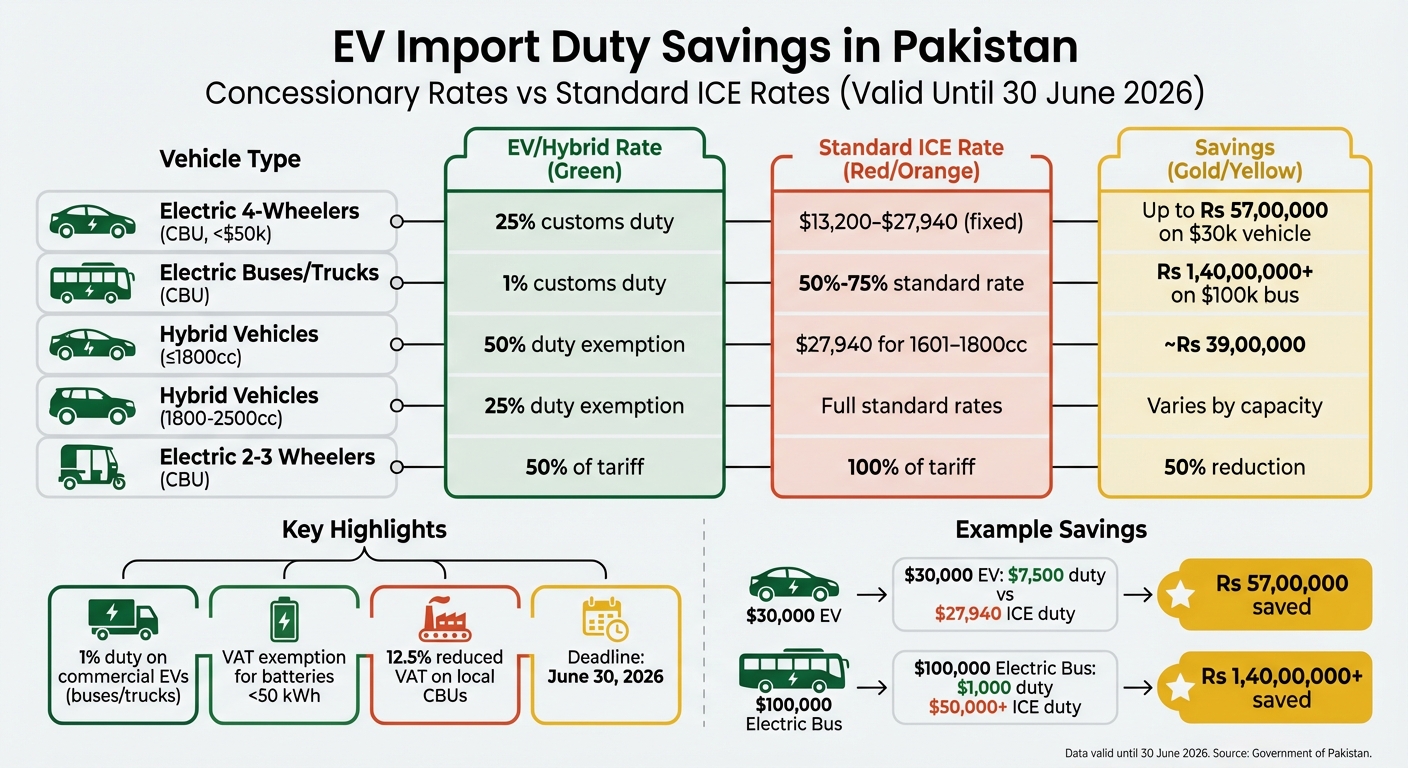
EV vs ICE Vehicle Import Duty Comparison in Pakistan 2024-2026
Pakistan’s concessionary duty structure for electric vehicles (EVs), effective until 30 June 2026, offers substantial cost advantages over the standard rates applied to internal combustion engine (ICE) vehicles. Here’s a detailed comparison of the rates and the potential savings they bring:
| Vehicle Type | Concessionary EV/Hybrid Rate | Standard ICE Rate | Potential Savings |
|---|---|---|---|
| Electric 4-Wheelers (CBU, value < $50,000) | 25% customs duty | $13,200–$27,940 (fixed, based on engine capacity) | Up to Rs 57,00,000 on a $30,000 vehicle |
| Electric Buses/Trucks (CBU) | 1% customs duty | 50%–75% standard commercial rates | Rs 1,40,00,000+ on a $100,000 bus |
| Hybrid Vehicles (≤1800cc) | 50% duty exemption | $27,940 for 1601cc–1800cc | Approximately Rs 39,00,000 |
| Hybrid Vehicles (1800cc–2500cc) | 25% duty exemption | Full standard rates apply | Varies by capacity |
| Electric 2-3 Wheelers (CBU) | 50% of prevailing tariff | 100% of prevailing rate | 50% reduction in duty costs |
The savings are particularly striking when you consider specific examples. A $30,000 electric 4-wheeler, subject to a 25% duty, would incur $7,500 in customs charges. In contrast, a comparable ICE vehicle in the 1601cc–1800cc category would face a fixed duty of $27,940. This results in savings of up to Rs 57,00,000. Similarly, electric buses benefit enormously from the 1% flat duty rate. For instance, a $100,000 bus would incur just $1,000 in duty, compared to over $50,000 under the standard commercial vehicle rates.
There are additional perks for EV buyers as well. Vehicles with batteries under 50 kWh are exempt from VAT, and locally imported CBUs of the same type are charged a reduced VAT rate of 12.5%, further lowering costs.
These reduced rates are part of the Electric Vehicle Policy 2020 and the Auto Industry Development and Export Policy (AIDEP) 2021–26. Buyers have until 30 June 2026 to take full advantage of these financial incentives, making now the ideal time to consider switching to EVs.
Conclusion
Bringing electric vehicles (EVs) into Pakistan offers financial benefits and a wider variety of choices compared to locally available options. With the current 1% import duty on EVs and tariff adjustments that could lower car prices by 15% to 50%, importing EVs is becoming an increasingly cost-effective option. This opens the door to global brands like Tesla and XPeng, as well as advanced models that are not yet part of Pakistan’s domestic market [4,32].
The process has also been made more convenient with the Pakistan Single Window (PSW) system, which simplifies customs clearance. This aligns with the country’s broader push towards EV adoption.
For overseas Pakistanis, schemes like Personal Baggage, Gift, and Transfer of Residence provide flexible ways to bring vehicles into the country [4,25]. On top of that, incentives for hybrid vehicles make it even more appealing to transition to greener modes of transportation.
Platforms like EV24.asia further simplify the experience by offering a complete import solution. They connect Pakistani buyers with a wide range of EVs – from budget-friendly options to high-end models packed with advanced features – while managing international shipping and ensuring compliance with local regulations.
FAQs
What are the financial advantages of importing an electric vehicle (EV) to Pakistan?
Importing an electric vehicle (EV) to Pakistan comes with some clear financial perks, thanks to reduced customs duties and taxes compared to conventional vehicles. For example, customs duty on EV components like CKD kits is just 1%, making it much more economical to import and assemble EVs. On top of that, hybrid electric vehicles (HEVs) with engine capacities up to 1800cc get a 50% duty exemption, which translates into noticeable cost savings.
EV chargers and related accessories also benefit from the same 1% customs duty, which helps cut down the upfront costs of establishing EV infrastructure. These measures align with Pakistan’s efforts to encourage electric mobility and reduce reliance on fossil fuels, making EVs not just environmentally friendly but also a budget-friendly choice for buyers.
How does the Pakistan Single Window (PSW) system make importing electric vehicles easier?
The Pakistan Single Window (PSW) system has made importing electric vehicles (EVs) into Pakistan much simpler by providing a centralised digital platform for handling trade-related tasks. Instead of navigating through multiple agencies, importers can now submit a single declaration. This declaration is automatically forwarded to the relevant authorities, cutting down on delays and eliminating the need for excessive paperwork.
Another key advantage of the PSW system is its focus on transparency, offering complete audit trails. It also supports pre-arrival filing, which speeds up customs clearance. By simplifying these procedures, PSW not only saves time but also reduces administrative hassles, making the process of bringing EVs into Pakistan smoother and more efficient.
What unique technologies do imported EVs offer compared to locally assembled models in Pakistan?
Imported electric vehicles (EVs) bring a host of modern technologies that are often missing in locally assembled models in Pakistan. These include features like autonomous driving capabilities, AI-driven virtual assistants, and advanced driver-assistance systems (ADAS), all designed to enhance safety, convenience, and the overall driving experience.
These vehicles also come equipped with cutting-edge battery management systems, ensuring better energy efficiency and extended driving ranges. On top of that, they offer smart infotainment systems with seamless integration for devices, providing a more connected and enjoyable journey.
With their focus on global advancements and adherence to higher quality standards, imported EVs offer a technological advantage that appeals to buyers looking for high performance and the latest innovations in Pakistan’s automotive market.