
 sysadmin
 Uzbekistan, a doubly landlocked nation in the heart of Central Asia, is experiencing a significant shift in its automotive landscape. With a growing population of approximately 36 million and a developing economy, the country is rapidly embracing electric mobility. This transition is driven by a combination of government support, increasing consumer awareness, and a burgeoning local industry. For international automotive businesses and importers, Uzbekistan presents a market with considerable potential, albeit one with its own unique set of regulations and characteristics.
The capital city, Tashkent, serves as the primary economic and cultural hub, where much of the country’s development is concentrated. The official language is Uzbek, with Russian also widely spoken, reflecting the nation’s history. The national currency is the Uzbekistani Som (UZS). As a country with right-hand traffic, vehicles are driven on the right side of the road. Given its landlocked status, Uzbekistan relies on land-based importation routes for vehicles, primarily through neighboring countries and extensive rail and road networks that connect it to major international ports.
The Uzbek government has been proactive in creating a favorable environment for the adoption of electric vehicles. Until early 2025, the import of electric vehicles was exempt from customs duties, excise taxes, and vehicle registration taxes, which significantly lowered the cost of ownership. However, importers are still required to pay a value-added tax (VAT) and a recycling fee, which can vary based on the age of the vehicle. While specific details on vehicle age restrictions for imports are to be confirmed, it is understood that newer vehicles may benefit from lower fees. The government has also announced a range of incentives for both consumers and producers of electric and hybrid vehicles, valid until 2030, to further stimulate the market.
The electric vehicle market in Uzbekistan has witnessed explosive growth in recent years. The market share of EVs, which stood at 7.1% in 2024, has continued to climb throughout 2025. In the first eight months of 2025, electric vehicles accounted for nearly 70% of all vehicle imports, and monthly sales reached a record high of 7,798 units in September 2025. The market is currently dominated by Chinese brands, with BYD emerging as the top-selling manufacturer. While specific data on the most popular EV categories, such as sedans or SUVs, is yet to be confirmed, the influx of various models from China suggests a diverse and growing consumer preference.
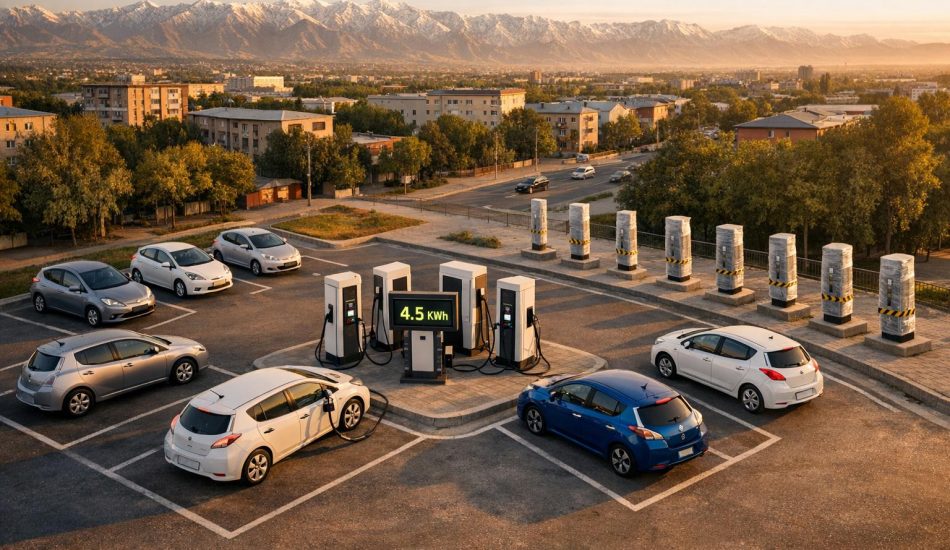
To support the growing fleet of electric vehicles, Uzbekistan is rapidly expanding its charging infrastructure. As of May 2025, the country had nearly 1,400 public charging stations, a number that has more than doubled in just one year. The government has ambitious plans for further expansion, aiming to have thousands more charging stations installed in the coming years. Major charging network operators such as TOK BOR, Voltauto, and Pulseev are actively deploying new stations across the country, including both AC and DC fast-charging options. The specific breakdown of AC versus DC chargers is data to be confirmed, but the focus is on building a comprehensive and reliable network to serve the needs of EV drivers.
The local EV industry in Uzbekistan is also gaining momentum, with a strong focus on local assembly and manufacturing. The state-owned automotive company, UzAuto, has entered into a joint venture with BYD to establish the “BYD Uzbekistan Factory” for the local assembly of electric and hybrid vehicles. This partnership aims to produce a significant number of vehicles annually, reducing the reliance on imports and fostering a domestic manufacturing ecosystem. Furthermore, other Chinese companies are exploring opportunities to set up production facilities in the country. The government is actively encouraging these initiatives through various support measures, with the goal of transforming Uzbekistan into a regional hub for electric vehicle production. Local manufacturing of charging equipment is also emerging, with companies like Pulseev developing and producing charging stations tailored to the local climate and energy grid.
In conclusion, the electric vehicle market in Uzbekistan is poised for continued and substantial growth. The combination of strong government support, a rapidly expanding charging infrastructure, and a burgeoning local manufacturing industry creates a fertile ground for the widespread adoption of electric mobility. For EV importers, the market offers significant opportunities, particularly for those who can introduce new brands and models to compete with the current market leaders. The long-term outlook for the EV sector in Uzbekistan is exceptionally positive, with the country well on its way to becoming a key player in the electric vehicle revolution in Central Asia.