
 Arka Pratama
 India, a nation of immense diversity and a rapidly growing economy, is making significant strides in the global transition towards electric mobility. With its capital in New Delhi, a population exceeding 1.4 billion, and the Indian Rupee (INR) as its currency, the country presents a unique and complex market for electric vehicles (EVs). The official languages are Hindi and English, which facilitates international business and communication. A crucial factor for vehicle importers to consider is that India follows left-hand traffic regulations, a legacy of its British colonial past. The primary gateways for vehicle importation are major ports such as Mumbai, Chennai, and Kolkata, along with other significant hubs like Jawaharlal Nehru Port and Mundra Port, which are well-equipped to handle large-scale automotive logistics.
The Indian government has implemented a series of regulations and incentives to both control and encourage the importation of electric vehicles. In a landmark move to attract foreign investment and bolster domestic manufacturing, the import duty on fully assembled EVs priced above $35,000 has been drastically reduced from as high as 110% to a mere 15%. This concession, however, is contingent on manufacturers committing to a significant investment in local production facilities. For other categories of imported EVs, the tariff structure remains complex and can be a significant cost factor. To further stimulate the market, the government offers a range of incentives under schemes like FAME II (Faster Adoption and Manufacturing of Electric Vehicles), which includes purchase subsidies, road tax exemptions, and reduced registration fees. While there are generally restrictions on importing used vehicles older than three years, a special provision allows for the import of classic and vintage cars over 50 years old, albeit with substantial customs duties.
The Indian EV market is experiencing exponential growth, with sales figures reflecting a strong consumer shift towards electric mobility. In the fiscal year 2024-2025, the total EV sales in India surpassed the two million unit mark, a testament to the burgeoning demand. This surge has pushed the EV market share to approximately 8% of total vehicle sales, a figure that is expected to climb steadily in the coming years. The market has been historically dominated by domestic auto giant Tata Motors, which offers a popular range of electric cars including the Nexon EV and the Punch EV. However, the competitive landscape is evolving rapidly with the entry of international players like MG Motor, whose Windsor EV has gained significant traction, alongside other brands such as Mahindra, Kia, and BYD. The most popular EV categories in India are currently SUVs and compact cars, which cater to the diverse needs and preferences of the Indian consumer.
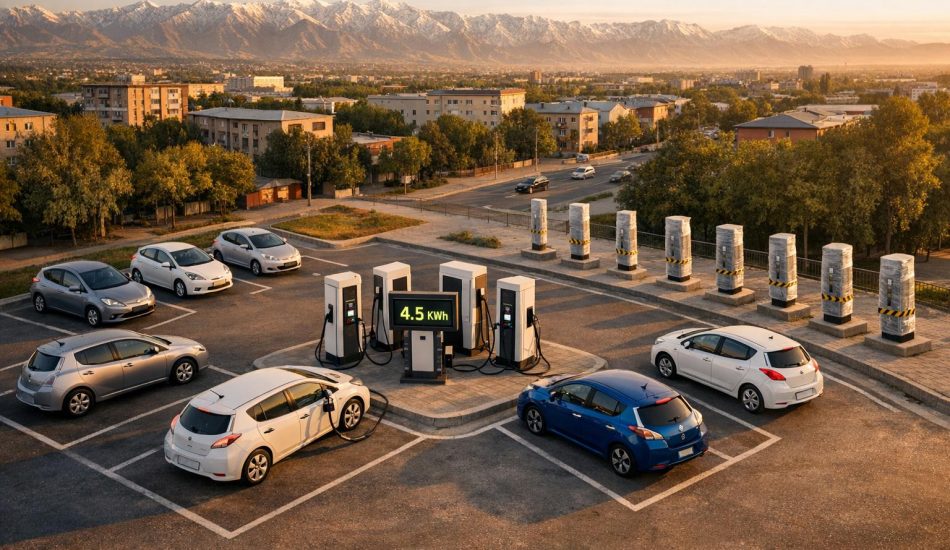
To support this burgeoning EV ecosystem, India is rapidly expanding its charging infrastructure. While exact figures vary, it is estimated that there are over 25,000 public charging stations across the country, a number that is constantly growing. The distinction between AC and DC charging points is still an area where data is being consolidated, but the focus is clearly on establishing a dense network of both standard and fast-charging options. Several key players are driving this expansion, including Tata Power, which has established a vast network of EZ Charge stations, alongside other major operators like Statiq, Bolt.Earth, and Jio-bp. These companies are not only setting up charging points in urban centers but are also focusing on highways and other strategic locations to alleviate range anxiety and facilitate long-distance travel in EVs.
The ‘Make in India’ initiative is at the heart of the country’s EV policy, with a strong emphasis on developing a robust local manufacturing ecosystem. The Indian EV industry is not just limited to four-wheelers; it also includes a thriving sector for electric two-wheelers and three-wheelers, with companies like Hero Electric, Ather Energy, and Ola Electric leading the charge. The local manufacturing landscape is further strengthened by a growing number of companies producing charging equipment, such as Exicom Tele-Systems, Servotech Power Systems, and ABB India. The government’s Production Linked Incentive (PLI) scheme has been instrumental in attracting foreign investment, with companies like Vietnamese automaker VinFast recently inaugurating an assembly plant in Tamil Nadu. These initiatives are aimed at creating a self-reliant EV industry that can cater to both domestic and international markets.
In conclusion, the Indian electric vehicle market is poised for a period of unprecedented growth and transformation. The combination of a large and young population, increasing environmental awareness, and strong government support creates a fertile ground for the expansion of electric mobility. For EV importers, the key opportunity lies in leveraging the new import duty regulations by committing to local manufacturing, which not only provides access to a massive market but also aligns with the government’s long-term vision for a self-sufficient and sustainable automotive industry. The road ahead is electric, and India is firmly in the driver’s seat of this global revolution.
© 2025 EV24.asia. All rights reserved.