
 Arka Pratama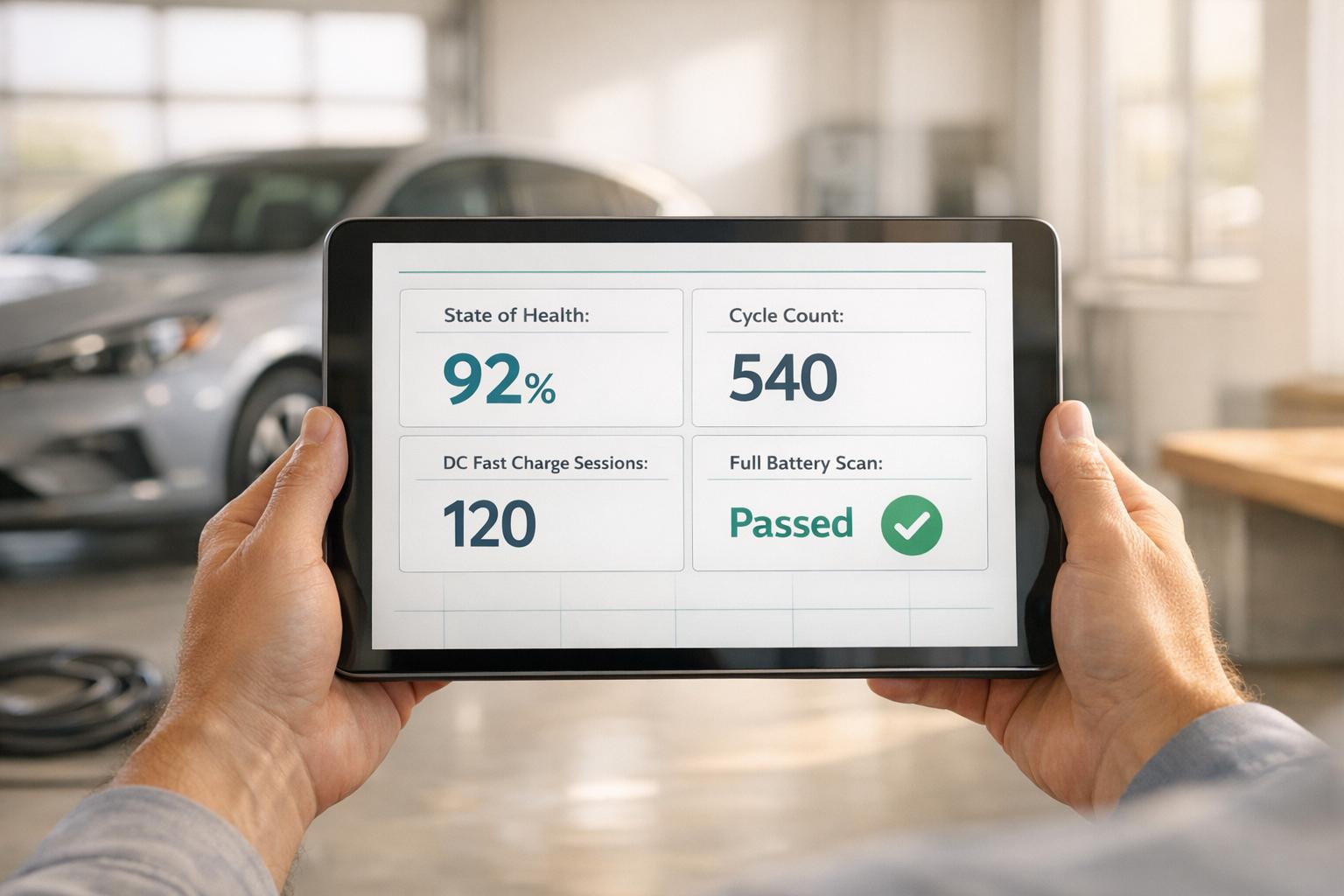
When buying a used electric vehicle (EV), the battery’s health is the most critical factor to evaluate. Batteries degrade over time, and their condition directly affects range, performance, and resale value. Here’s what you need to know:
- State of Health (SOH): This shows the battery’s current capacity compared to when it was new. A healthy battery in a 3–4-year-old EV should have an SOH between 88%–94%. Anything below 80% may require price negotiations.
- Degradation Rates: Batteries degrade at an average of 1.8% per year. Factors like frequent DC fast charging or extreme heat can accelerate this.
- Charging Habits: Check the vehicle’s charging history. Consistent charging within 20%-80% is ideal, while excessive fast charging or deep discharges can harm the battery.
- Cycle Count: A 3-year-old EV should have fewer than 500 full charge cycles. Higher counts may indicate quicker wear.
- Inspection Tools: Use diagnostic tools like OBD scanners to check metrics like SOH, cycle count, and cell voltage variance.
- Professional Scans: A detailed battery health report from a service centre can help identify hidden issues and support price negotiations.
- Warranty Check: Verify the battery’s warranty coverage and ensure it transfers to the new owner.
Key Tip: Always request a professional battery scan and service records before finalizing a purchase. Battery replacements can cost Rs. 2.0–5.5 million, so understanding the battery’s condition upfront can save you from unexpected expenses.
Buying a Used EV Advice | Battery Health Check
Key Battery Health Metrics You Need to Know
Used EV Battery Health Guide: SOH Ranges by Vehicle Age and Mileage
When considering a used EV, understanding its battery health is crucial. Three key metrics can give you a clear picture of the battery’s condition, helping you decide whether the vehicle is a worthwhile investment or a potential money pit. These metrics reveal how well the battery is performing now and offer clues about future maintenance needs.
State of Health (SOH)
State of Health (SOH) reflects the current usable capacity of the battery as a percentage of its original capacity. Think of it like this: while the State of Charge (SOC) shows how much energy is currently available – like a fuel gauge – SOH tells you how much "fuel tank" remains compared to when the battery was new. Over time, chemical wear reduces this capacity.
"State of health (SOH) is an estimate of how much usable energy your battery can store today compared with when it was new." – Recharged
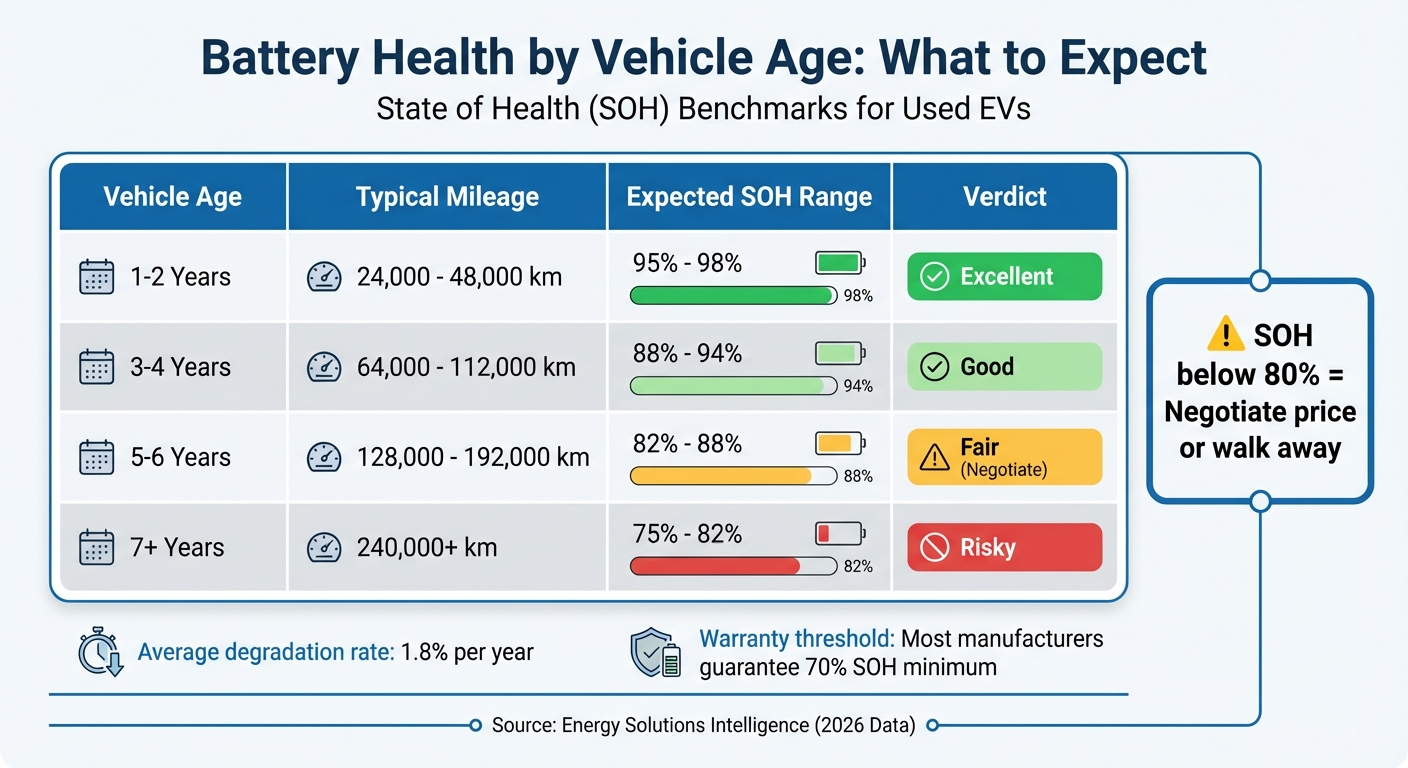
For example, an SOH of 75% means a vehicle with an initial 300-mile range now offers about 225 miles. Most manufacturers promise a minimum SOH of 70% over an 8-year/160,000 km warranty period. After 3–4 years and between 64,000 and 112,000 km, a healthy EV typically maintains an SOH of 88% to 94%. If the SOH falls below 80%, it’s wise to negotiate the price since the battery may soon hit the replacement threshold.
| Vehicle Age | Typical Mileage | Expected SOH Range | Verdict |
|---|---|---|---|
| 1-2 Years | 24,000 – 48,000 km | 95% – 98% | Excellent |
| 3-4 Years | 64,000 – 112,000 km | 88% – 94% | Good |
| 5-6 Years | 128,000 – 192,000 km | 82% – 88% | Fair (Negotiate) |
| 7+ Years | 240,000+ km | 75% – 82% | Risky |
Source: Energy Solutions Intelligence (2026 Data)
SOH is a critical factor in determining whether the remaining battery capacity justifies the asking price and helps you anticipate potential replacement expenses.
Battery Capacity and Degradation Rates
Battery degradation isn’t one-size-fits-all – it depends heavily on charging habits and environmental conditions. For instance, EVs that rely mostly on DC fast charging degrade about 12% faster than those charged with Level 2 home chargers. Similarly, air-cooled batteries in extremely hot climates can lose up to 30% of their capacity in just three years.
The type of battery chemistry also matters. LFP (Lithium Iron Phosphate) batteries, for example, degrade around 40% slower than NCA (Nickel Cobalt Aluminium) or NCM (Nickel Cobalt Manganese) batteries. This means newer EVs with LFP batteries often maintain better capacity compared to older models with NCM packs. Many long-range EVs still hold over 80% of their original capacity even after 200,000 km.
Understanding these factors can help you gauge the battery’s long-term reliability and potential maintenance costs.
State of Charge (SOC) and Charging Cycle Count
Beyond capacity metrics, how the battery has been charged and maintained plays a significant role in its longevity. Testing the SOC within a 20%-80% range ensures a more accurate evaluation of battery health.
The charging cycle count is another important metric. It tracks the total number of complete 0%-100% charge cycles the battery has undergone. Each full cycle contributes to cell wear. Ideally, a 3-year-old EV should have fewer than 500 full charge cycles. High cycle counts, especially when combined with frequent DC fast charging, suggest the battery may wear out sooner than its mileage or age might indicate.
"The age of a vehicle becomes less of a marker in comparison to how it has been charged and driven." – Paul Bennett, Senior Partner, Madox Square
To assess this, use an OBD-II scanner to check the charge cycle count and DC fast charging history. If over 50% of the energy has come from DC fast chargers, consider negotiating a lower price due to the increased risk of accelerated degradation. On the other hand, vehicles consistently charged within the 20%-80% range tend to show better long-term performance compared to those frequently charged to 100% or allowed to deplete completely.
Reviewing these charging habits and cycle counts provides valuable insights into how the battery has been treated and what to expect from its remaining lifespan.
Pre-Purchase Battery Inspection Checklist
When buying a used EV, it’s crucial to verify the seller’s claims about the battery’s condition. This checklist combines reviewing records, conducting tests, and using diagnostic tools to assess the battery’s actual health.
Review Service Records and Charging History
Start by asking the seller for the complete service history and charging logs. Keep in mind that frequent use of DC fast charging can wear down batteries about 12% faster than Level 2 charging. Look for charging patterns that show the battery was typically kept between 20% and 80% charge, avoiding full charges or deep discharges below 20%.
For an EV that’s around three years old, the charge cycle count should ideally be under 500. Confirm that any battery repairs or replacements were handled by authorised service centres. Also, check for any battery-related recalls – like the Chevy Bolt‘s LG battery fire issues or the Ford Mustang Mach-E‘s contactor problems – and ensure the necessary fixes were completed.
It’s also worth considering where the vehicle has been driven. EVs that have spent a lot of time in extreme heat, such as Karachi’s scorching summers, tend to experience faster battery degradation, especially if they’re air-cooled models like the Nissan Leaf. If the seller cannot or will not provide charging history or battery reports, it’s best to walk away from the deal.
Once you’ve confirmed the documentation is in order, move on to testing the battery’s performance in person.
Perform On-Site Charging and Range Tests
After reviewing the records, test the battery’s performance on-site. Don’t rely solely on the dashboard range estimate, as it reflects recent driving habits rather than the battery’s true capacity. Instead, perform a practical range test: fully charge the EV, note the displayed range, and drive a set distance – say 48 kilometres at 100-110 km/h on the highway. Use this to calculate the car’s efficiency (kilometres driven ÷ kWh consumed). This real-world test helps confirm the battery’s performance against the paperwork.
To further evaluate capacity, compare the energy added during charging with the change in the state of charge (SOC). For instance, if you add 33 kWh to a 66 kWh battery, the SOC should increase by 50%. Test charging on Level 1 (120V), Level 2 (240V), and Level 3 (DC Fast Charging) to ensure all ports and circuits are working properly and meet the manufacturer’s speed specifications.
Use Diagnostic Tools or OBD Scanners
For a more detailed assessment, use diagnostic tools to scan the battery. Most EVs allow you to monitor battery health via the On-Board Diagnostics (OBD) port, usually located under the steering wheel. For DIY inspections, consider reliable adapters like the OBDLink MX+ (around Rs. 28,000), which work with advanced EV apps.
Choose apps suited to your EV model: Scan My Tesla (Rs. 8,500) for Tesla vehicles provides data on internal resistance and temperature, LeafSpy Pro (Rs. 4,200) is ideal for monitoring Nissan Leafs’ battery bars and cell pairs, and Torque Pro (Rs. 1,400) works with Chevy Bolts when paired with specific PID codes.
When scanning, check that the cell voltage variance stays below 0.02V – anything above 0.05V could indicate failing cells. For accurate results, ensure the battery temperature is between 15°C and 27°C during the scan. For used EVs under five years old, a State of Health (SOH) below 85% is generally a red flag.
sbb-itb-5f05a6f
Professional Battery Health Scans and Warranties
Get a Professional Battery Health Scan
Once you’ve done your initial checks, a professional battery health scan provides a deeper, more precise look at the battery’s condition. While DIY tools are handy, they can’t match the accuracy of professional-grade diagnostics. Authorised dealers and specialised service centres use advanced equipment to spot issues that basic OBD scanners might miss, such as Battery Management System (BMS) errors, high internal resistance, or high-voltage isolation problems.
A professional scan report typically includes details like the State of Health (SOH), cell voltage range, total charge cycles, and the number of DC fast charges. Alongside this, technicians physically examine the battery for dents, scrapes, or coolant leaks – issues that could lead to dangerous thermal runaway. The service can cost between Rs. 42,000 and Rs. 84,000, which is a small price to pay compared to replacing a degraded battery, which can cost anywhere from Rs. 2,240,000 to Rs. 6,160,000.
"Without battery data, dealers guess on trade-in value and retail price, eroding margin on both ends." – Voltest
Having a detailed health report is a game-changer when negotiating. Buyers armed with professional battery data save an average of Rs. 1,176,000 compared to those who don’t. If the seller refuses to allow a professional scan, it’s a clear red flag – walk away without hesitation.
This data-backed health report not only confirms the battery’s current performance but also helps you verify warranty terms with confidence.
Verify Battery Warranty and Degradation Norms
After getting the professional scan, the next step is to confirm the battery’s warranty details. It’s crucial to verify this information directly with the manufacturer, not just rely on what the seller says. Use the Vehicle Identification Number (VIN) to contact the manufacturer’s customer service and confirm the warranty’s remaining duration, mileage limits, and whether it’s transferable. Most EV warranties transfer to new owners at no extra cost, but brands like BMW and Mercedes often limit coverage to the original owner, which can affect your negotiation.
Typically, manufacturers guarantee battery capacity until it falls below 70% SOH within the warranty period. For reference, a 3-4 year old EV should generally have an SOH between 88% and 94%. If a vehicle under five years shows an SOH below 85%, it could indicate significant wear or environmental stress – best to steer clear. Always get written confirmation of the warranty status via email, and include a clause in the purchase agreement that the sale depends on the battery SOH meeting your minimum standard. This step is essential in reducing long-term risks.
| Manufacturer | Warranty Coverage | Transfers to 2nd Owner? | Degradation Threshold |
|---|---|---|---|
| Tesla | 8 yr / 193,000 km | Yes (Full) | 70% SOH |
| Hyundai/Kia | 10 yr / 161,000 km | Yes (Full) | 70% SOH |
| Ford | 8 yr / 161,000 km | Yes (Full) | 70% SOH |
| Chevrolet | 8 yr / 161,000 km | Yes (Full) | 60% SOH (Bolt) |
| BMW/Mercedes | 8 yr / 161,000 km | No (1st owner only) | 70% SOH |
EV24.asia Buying Tips for Used EVs
Access Transparent Listings and Verified Battery Health
When it comes to buying a used EV, understanding the battery’s condition is crucial. EV24.asia takes the guesswork out of the process by providing State of Health (SOH) certificates with every listing. These certificates clearly show the battery’s remaining capacity compared to its original factory specifications. This way, you can base your decision on the actual battery condition, not just the vehicle’s age or mileage.
To further ensure transparency, the platform includes independent health reports from trusted third-party providers. These reports offer an unbiased look at the battery’s status. Additionally, listings come with verified charging histories, detailing how often DC fast charging was used. This is particularly important in Pakistan, where the hot climate can accelerate battery wear. Liquid-cooled systems are often preferred in such conditions, as they handle heat better than air-cooled alternatives.
Battery health now plays a major role in determining resale value. With verified data and transparent pricing provided by EV24.asia, you can negotiate with confidence and avoid paying extra for a vehicle with hidden battery problems. This approach not only ensures fair pricing but also simplifies the process of importing a used EV.
Simplify Import and Compliance Processes
Importing a used EV into Pakistan can be a complicated process, involving layers of paperwork, customs clearance, and local registration. EV24.asia takes care of all these steps, offering a seamless experience. From shipping services – whether through Roll-on/Roll-off (RoRo) or container options – to customs handling and registration, the platform manages the entire process.
Their end-to-end service removes much of the administrative hassle. You’ll get clear instructions on meeting local regulatory standards, ensuring your imported EV complies with all Pakistani requirements. With flexible payment options and expert support, EV24.asia allows you to focus on selecting the right vehicle, while they handle the logistics.
Conclusion: Making Informed Decisions When Buying a Used EV
When it comes to buying a used EV in 2026, taking a data-driven approach can make all the difference between a smart investment and a costly mistake. As Energy Solutions Intelligence puts it, "Battery health was the #1 deal-breaker". This insight underscores the importance of prioritising battery condition during your evaluation process.
Before you even consider a test drive, make sure to request a detailed State of Health (SOH) report and examine the vehicle’s service records to get a clear picture of its charging habits. Pair this with real-world range tests and warranty checks to assess the battery’s performance accurately. Keep in mind that modern EV batteries tend to degrade at approximately 1.8% annually. For context, a 3–4 year old EV with an SOH of 88%–94% is generally in good shape, while anything below 82% should raise red flags and lead to either tough negotiations or a second thought about the purchase.
Investing in a professional battery scan – costing around Rs. 43,000 to Rs. 86,000 (approximately $150–$300) – can save you from unexpected expenses later. This is especially true when you consider that replacing a battery could set you back anywhere from Rs. 2.3 million to Rs. 6.3 million (approximately $8,000–$22,000). Buyers have successfully used battery health data during negotiations, saving an average of Rs. 1.2 million (approximately $4,200). Clearly, this small upfront cost can lead to significant savings.
Platforms like EV24.asia simplify the buying process by offering verified SOH certificates, independent battery health reports, and comprehensive charging histories for each listing. This level of transparency, combined with import support, allows you to focus on finding the right vehicle. In Pakistan, where high temperatures can accelerate battery wear, having access to reliable data on cooling systems and degradation rates is even more critical.
With the used EV market growing by an impressive 60.6% in early 2025, Energy Solutions Intelligence highlights that "battery literacy will be a core car-buying skill." Armed with this checklist and the right tools, you can confidently navigate the market and secure a reliable EV for years to come.
FAQs
What should I check to assess the battery health of a used electric vehicle?
To evaluate the battery health of a used EV, start by examining the State of Health (SOH). This metric indicates the battery’s current capacity as a percentage of its original capacity. You can usually find this information on the vehicle’s dashboard or through the manufacturer’s app. For a deeper dive, tools like OBD-II scanners can provide data on SOH percentage, cell voltages, and temperature readings.
It’s also a good idea to check the vehicle’s service records. Look for any past battery issues, accidents, or instances of overheating, as these can impact the battery’s longevity. Taking the car for a test drive is another practical step. Compare the actual driving range to the manufacturer’s specifications to identify any noticeable drop in capacity. Some automakers or independent services may even offer official battery health reports or warranties, which can add peace of mind.
By factoring in these aspects, you’ll have a clearer picture of the battery’s condition and performance before committing to the purchase.
How can I check if the warranty on a used EV is valid and transferable to me?
To verify the warranty on a used EV and ensure it’s transferable, start by checking the manufacturer’s warranty terms. Most EVs include a high-voltage battery warranty, which typically lasts 8 years or up to 160,000 km. However, the exact coverage and transfer rules vary by brand.
Request the seller to provide the warranty documents. These should outline the start date, coverage period, and any conditions for transferring the warranty. Some manufacturers allow transfers at no cost, while others might require a formal registration process or charge a small fee. Also, confirm whether the warranty includes coverage for battery degradation in addition to outright failure, as this can have a big impact on the EV’s long-term value. Sorting out these details before buying can save you from unexpected expenses down the road.
Why should you get a professional battery health scan before buying a used electric vehicle?
A professional battery health scan is a crucial step when purchasing a used electric vehicle (EV). It provides an accurate assessment of the battery’s condition, focusing on key aspects like capacity and degradation. These details help you understand how well the battery can perform and whether it suits your daily driving needs.
This process can save you from unexpected costs, like expensive battery replacements, while ensuring the EV delivers consistent range and performance. Spending on a professional scan allows you to make a well-informed choice, giving you confidence that the battery meets your expectations.