
 Arka Pratama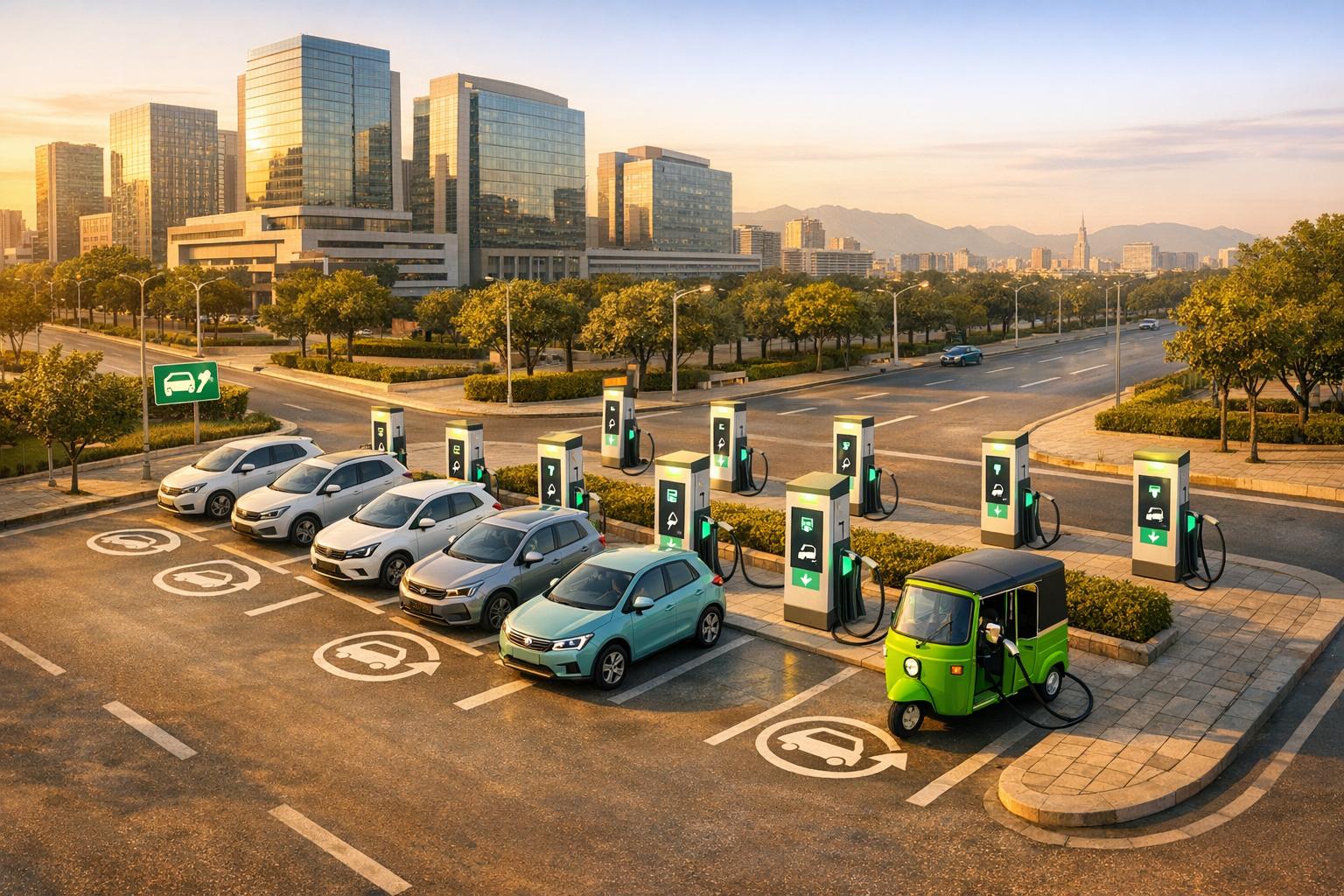
Asia’s electric vehicle (EV) market is transforming in 2026, driven by affordable models, expanded charging networks, and local manufacturing. Countries like Vietnam, Thailand, and Indonesia are outpacing global players in EV adoption, with Pakistan focusing on electric two- and three-wheelers for affordable mobility. Key highlights include:
- Sales Growth: By 2025, Vietnam and Singapore achieved 40% EV share in new cars, while Pakistan is targeting two-wheelers and e-rickshaws.
- Affordability: EV prices in Asia are dropping, with many models under USD 25,000. In Pakistan, subsidies under the PAVE programme reduce costs by 20%-25%.
- Charging Infrastructure: Pakistan slashed EV charging tariffs by 45%, with 40 new stations planned along motorways.
- Local Manufacturing: BYD and XPeng are setting up assembly plants in Pakistan and Southeast Asia, reducing import costs.
This shift is making EVs more accessible, with Pakistan poised to benefit from lower prices, subsidies, and improved infrastructure.
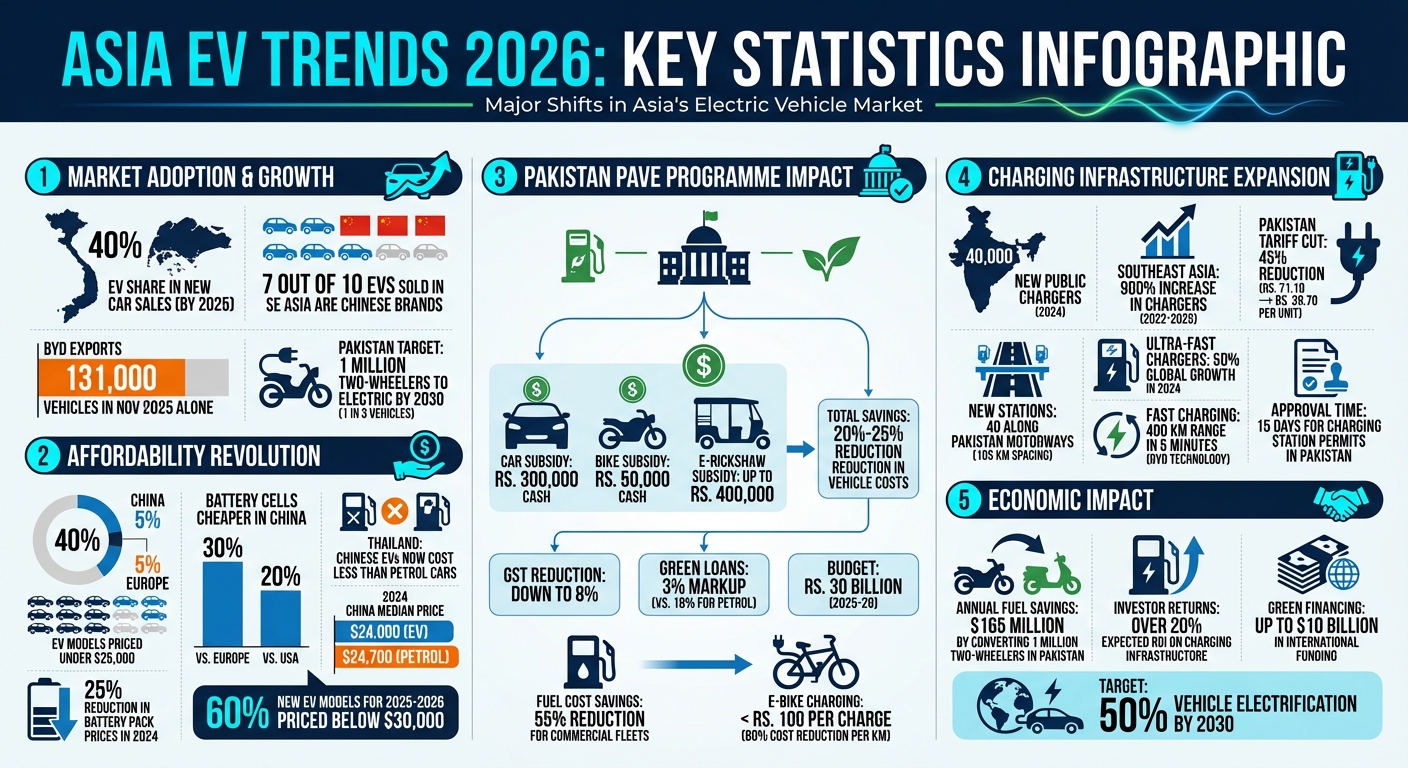
Asia EV Market 2026: Key Statistics on Prices, Charging Infrastructure and Adoption Rates
The Best New Electric Cars Arriving In 2026!
sbb-itb-5f05a6f
New EV Models Coming to Asian Markets
In 2026, Asia’s electric vehicle (EV) market is set to expand with a wide variety of options, from compact city cars to spacious seven-seat MPVs. These vehicles are designed to navigate the bustling streets of Karachi and the suburban landscapes of Jakarta. Here’s a closer look at the dominance of Chinese EV manufacturers, the rise of regional production, and the types of vehicles gaining traction among consumers.
Chinese Manufacturers Leading the Market
Chinese brands are firmly establishing their dominance, with seven out of every ten EVs sold in markets like Indonesia, Malaysia, Vietnam, Thailand, Singapore, and the Philippines being of Chinese origin. BYD, for instance, exported 131,000 vehicles in November 2025 alone and plans to begin local assembly in Pakistan by 2026. Meanwhile, XPeng is gearing up to launch its upgraded P7+ model across 36 countries. This model boasts 104 enhancements, including a 29-inch AR head-up display and an AI-powered autopilot system capable of delivering 2,250 TOPS (trillion operations per second).
The technology in these models is impressive. The XPeng P7+ comes in both pure battery and REEV (Range-Extended Electric Vehicle) versions. The REEV variant pairs a large battery with a small petrol engine, offering an extraordinary range of 1,550 km. Similarly, the MG4 EV is set to introduce semi-solid-state battery technology in its "Anxin Edition", developed in collaboration with Suzhou QingTao Power Technology, bringing advanced battery features to everyday consumers.
"EVs are inevitable. The journey has just begun with this technology, and already it is proving that plugging into a national grid of large power plants is more efficient than using millions of little generators." – Paul Tan, founder of PaulTan.org
Regional Manufacturing and Assembly
Local production is changing the game for availability and pricing in Asia. BYD plans to assemble vehicles in Pakistan starting in 2026, while XPeng is partnering with EP Manufacturing Berhad in Malaysia to cater to ASEAN markets. The move from importing fully built units (CBUs) to local assembly helps manufacturers sidestep hefty import duties. For example, Malaysia imposes a minimum price of RM 100,000 on imported EVs.
This strategy is paying off. In Malaysia, the Proton e.MAS 7 – produced in partnership with Geely – became the top-selling EV in the first nine months of 2025. With 6,655 units sold, it captured 25% of the EV market, showing how locally assembled vehicles with strong national branding can compete effectively against international players.
Most Popular Vehicle Types
Electric SUVs and crossovers continue to dominate consumer preferences across Asia. In India, notable launches include the Maruti Suzuki e-Vitara (featuring a 61 kWh battery and a 543 km range), the Tata Sierra EV with all-wheel drive, and the Skoda Elroq, which offers multiple battery options and a 340 hp AWD version. MPVs are also gaining momentum, with models like Vinfast‘s seven-seat Limo Green competing with BYD’s eMax 7.
For urban commuters, compact city cars remain a popular choice. Models like the Vinfast VF3 and the Kia Syros EV – expected by June 2026 – are designed with features such as panoramic sunroofs to meet the needs of city dwellers.
EV Pricing and Affordability in 2026
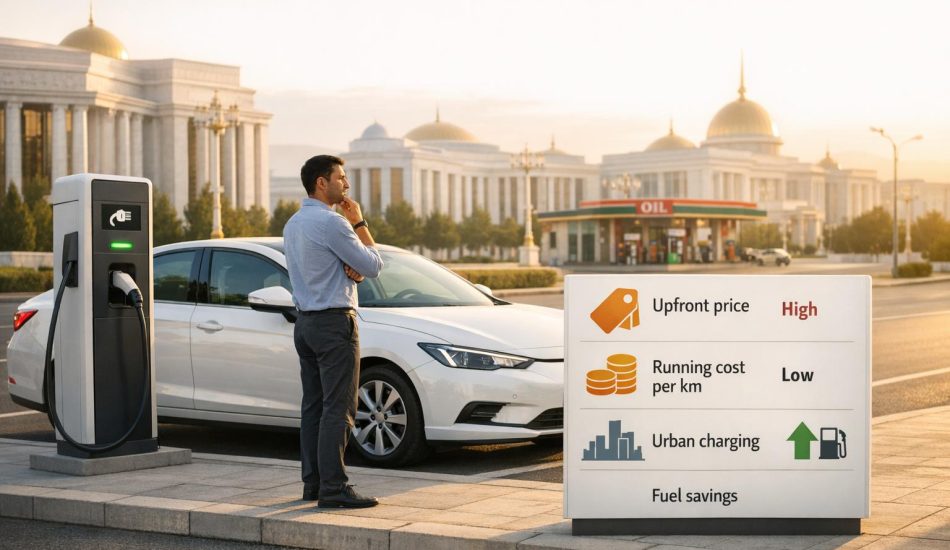
With the rapid introduction of new electric vehicle (EV) models, affordability has become a major factor driving market growth across Asia. Falling battery costs and expanded manufacturing have made EVs more accessible. For example, battery pack prices dropped by over 25% in 2024, and this downward trend is expected to continue as production capacity surpasses demand. In China, 40% of available EV models are priced under USD 25,000, in stark contrast to just 5% in Europe.
The price gap between EVs and traditional petrol vehicles is narrowing quickly. In Thailand, the average cost of a Chinese-made EV is now lower than that of a petrol car. Additionally, battery cells in China are over 30% cheaper than in Europe and 20% cheaper than in the U.S., which helps reduce overall production costs by about 30%. These cost advantages, combined with strong government incentives and a shift toward local manufacturing, are reshaping the EV landscape.
Government Support and Tax Benefits
Pakistan’s PAVE (Pakistan Accelerated Vehicle Electrification) programme, launched in September 2025 through the pave.gov.pk portal, is a game changer. It offers direct cash subsidies of Rs. 300,000 for electric cars and Rs. 50,000 for electric bikes, backed by a Rs. 30 billion budget for 2025–26. The programme also reduces GST to 8% and eliminates customs duties on EV batteries.
These subsidies and incentives can help individual buyers save 20%–25% on vehicle costs. Additionally, "Green Loans" are available at a 3% mark-up for EV financing, compared to the 18% rate for conventional auto loans. This financing advantage significantly lowers monthly payments. For instance, a Lahore-based ride-sharing startup converted 50 mini-vans to electric, slashing their fuel costs by 55%.
The 2025 budget also introduced a "Green Tax", which adds a 1%–3% levy to the price of petrol and hybrid vehicles based on engine size, while fully electric vehicles remain completely exempt. This tax structure gives EVs a clear price edge over hybrids like the Toyota Corolla Cross HEV (priced at Rs. 9,178,980) and the Kia Sorento 1.6T HEV AWD (Rs. 16,318,980).
How Local Production Reduces Costs
In addition to government policies, local manufacturing plays a crucial role in lowering EV costs. By avoiding high import duties and ensuring the availability of spare parts, local production makes EVs more affordable. Under the PAVE programme, zero customs duty on EV batteries and reduced GST for locally assembled vehicles further encourage domestic manufacturing.
Local production also achieves economies of scale that imported units cannot. For example, all domestically manufactured EVs in India are priced below USD 20,000, while imported Chinese models exceed that price due to import duties. Similarly, Thailand has rolled out the second phase of its EV subsidy programme (2024–2027), offering tax holidays and reduced import duties to global manufacturers setting up local production plants.
Operational savings are another key benefit. In Pakistan, e-bikes can be charged for less than Rs. 100, reducing daily travel costs by 80% per kilometre compared to petrol bikes.
Price Ranges by Vehicle Segment
Pakistan’s EV market in 2026 caters to a wide range of budgets, from economical two-wheelers to high-end family vehicles. Entry-level electric scooters like the Crown Benling Fairy start at Rs. 210,000, while mid-range options such as the Jolta Electric JE 100L SE are priced at Rs. 289,900. On the premium end, models like the E Turbo Warrior 200KM go for Rs. 577,000.
The PAVE scheme has approved a variety of electric bikes across different price points to meet diverse needs:
| Company | Model | Price (PKR) |
|---|---|---|
| Chang Jiang Industrial | N21 | 245,000 |
| Eiffel Industries | Road Prince E-Go-2 | 250,000 |
| United Auto | EV Bullet Max | 280,000 |
| MS Jaguar | Jaguar E-125 | 349,900 |
| Eiffel Industries | Yadea Velax | 490,000 |
| Zong Fa New Energy | ZF125E3000 | 510,000 |
The programme also includes quotas for women, students, widows, and low-income households, ensuring that EVs are accessible to a broader audience. For three-wheelers, PAVE offers subsidies of up to Rs. 400,000 for e-rickshaws and loaders, targeting the large fleet of over 20 million motorcycles and three-wheelers in Pakistan, many of which currently depend on costly imported fuel.
Across Asia, about 60% of announced EV models for 2025–2026 are expected to launch at prices below USD 30,000. In China, the median price for an EV in 2024 was approximately USD 24,000 – USD 700 less than the median price for a petrol car. This shift highlights how quickly the market is tilting in favour of electric vehicles.
Charging Infrastructure Development
Charging stations are growing at a rapid pace across Pakistan and the broader Asian region. For instance, India added around 40,000 new public chargers in 2024 alone. This expansion is crucial in addressing range anxiety, a significant hurdle for EV adoption in emerging markets.
Charging Station Network Growth
In a major move to encourage EV adoption, Pakistan’s government approved a 45% reduction in electricity tariffs for EV charging station operators. This brought the rate down from Rs71.10 to Rs39.70 per unit. The policy is aimed at making investments in charging infrastructure more attractive, with investors expecting returns exceeding 20%.
"Charging station tariffs will decrease from Rs71.10 to Rs39.70… we want the investor as well as the consumer to benefit from this policy." – Awais Leghari, Pakistan Energy Minister
Further boosting this effort, the government is setting up 40 new EV charging stations along national motorways. These stations will be spaced approximately 105 kilometres apart. To streamline the process for investors, the National Energy Efficiency and Conservation Authority (NEECA) has introduced a one-window permitting system, ensuring approvals for charging station installations are granted within just 15 days. These developments are laying the groundwork for advanced and accessible charging solutions.
Fast-Charging and Home Charging Options
Ultra-fast charging technology is reshaping the EV landscape across Asia. Globally, the number of ultra-fast chargers (150 kW+) grew by 50% in 2024. In China, companies like BYD are leading the way with megawatt charging platforms that can deliver 400 kilometres of range in just 5 minutes. Meanwhile, the cost of ultra-fast charging equipment dropped by 20% between 2022 and 2024.
Though most EV owners still rely on home charging, public fast-charging is vital for urban residents without private parking. In India, about 55% of consumers reported access to home charging in 2024. Additionally, battery swapping is becoming a popular alternative for two- and three-wheelers in India and Southeast Asia, offering a quick and convenient charging option.
Government and Private Sector Partnerships
Building on technological advancements, collaboration between the public and private sectors is accelerating the development of charging infrastructure. Pakistan’s National Electric Vehicle (NEV) Policy 2025-30 was crafted with input from over 60 industry stakeholders to promote local manufacturing and private investment. The policy also requires EV charging points to be integrated into new building codes for urban areas.
Private companies are also stepping up. BYD, in partnership with Mega Motors, is working on establishing local manufacturing and charging ecosystems, aiming for 50% vehicle electrification by 2030. To support these efforts, the government is pursuing up to $10 billion in international green financing.
"The success of the new policy depends on how the international community lives up to its commitment to catalysing adoption through green financing for such initiatives." – Awais Leghari, Energy Minister, Pakistan
Switching 1 million two-wheelers to electric in Pakistan could save approximately $165 million annually in fuel import costs. With reduced tariffs, streamlined permitting processes, and strong public-private collaboration, Pakistan is on track to significantly expand its charging network, making EVs a viable option for millions.
Conclusion: What These Changes Mean for Asian EV Markets
Asia’s electric vehicle (EV) market is undergoing a major shift, transitioning from being heavily reliant on government policies to thriving on its own through market-driven growth. Emerging economies are leading the way, with affordable EVs redefining transportation across the region. This evolution is reshaping consumer preferences and pricing strategies, paving the way for a broader transformation.
"The assumption that EV growth will stall outside Europe and China is already outdated. Emerging markets will shape the future of the global car market." – Euan Graham, Electricity and Data Analyst, Ember
For many Asian consumers, the total cost of ownership has become the key factor when choosing an EV, often outweighing environmental considerations. In China, for instance, two-thirds of electric cars sold in 2024 were priced lower than petrol-powered alternatives. This affordability is making EVs more accessible to a wider audience.
The availability of budget-friendly EV models, combined with rapidly expanding charging networks, is driving this transformation. In countries like Pakistan, electric two- and three-wheelers are expected to play a pivotal role in introducing electrification. By 2030, one in three of these vehicles is projected to be electric. On the infrastructure side, the gap is closing fast. Southeast Asia saw a staggering 900% increase in installed chargers between 2022 and 2025, while India added 40,000 new public chargers in 2024 alone.
Chinese manufacturers are exporting low-cost models, local assembly is bringing down prices, and market demand is taking over from government subsidies. For Pakistani buyers, this means greater variety, more affordable prices, and a charging network that supports everyday use. What was once seen as a distant dream – owning an electric vehicle – is becoming an achievable reality.
FAQs
How does local manufacturing influence EV prices in Asia, including Pakistan?
Local production is a game-changer when it comes to making electric vehicles (EVs) more affordable across Asia, including Pakistan. By manufacturing EVs within the country, companies can cut costs by leveraging economies of scale, streamlining supply chains, and using locally sourced components. This approach doesn’t just lower prices – it also reduces dependency on costly imports.
In Pakistan, assembling EVs locally helps sidestep hefty import duties, fluctuating exchange rates, and steep shipping expenses, all of which can drive up prices for consumers. With the regional EV market expanding – thanks to government incentives and private sector investments – the prices of EVs are expected to drop even further. This shift will make EVs more affordable for a larger section of the population, paving the way for a move towards cleaner, more economical transportation options.
What incentives does the government offer for electric vehicle buyers in Pakistan?
The Government of Pakistan has rolled out a series of incentives to encourage the adoption of electric vehicles (EVs) under the National Electric Vehicle (NEV) Policy 2025-30. For the fiscal year 2025-26, the government has allocated a hefty Rs 9 billion subsidy, targeting over 116,000 electric bikes and 3,000 electric rickshaws. Buyers of electric two-wheelers can benefit from a Rs 65,000 subsidy, while those opting for electric three-wheelers can receive a subsidy of Rs 400,000.
To further support EV adoption, the cost of charging has been made significantly cheaper. Electricity tariffs for EV charging stations have been slashed by 44%, bringing the rate down to Rs 39.70 per unit. On top of this, the policy sets an ambitious goal of installing 3,000 charging stations across the country by 2030. It also mandates that new buildings must include EV charging points. These steps aim to cut down on fuel imports, reduce vehicle running costs, and promote cleaner transportation solutions in Pakistan.
How is improved charging infrastructure driving EV adoption in Asia?
The growth of charging infrastructure is proving to be a game-changer for electric vehicle (EV) adoption across Asia. By addressing challenges like accessibility and convenience, it’s making EVs a more appealing option for consumers. Take China, for example – it’s on a mission to expand its network by building millions of charging stations, including fast chargers, to keep up with the rising demand in its rapidly growing EV market.
Elsewhere in the Asia-Pacific region, countries such as Singapore, Thailand, and Indonesia are also stepping up. They’re pouring resources into fast-charging stations and advanced charging technologies, making EVs a practical choice for daily use. These efforts are helping to build trust among consumers, encouraging more people to make the switch to EVs. Governments and private companies are teaming up to ensure charging networks are reliable and widely available, paving the way for a smoother transition to electric mobility.