
 Arka Pratama
Singapore’s electric vehicle (EV) market has seen rapid growth, with EVs now making up 45% of new car registrations in 2026, compared to 18.2% in 2023. This shift is driven by government incentives, a growing charging network, and the rising popularity of premium EVs. Key updates include:
- Budget 2026 Policy Changes: Reduced rebates for petrol vehicles, while EV buyers still enjoy up to SGD 30,000 in incentives.
- Premium EV Models: Brands like Audi, Volvo, and XPeng are leading with high-performance, feature-rich EVs. For example:
- Audi Q6 e-tron: Priced at SGD 358,999, offering dual charging ports and advanced cabin features.
- Volvo ES90: Starting at SGD 380,000, with a range of 661 km and ultra-fast charging.
- XPeng G6: Priced from SGD 218,999, featuring 800V systems and rapid charging capabilities.
- Charging Infrastructure: Over 25,000 charging points installed, with a target of 60,000 by 2030. Highlights include:
- Great World Mall’s 55-point hub with ultra-fast 480kW chargers.
- Temasek Polytechnic‘s site featuring a battery energy storage system for efficient grid use.
These developments make EVs an attractive option for urban drivers, offering lower running costs and advanced technology. Singapore’s policies and infrastructure upgrades are paving the way for a more electric future.
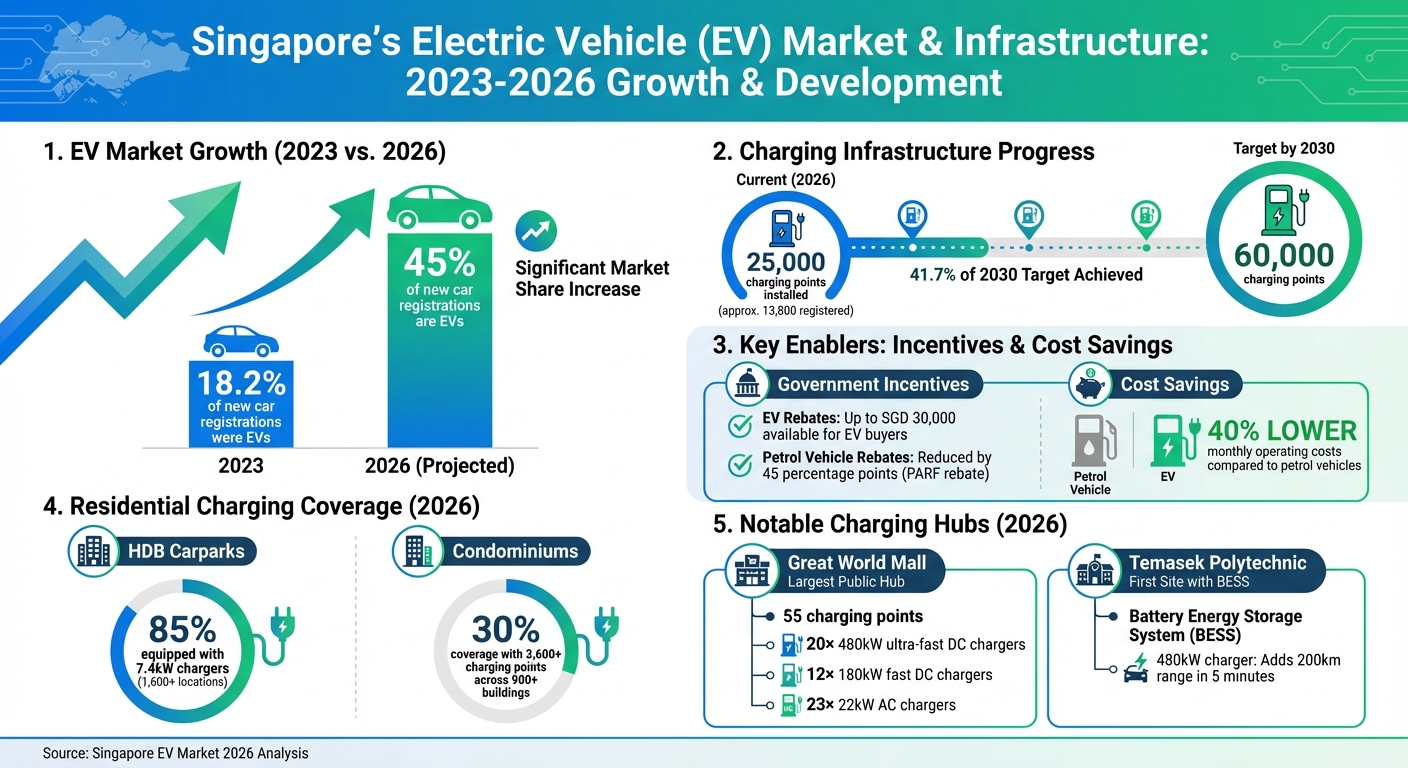
Singapore EV Market Growth 2023-2026: Key Statistics and Infrastructure Targets
Will lower incentives shake up Singapore’s EV boom?
sbb-itb-5f05a6f
Premium Electric Vehicles Leading Singapore’s Market in 2026
In 2026, premium electric vehicles (EVs) are reshaping Singapore’s automotive market, offering advanced features tailored to urban living. These vehicles combine cutting-edge technology with practical solutions, perfect for city commutes that rarely exceed 30 kilometres a day.
Audi Q6 e-tron and A6 e-tron
Audi has introduced two standout models, the Q6 e-tron and the A6 Sportback e-tron, both built on platforms designed exclusively for EVs. The Q6 e-tron is priced at approximately S$358,999, while the A6 Sportback e-tron starts at S$375,999 (both prices include COE).
The Q6 e-tron is packed with thoughtful features like dual charging ports and programmable LED/OLED lights that enhance safety by alerting road users during heavy braking or door opening.
"What you get instead is quiet confidence, a smooth power delivery, stable handling and a ride that feels tuned for everyday comfort, not unnecessary drama." – Joel Tam, CEO and Founder, Ignition Labs
The A6 Sportback e-tron boasts a record-low drag coefficient of 0.21 and offers a range of up to 563 kilometres, while the S6 e-tron variant provides 405 kW (543 hp) and a range of 646 kilometres. Enhanced sound insulation reduces cabin noise by up to 30%, creating a serene driving experience in bustling city environments.
The Q6 e-tron supports ultra-fast DC charging at 225 kW, allowing for quick top-ups, and features a spacious 526-litre boot along with a 64-litre front compartment for storing charging cables. Inside, the Digital Stage architecture integrates a 14.5‑inch MMI touchscreen, an 11.9‑inch instrument cluster, and a 10.9‑inch display for the front passenger.
Volvo ES90 and EX90
Volvo’s ES90 and EX90 models bring a blend of elegance and practicality to Singapore’s EV scene. The ES90, a sleek fastback, combines sedan sophistication with SUV-like ground clearance (178–208 mm), making it ideal for navigating urban roads and speed humps. Priced between S$380,000 and S$410,000 (inclusive of COE), it undercuts competitors like the BMW i5 and Mercedes-Benz EQE, which are priced around S$419,000.
The ES90 Plus variant offers a WLTP range of 661 kilometres with a 92 kWh battery. In local driving tests, it achieved an impressive 6.25 km/kWh, translating to a real-world range of approximately 575 kilometres. Its 800V architecture supports ultra-fast DC charging, reaching 80% in just 22 minutes with a 350 kW charger.
"Where modern EVs may lean towards over-exuberance, I do like how the ES90 takes a more restrained approach, whilst still projecting quiet confidence." – Desmond Chan, Reviewer, sgCarMart
Both the ES90 and EX90 are built on Volvo’s SPA2 platform, featuring a software-driven architecture powered by dual Nvidia Drive AGX Orin processors capable of 508 trillion operations per second. The ES90 Ultra variant includes a 25-speaker Bowers & Wilkins sound system and laminated acoustic glass for a quieter cabin. The EX90, Volvo’s flagship SUV, offers a higher seating position and starts at approximately S$433,000.
XPeng G9 and G6 Air
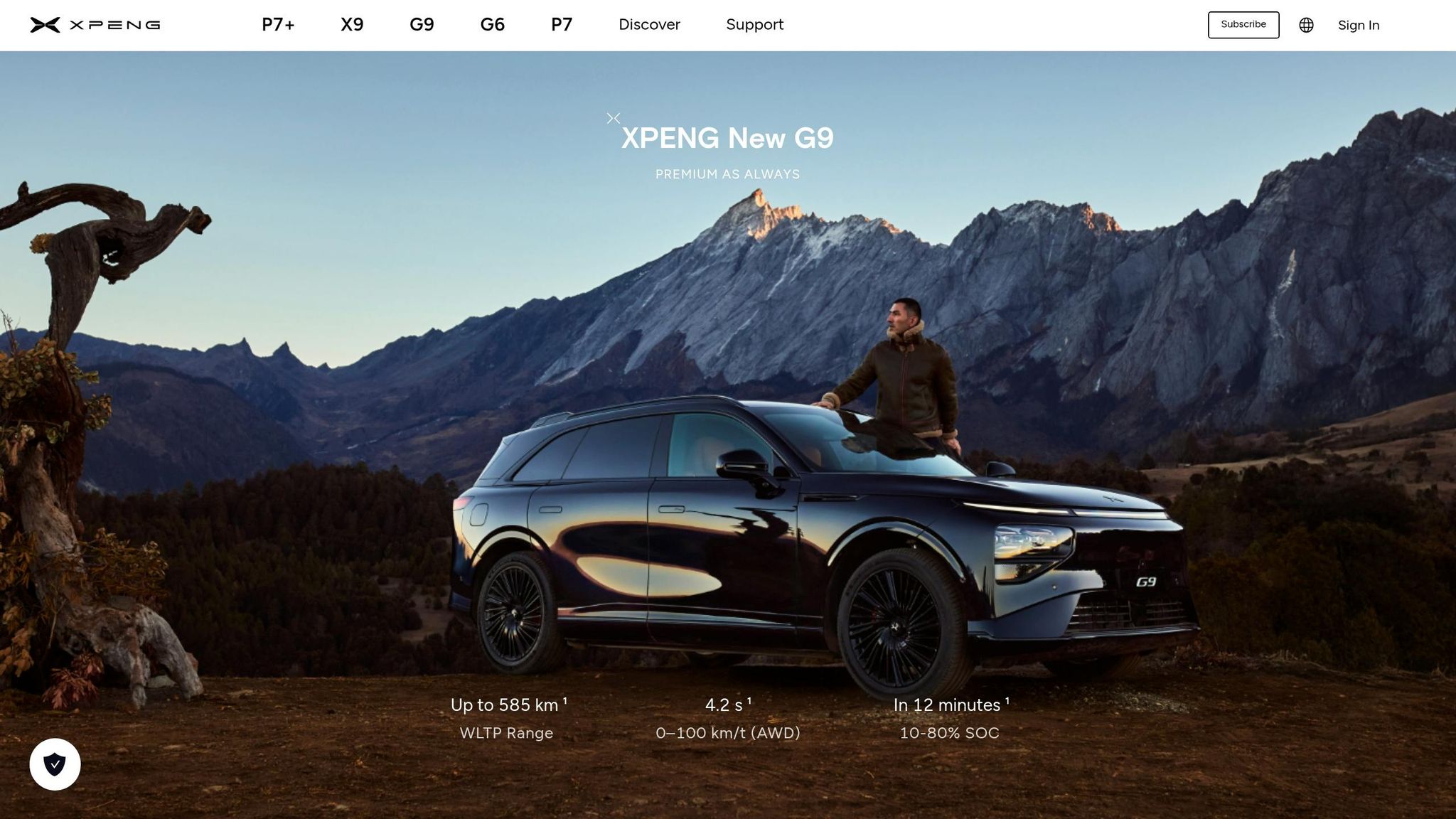
XPeng caters to a wide range of drivers with the G6 Air, G6 Long Range, and the high-performance G6 AWD. The G6 Long Range RWD starts at around S$218,999, while the G6 Performance AWD is priced between S$241,999 and S$243,999 (inclusive of COE).
Both models feature an 800V electrical system and next-generation 5C Supercharging LFP battery technology. The G9 supports charging at 525 kW, while the G6 reaches 451 kW, with both models charging from 10% to 80% in just 12 minutes using a 500 kW charger. A 10-minute top-up adds up to 450 kilometres of range.
"The Xpilot automatic parking is arguably one of the best in the business so far." – David Ting, Author, Motorist Singapore
The G6 Performance variant delivers 480 hp and 660 Nm of torque, accelerating from 0–100 km/h in 4.1 seconds, while maintaining an efficiency of 14.6 kWh/100 km in real-world testing. The 2026 models come equipped with a 15.6‑inch infotainment system, Qualcomm 8295 processors, and the Turing AI driver-assist system, enhancing object recognition and safety.
| Feature | XPeng G6 Performance | XPeng G9 |
|---|---|---|
| Max DC Charging | 451 kW | 525 kW |
| 0-100 km/h | 4.1 seconds | 3.9 seconds (Dual Motor) |
| Battery Capacity | 80.8 kWh | 79 kWh / 93.1 kWh |
| Max Power | 358 kW (480 hp) | 423 kW (Dual Motor) |
| 10-80% Charge Time | 12 minutes | 12 minutes |
XPeng’s focus on power, efficiency, and charging speed reflects the rapid evolution of Singapore’s EV market.
EV Charging Infrastructure Updates in Singapore for 2026
Singapore has made impressive strides in expanding its EV charging network, with approximately 13,800 registered charging points now supporting the city-state’s 40,000 electric vehicles. This growing infrastructure plays a vital role in supporting the increasing number of EVs on the roads. In fact, by 2025, EVs made up nearly 50% of all new car registrations, setting the stage for further advancements in charging technology.
Public Charging Station Expansion
In January 2026, Allgreen Malls unveiled Singapore’s largest public EV charging hub at Great World (Levels B3 and B3A). This facility hosts 55 charging points, including 20 ultra-fast 480kW Huawei DC chargers, 12 fast 180kW DC chargers, and 23 standard 22kW AC chargers. Initial rates are set at S$0.600 per kWh for DC charging and S$0.545 per kWh for AC charging, inclusive of 9% GST.
"As our fastest public chargers to date, they offer more efficient charging for drivers, especially those with higher daily mileage." – Dean Cher, Managing Director, SP Mobility
In February 2026, Huawei International and SP Mobility introduced Singapore’s first ultra-fast charging site equipped with a Battery Energy Storage System (BESS) at Temasek Polytechnic. This site, inaugurated by Minister Baey Yam Keng, features a 480kW charger (configured to 400kW) capable of adding 200 kilometres of range in just five minutes. The BESS stores energy during off-peak hours and releases it during charging, reducing the strain on the grid and minimising the need for costly upgrades.
Government Programmes and Private Partnerships
To complement these infrastructure advancements, government initiatives are encouraging private sector involvement. The Land Transport Authority (LTA), through its subsidiary EV-Electric Charging Pte Ltd (EVe), has partnered with five EV Charging Point Operators (EVCOs) – Charge+, ComfortDelGro Engie, Shell, SP Mobility, and Volt Singapore – to accelerate the rollout of charging points over the next two years. In November 2025, Charge+ secured tender CD107 to install charging points in new HDB estates, with full deployment expected by the end of 2026.
Additionally, grants like the EV Common Charger Grant (ECCG) provide up to 50% of installation costs (capped at S$3,000 per charger) for non-landed private residences. A new initiative, the Electric Heavy Vehicle Charger Grant (EHVCG), launched on 1 January 2026, offers up to S$30,000 per charger for buses and lorries.
"This site is a game-changer; it demonstrates that we are prepared to scale up ultra-fast deployments across the island to meet Singapore’s surging demand for EVs." – Maxi Wang, CEO, Huawei International
Home and Workplace Charging Options
Charging access has also expanded to residential and workplace locations. Currently, around 85% of HDB carparks (over 1,600 locations) are equipped with 7.4kW slow chargers. Meanwhile, more than 3,600 charging points have been installed across 900+ non-landed private residences, covering about 30% of condominiums in Singapore.
At workplaces, some companies offer free charging as an employee perk, while others use smart Charging Management Systems (CMS) to automate billing and manage electricity loads efficiently. For added flexibility, portable solutions like the QuickCharge Mercury 7 II allow drivers to gain 40 km of range per hour using standard outlets – perfect for long trips or locations with limited charging infrastructure.
| Location | Total Points | Charger Types | Key Feature |
|---|---|---|---|
| Great World | 55 | 20× 480kW DC, 12× 180kW DC, 23× 22kW AC | Largest single-site public hub in Singapore |
| Temasek Polytechnic | 1 (High Capacity) | 480kW (Liquid-cooled) | First site integrated with BESS |
| Pasir Ris Mall | 20 | 20× 180kW DC | Largest public DC-only charging hub |
These developments ensure that Singapore’s EV owners can enjoy accessible and reliable charging options across residential, workplace, and public spaces, making EV adoption more practical and convenient than ever before.
How to Import Premium EVs to Singapore Through EV24.asia
Transparent Pricing and Model Selection
EV24.asia lays out every cost detail clearly, covering components like OMV, ARF, and government rebates that can trim up to SGD 30,000 off your expenses. Their platform showcases a handpicked range of premium EVs, including the Audi Q4 e-tron, Tesla Model 3 RWD, and MG 4 EV. This allows buyers to compare specs, driving range, and overall costs all in one convenient place. Once you’ve chosen your EV, EV24.asia takes care of the entire import process with ease.
Comprehensive Shipping and Compliance Services
From shipping – whether via RoRo or container – to customs clearance through the TradeNet System, EV24.asia handles it all. They ensure your vehicle meets Singapore’s technical standards, such as right-hand drive configurations and compatibility with Type 2 AC/Combo-2 DC charging systems. The platform also manages all essential paperwork and financial obligations, including the 20% Excise Duty on OMV and the 9% GST. Starting 1st April 2026, they will even facilitate the installation of the new ERP2 On-Board Unit (OBU) at authorised workshops for a subsidised fee of SGD 158.70 (inclusive of 9% GST).
Flexible Payment Options and End-to-End Support
EV24.asia goes beyond just pricing and shipping by offering flexible payment plans and full support through the registration process. Their team guides buyers through every step, including submitting applications via the Vehicle Inspection and Type Approval System (VITAS), scheduling inspections, and bidding for Certificates of Entitlement (COE). They also help buyers take advantage of the 2026 rebates before the EEAI programme ends on 1st January 2027. Additionally, their support team keeps customers informed about road tax surcharges and EVCA regulations.
For urban drivers looking for premium EVs that combine performance with eco-friendliness, EV24.asia makes the entire import process straightforward, transparent, and fully aligned with Singapore’s requirements.
Conclusion
Singapore is setting the pace for EV adoption in Southeast Asia, with electric vehicles projected to make up 45% of all new car registrations by 2026. This progress is fuelled by the availability of premium EV options from brands like Audi, Mercedes-Benz, and Volvo, combined with infrastructure upgrades that have tackled many of the challenges of EV ownership. For instance, ultra-fast 480 kW chargers can now deliver 200 km of range in just five minutes.
Government policies have been a key driver of this shift. The Budget 2026 announcement included a 45-percentage-point reduction in the PARF rebate for internal combustion engine vehicles, making petrol cars less appealing. Additionally, the country has already installed around 25,000 charging points, with a national goal of reaching 60,000 by 2030. As Timothy Wong, Principal at Roland Berger, notes:
"Singapore is expected to continue leading EV adoption in South-east Asia in 2026"
Premium EVs are not just about luxury – they now offer monthly operating costs that are approximately 40% lower than petrol vehicles, thanks to cheaper charging and reduced maintenance. These savings, coupled with better performance, are reshaping how buyers perceive value. As Soh Ming, Singapore Managing Director at Dongfeng, puts it:
"The transition will be more about changing how value is framed, from ‘what I get back at the end’ to ‘what I spend each month’"
This growing interest in EVs has also increased demand for efficient import processes. For those looking to bring in premium EVs, EV24.asia simplifies the experience with transparent pricing that includes OMV, ARF, and rebates, along with full shipping and compliance support. With rebates now capped at up to SGD 30,000 under the revised scheme, 2026 presents an ideal opportunity to take advantage of these benefits.
FAQs
How do I choose the right premium EV for my daily driving in Singapore?
To choose the best premium electric vehicle (EV) in Singapore, focus on a few critical factors. Start with the range – make sure the vehicle can comfortably handle your daily travel needs without frequent recharging. Next, look at the charging speed, as faster charging means less waiting time and more convenience.
Consider additional features like smooth driving performance, energy-efficient options, and top-tier comfort that enhance the overall experience. Don’t forget to factor in the total cost, including taxes, rebates, and incentives, to ensure it aligns with your budget.
By weighing these elements, you’ll be able to select a premium EV that fits your lifestyle and preferences perfectly.
What charging speed can my EV support on Singapore’s new 480 kW chargers?
Singapore’s new ultra-fast, battery-buffered chargers can deliver charging speeds of up to 480 kW for your electric vehicle (EV). With this technology, you can add approximately 200 km of range in just five minutes. This dramatically cuts down charging time, making EV ownership far more convenient and efficient.
What documents and approvals are needed to import an EV via EV24.asia?
To bring in an EV through EV24.asia, you’ll need to gather a few essential documents. These include compliance certificates for emissions and safety standards, details on CO2 and energy consumption, and the manufacturer’s technical documents. Once you’ve submitted these and they’ve been verified, the Land Transport Authority (LTA) will issue a Letter of No Objection (LNO). This document is a key requirement to finalise the import process.