
 Arka Pratama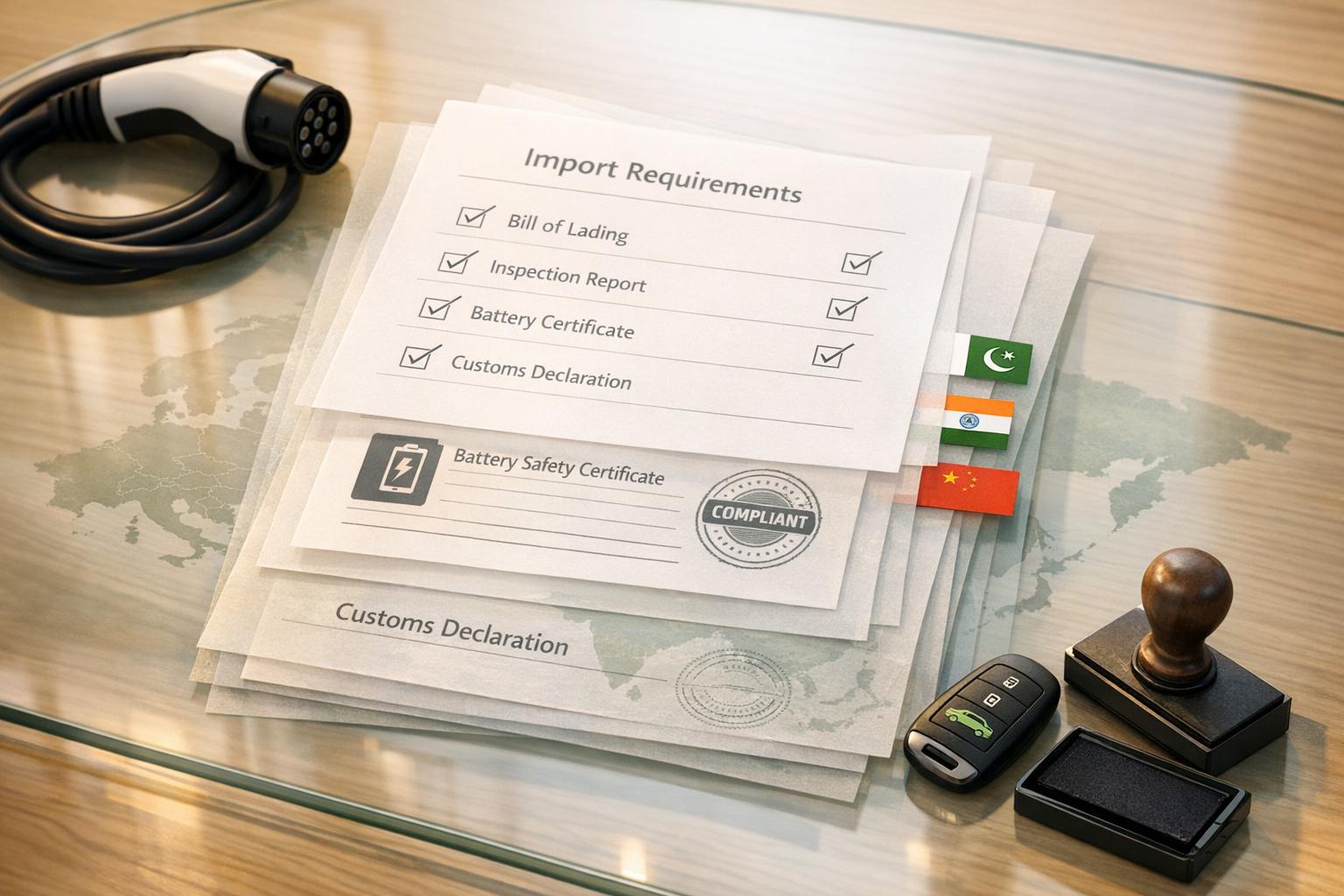
Importing an electric vehicle (EV) into Pakistan or other Asian countries can be challenging due to the extensive paperwork involved. To avoid delays, fines, or other issues, you must prepare specific documents tailored to each country’s regulations. Here’s a quick breakdown of the key documents you’ll need:
- Commercial Invoice: Includes vehicle details (VIN, CIF value, etc.) and is used to calculate taxes. Accuracy is critical to avoid penalties.
- Bill of Lading (B/L): Proof of shipment and ownership. Necessary for customs clearance.
- Certificate of Origin: Confirms the manufacturing country and determines tariff eligibility under trade agreements.
- Material Safety Data Sheet (MSDS): Required for lithium-ion batteries, ensuring compliance with international safety standards.
- Packing List: Details vehicle dimensions, weight, and packaging specifics.
Each country has its own additional requirements. For instance:
- Pakistan: Imports are allowed under the Gift Scheme or Transfer of Residence, with a reduced 1% customs duty under specific conditions.
- India: Requires BIS certification for batteries and ARAI homologation for safety compliance.
- China (for exports): Mandates an export licence and after-sales service confirmation for "zero-kilometre" EVs.
To simplify the process, double-check local regulations and ensure all documents are accurate and complete before shipping. Missing or incorrect paperwork can lead to fines, delays, or even confiscation of the vehicle.
How to Import Electric Cars from China?
sbb-itb-5f05a6f
Core Documents Required for EV Imports in Asia
5 Essential Documents Required for EV Import in Asia
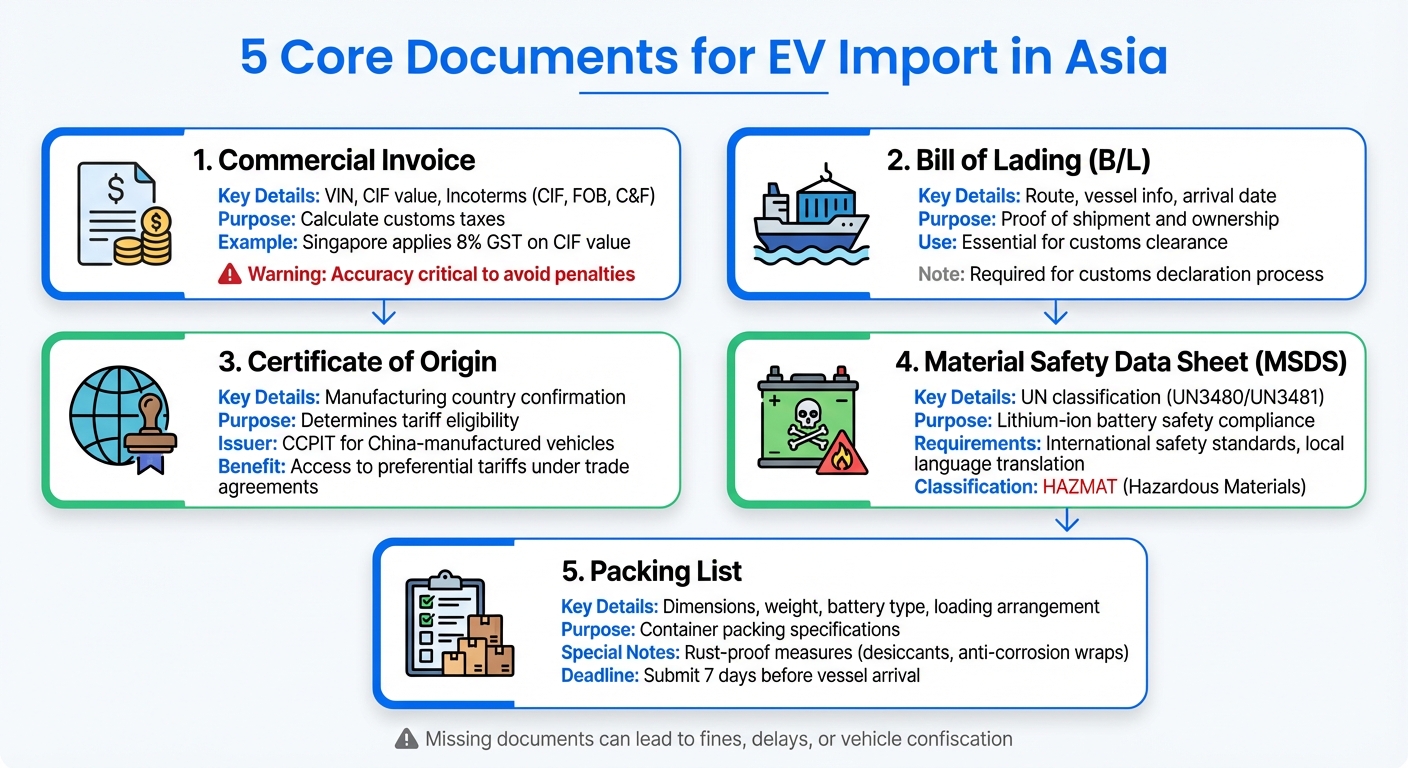
Importing an EV into Asia? Whether it’s a Tesla for Pakistan or a BYD for Singapore, there are five key documents you’ll need. These form the backbone of the EV import process, ensuring everything runs smoothly.
Commercial Invoice
This document is crucial because it outlines your vehicle’s details, including the VIN, a full description, the CIF value, currency, and Incoterms (like CIF, FOB, or C&F). Customs use this to calculate taxes. For example, Singapore applies an 8% GST on the CIF value listed on your invoice. Accuracy is critical – any mismatch between the invoice and the vehicle’s actual specs can lead to delays or penalties.
Bill of Lading
The Bill of Lading (B/L) serves as proof of shipment and ownership. It’s a contract between you and the shipping carrier and is essential for customs clearance. This document includes shipment details like the route, vessel information, and arrival date, which customs use to start the declaration process. In Thailand, for example, once the B/L clears through the National Single Window system, it’s electronically linked to the Department of Land Transport.
Certificate of Origin
The Certificate of Origin confirms where your EV was manufactured and determines if it qualifies for preferential tariffs under trade agreements. For vehicles from China, the China Council for the Promotion of International Trade (CCPIT) typically issues and notarises this certificate. It must comply with local language requirements and include authorised stamps and signatures. Proper certification ensures you can take advantage of tariff benefits.
Material Safety Data Sheet (MSDS)
Because EVs use lithium-ion batteries, they’re classified as hazardous materials (HAZMAT). The MSDS verifies that your battery meets international safety standards and must include the correct UN classification – usually UN3480 for lithium-ion batteries or UN3481 for batteries in vehicles or equipment. Some countries, like Saudi Arabia and Vietnam, require the MSDS to be translated into the local language. Additionally, the battery packaging must have a UN mark and a packaging test report to ensure smooth customs processing.
Packing List
This document details your vehicle’s dimensions, weight, and how it’s packed in the container. It should also mention the battery type and any loading arrangements. For humid climates in Asia, note rust-proof measures like desiccants or anti-corrosion wraps. The packing list must be bilingual, signed by authorised personnel, and submitted as part of your Pre-Arrival Declaration at least seven days before the vessel arrives to avoid delays.
Documentation Requirements by Country
Navigating the EV import process in Asia requires understanding the specific rules of each country. Here’s a breakdown of the requirements for Pakistan, India, and China.
Pakistan
Pakistan’s EV import process underwent major changes in 2026 with SRO 61(I)/2026, eliminating the Personal Baggage scheme. Now, imports are allowed only under the Gift Scheme or Transfer of Residence (TR). To qualify, Pakistani nationals, dual nationals, or POC holders must meet an 850-day overseas residency requirement within the past three years. Additionally, the EV must be less than three years old, calculated from 1st January following the year of manufacture to the Bill of Lading date.
Under the Electric Vehicle Policy 2020–2025, EVs are subject to just 1% customs duty. A 1% monthly depreciation allowance is also applied based on the vehicle’s age. Duties and taxes must be paid through foreign remittance, either from the importer’s overseas account or a family member’s account. The Pakistan Single Window (PSW) system simplifies customs clearance, enabling a paperless process through the Federal Board of Revenue (FBR).
Key documents include the Purchase Receipt, Bill of Lading (with consignee details), attested passport or POC copies, Goods Declaration, and Remittance Certificate. For the Gift Scheme, the NIC of the donee (the family member receiving the vehicle) is also required. Post customs clearance, registration at the Excise Office involves submitting the Bill of Entry, Sales Invoice, Proof of Residence, and completing biometric verification. Note that vehicles imported under these schemes cannot be sold for a year.
India
India enforces stringent regulations for EV imports, especially concerning lithium-ion batteries. All batteries must have BIS (Bureau of Indian Standards) certification under the Compulsory Registration Scheme (CRS). Compliance with IS 16046 (Part 2): 2018, aligned with IEC 62133-2:2017, is mandatory. Importantly, only test reports from BIS-recognised laboratories in India are accepted – international certifications like UL or IEC are not valid. The certification process takes 6 to 12 weeks and remains valid for two years.
Vehicles also require ARAI (Automotive Research Association of India) homologation to meet safety and emission standards, with costs ranging from ₹50,000 to ₹2,00,000 depending on the model. Foreign manufacturers must appoint an Authorised Indian Representative (AIR) to handle BIS applications and legal compliance. Additionally, registration with the Central Pollution Control Board (CPCB) via the Batteries Registration and Management System (BRMS) portal is required for Extended Producer Responsibility (EPR).
The necessary documents include the Bill of Entry (BoE), Commercial Invoice, Bill of Lading or Airway Bill, Import Export Code (IEC) Certificate, Packing List, Technical Specifications, and a No Objection Certificate (NOC) for emissions. If the EV includes wireless features like Bluetooth or Wi-Fi, Equipment Type Approval (ETA) from the Wireless Planning & Coordination (WPC) wing is also needed. Be prepared for high customs duties ranging from 60% to 165% of the vehicle’s value.
China (for exports to Asia)
China has introduced new export regulations for EVs, effective from 1st January 2026. An export licence is now mandatory for all pure-electric passenger vehicles (HS code 8703801090).
Sun Xiaohong, Secretary-General of the Automotive Internationalisation Committee, stated: "Incorporating pure EVs into export licensing management aligns with the needs of healthy EV export development and high-quality international competition".
For "zero-kilometre" EVs (used vehicles registered within the last 180 days), an after-sales service confirmation document from the manufacturer is required. This document must include the destination and bear the manufacturer’s official seal.
The Ministry of Commerce of China clarified: "As of January 1, 2026, any vehicle exported within 180 days of initial registration must be accompanied by an after-sales service confirmation document issued by the manufacturer".
This regulation aims to curb grey market exports where new cars were falsely sold as used vehicles.
Standard export documentation includes the Booking Authorisation Letter, Commercial Invoice, Packing List, Sales Contract, Bill of Lading, and Motor Vehicle Registration Certificate for used vehicles, along with the export licence. Since EVs fall under Category 9 dangerous goods (UN3171 for vehicles, UN3480 for batteries), additional paperwork such as an English Material Safety Data Sheet (MSDS), Dangerous Goods Declaration, and UN38.3 test report is required. For Singapore-bound exports, all documents must be bilingual (English/Chinese) and stamped by authorised representatives. EVs with autonomous or connected features also need a data export security assessment under China’s 2026 guidelines.
Battery and Safety Documentation for EVs
Electric vehicles rely on lithium-ion batteries, which the UN Experts on Transport of Dangerous Goods classify as dangerous goods. Damaged cells can lead to thermal runaway and fires, making thorough safety documentation essential.
Battery Safety and MSDS
The Material Safety Data Sheet (MSDS) outlines a battery’s chemical makeup, handling guidelines, and emergency measures. Alongside the MSDS, batteries must have a UN 38.3 Certification, confirming they’ve passed tests like altitude simulation, thermal exposure, vibration, and impact resistance. Additionally, EU customs often require a Thermal Stability Analysis Report (TRA) at the cell level to mitigate thermal runaway risks. For shipments to the EU, the Battery Management System must comply with EN 62133-2:2017 standards, with an insulation resistance of at least 5MΩ being a critical requirement.
"Compliance is not an ‘additional expense’ but a ‘market entry prerequisite.’" – ULi Power
Certification requirements differ by region. For instance, India mandates BIS certification, Thailand requires TISI certification, Indonesia follows SNI standards, and Malaysia demands SIRIM certification. Securing international certifications can take 12 to 16 weeks, with expedited services costing up to 40% more. In Southeast Asia, countries like Thailand often require technical documentation in the local language to clear customs.
This certification process is integral to the HAZMAT declarations needed for transportation.
HAZMAT Declarations
Lithium-ion batteries, due to risks like short circuits, fires, and toxic fumes, require specialised Dangerous Goods Declarations. Under UN Model Regulations Rev. 23, shippers must use updated UN numbers in their declarations to avoid delays at ports. Compliance requirements vary based on the mode of transport: air (IATA), ocean (IMDG Code), and road (ADR).
"In global battery logistics, compliance is the cost of entry – ignorance can shut you out." – Americase
For U.S.-bound shipments, batteries over 35 kg need special permits from the Pipeline and Hazardous Materials Safety Administration (PHMSA), which can take months to obtain. In Hong Kong, importers must submit an accurate declaration using Form CED336 to the Customs and Excise Department within 14 days of importation.
Emission and Safety Compliance Certificates
EVs must also meet environmental and safety standards through compliance certificates. In Vietnam, this is done via Vehicle Type Approval (VTA), which includes both safety and environmental data. Testing reports from internationally recognised bodies are often accepted as proof.
China’s new "no fire, no explosion" standards, effective 1st July 2026, will require battery packs to endure higher temperatures and contain toxic fumes. Meanwhile, the EU’s Battery Regulation (EU) 2023/1542 will enforce mandatory carbon footprint declarations starting in 2025. Airlines and shipping companies are also adopting stricter pre-approval processes due to increasing EV-related fire incidents.
| Region | Mandatory Safety Certification | Key Standard/Regulation |
|---|---|---|
| European Union | CE Marking | EN 62133-2:2017 / UN 38.3 |
| United States | UL Certification | UL 2271 / UL 2272 (2nd Ed) |
| Thailand | TISI Certification | Thai Industrial Standards Institute |
| Indonesia | SNI Certification | Standard Nasional Indonesia |
| Australia | RCM Mark | AS/NZS 60335.2.29 |
| Gulf Countries | G Mark | SASO IEC 62133 |
Original Certificates of Conformity (CoC) or Declarations of Conformance (DoC) must be readily available, as inspection bodies require these for physical vehicle verification. In Hong Kong, manufacturers must also provide official documentation confirming the vehicle’s suitability for local use to pass the pre-registration examination. These battery and safety documents are a vital part of the EV import process.
How EV24.asia Handles Documentation
EV24.asia takes the hassle out of complex EV import procedures by managing everything from documentation and customs clearance to local registration, ensuring a smooth process from start to finish.
Document Preparation Services
EV24.asia offers tailored export documentation packages designed to meet the specific import requirements of different countries. They secure state-approved export documents, ensuring vehicles meet legal and customs standards, and verify that all paperwork aligns with local laws.
Their services include gathering manufacturer documentation and safety testing reports to confirm compliance with essential safety standards. For fully electric vehicles, EV24.asia handles noise emission compliance applications. For plug-in hybrids, they secure both exhaust and noise emission approvals from relevant environmental departments before shipping.
Once everything is in order, EV24.asia efficiently oversees the shipping and customs clearance processes.
Shipping and Customs Clearance Support
EV24.asia provides flexible shipping options, including RoRo (Roll-on/Roll-off) and container services, accommodating various budgets and timelines. They handle customs valuation and declaration processes, ensuring timely and accurate submissions. For instance, in Hong Kong, import declarations must be filed within 14 days.
The platform also ensures precise tax and duty processing to avoid costly mistakes. Missing an import return deadline in Hong Kong, for example, could result in a hefty fine of $500,000 and up to 12 months of imprisonment.
Once customs clearance is completed, EV24.asia continues to assist with the next crucial step: local registration.
Local Registration Assistance
EV24.asia coordinates technical inspections at authorised centres to secure Certificates of Roadworthiness or referral letters required for registration. They handle registration forms, like Form TD22 in Hong Kong, and verify local address proofs to prevent delays in licencing.
For imports destined for Pakistan, EV24.asia ensures compliance with local regulations, including arranging valid third-party risks insurance, a mandatory requirement for licencing. They also manage paperwork related to registration taxes, licencing fees, and mandatory fund contributions, letting buyers focus on enjoying their new electric vehicles without worrying about bureaucratic hurdles.
Conclusion
Importing EVs in Asia requires meticulous attention to documentation, covering everything from commercial invoices to battery safety and emissions certificates. Missing even a single requirement can lead to serious consequences. For example, failing to meet Hong Kong’s import return deadline can result in hefty fines and penalties. Additionally, many countries in the region enforce strict vehicle age restrictions. On top of customs clearance, countries impose specific technical requirements – like noise emission standards and safety testing reports – to confirm the vehicle’s roadworthiness.
With such complex demands, having a well-organised process is essential. EV24.asia simplifies this entire journey by handling every step of the documentation process. From obtaining state-approved export documents to managing customs declarations and technical inspections, they ensure compliance with local regulations. Whether you’re importing into Pakistan, Hong Kong, or Singapore, they make sure all paperwork aligns with the specific standards of your destination.
FAQs
What battery documents are required for an EV shipment?
To ship EV batteries, you’ll need technical documents such as safety certificates, construction certificates, testing reports, and compliance certificates. These should come from manufacturers or recognised testing bodies and must address the battery’s safety, construction, and charging system. Make sure all documents align with both international and local regulations specific to EV shipments in your region.
What extra documents are required to import an EV into Pakistan under Gift or TR?
To bring an electric vehicle (EV) into Pakistan under the Gift or Transfer of Residence (TR) scheme, you’ll need to gather the following documents:
- A signed Gift Undertaking form.
- Copies of passports or NICOP cards for both the sender and the recipient.
- Proof that the sender has spent at least 700 days abroad.
- The vehicle’s purchase receipt or title.
- Clear photos of the vehicle.
- A prepaid self-addressed envelope.
Make sure all the paperwork is complete and accurate to avoid any delays or issues during the process.
How can I avoid customs delays due to document mistakes?
When importing an EV into Asia, accurate and consistent documentation is crucial to avoid customs delays. Pay close attention to essential details like names, IDs, VINs (Vehicle Identification Numbers), and document numbers. Ensure that all key documents – such as the invoice, certificate of origin, registration papers, permits, and payment records – match perfectly.
Additionally, take the time to review local regulations. Some countries may require specific import permits or certified translations of documents. Meeting these requirements in advance can help you sidestep unnecessary issues during customs clearance. A little extra preparation can save you a lot of time and hassle.