
 Arka Pratama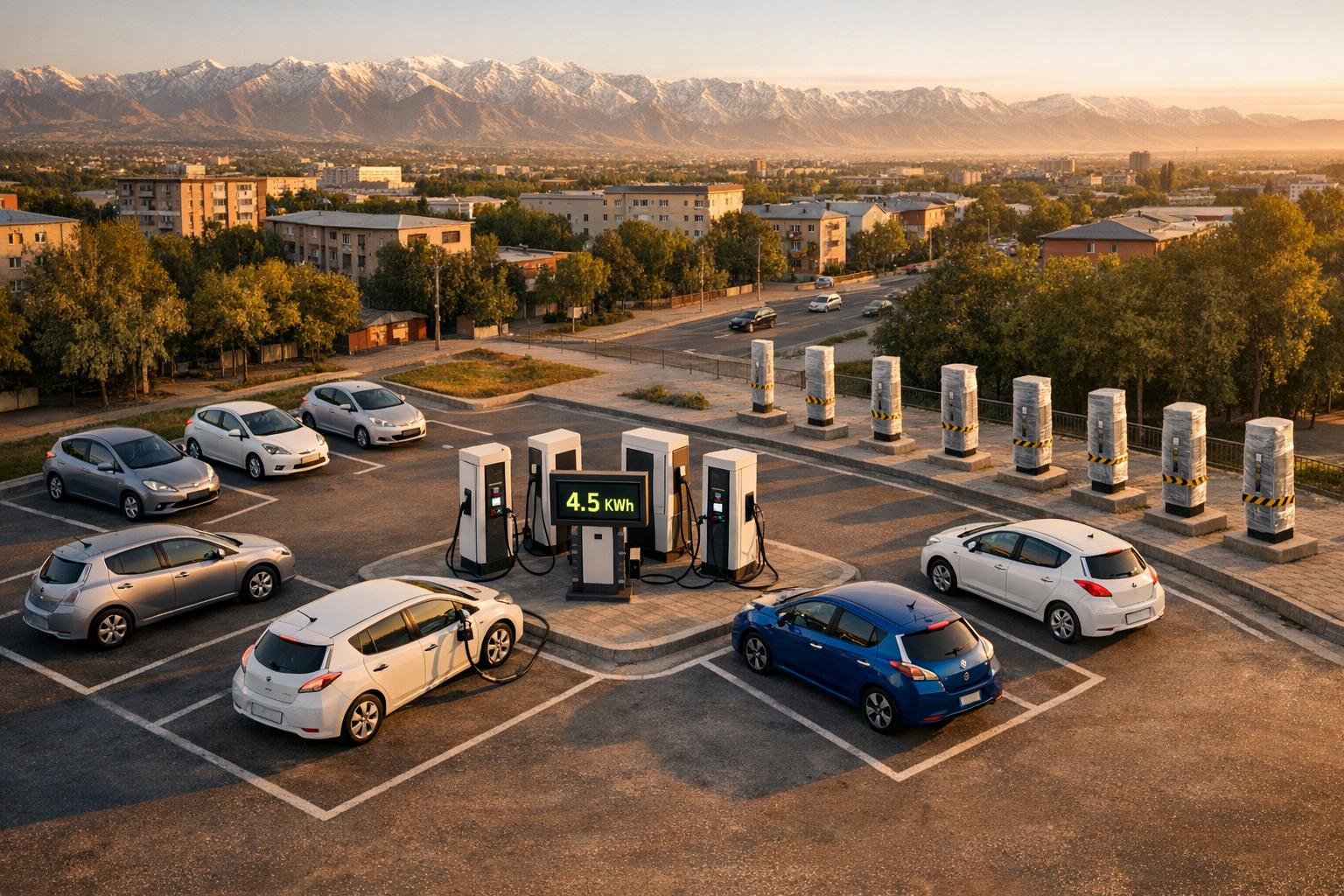
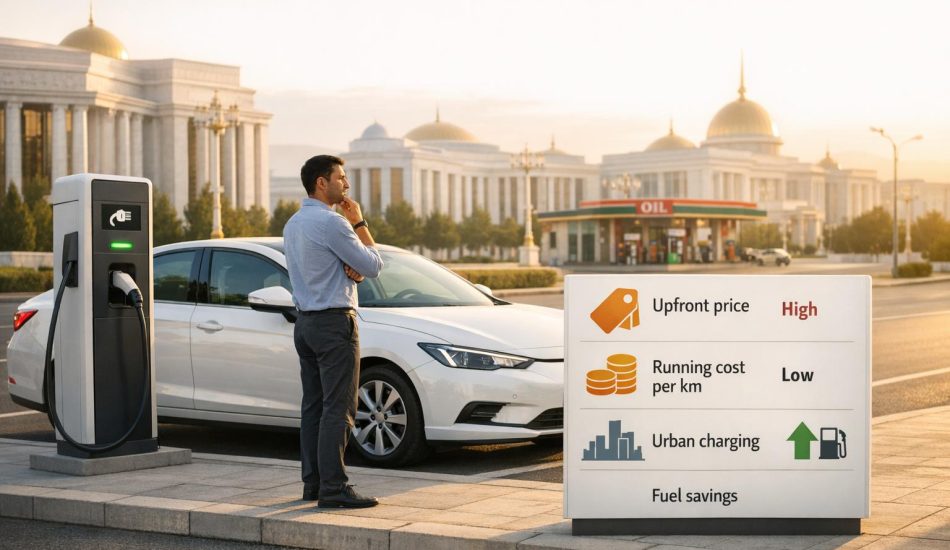
Kyrgyzstan’s EV market is growing fast in 2026, thanks to duty-free import quotas, low electricity costs, and government incentives. Over 200 EVs are entering the country daily, supported by zero import taxes and affordable electricity at Rs. 6.48 per kWh – 77% cheaper than the global average. However, challenges like limited charging stations (only 30 nationwide) and lengthy permit processes (up to 195 days) persist.
Key Highlights:
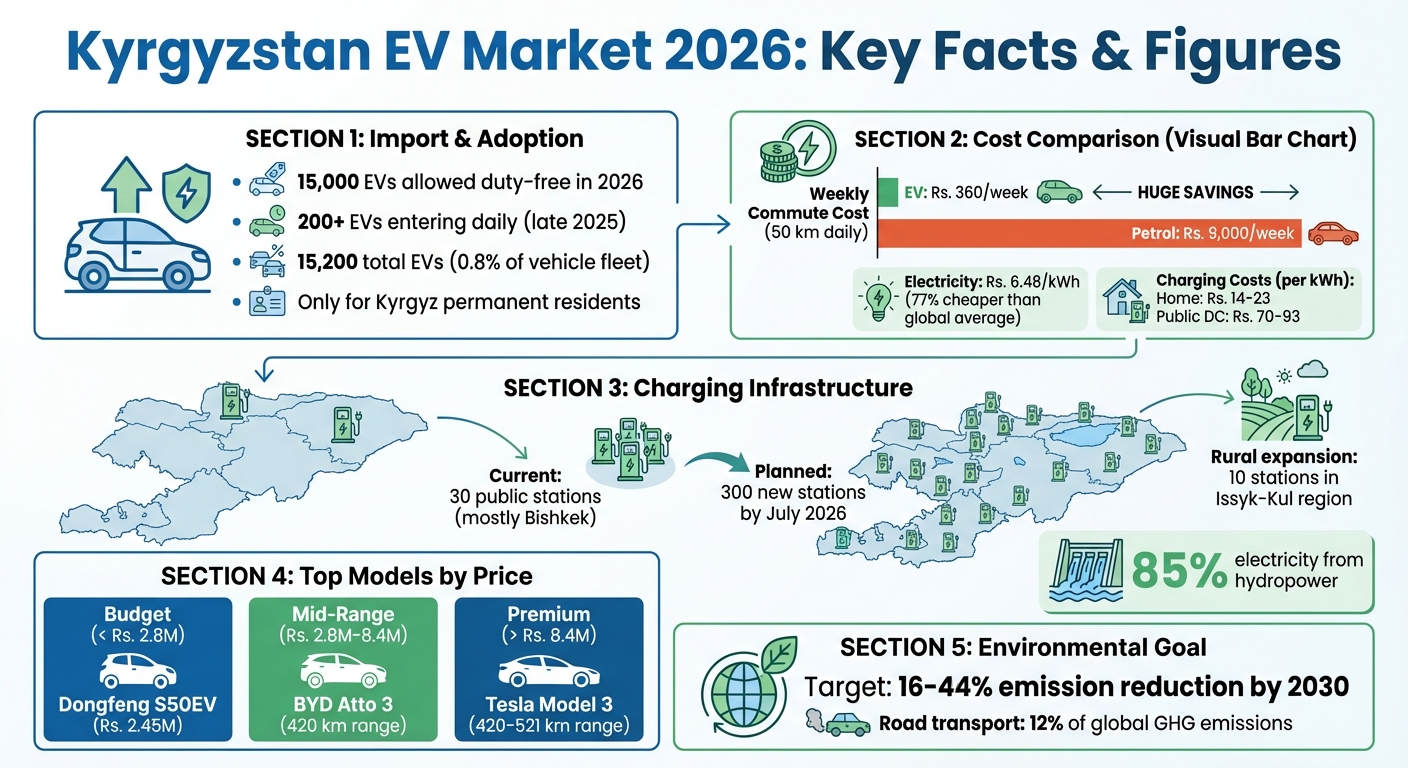
- Duty-Free Imports: 15,000 EVs allowed duty-free in 2026 for Kyrgyz residents.
- Cost Savings: EVs cost Rs. 360/week for a 50 km daily commute, compared to Rs. 9,000 for petrol cars.
- Top Models: Affordable options like Dongfeng S50EV (Rs. 2.45 million) and premium choices like Tesla Model 3.
- Charging Gaps: Only 30 public stations, mostly in Bishkek; rural areas underserved.
- Future Plans: 300 new charging stations by mid-2026, with rural expansions in Issyk-Kul.
Kyrgyzstan’s EV market offers affordable options for residents, but improving charging infrastructure is crucial for long-term growth.
Kyrgyzstan EV Market 2026: Key Statistics and Cost Savings
Как зарядить электромобиль в Кыргызстане (цены, локации и пр.)
sbb-itb-5f05a6f
Importing Used EVs to Kyrgyzstan
Kyrgyzstan’s membership in the Eurasian Economic Union (EAEU) makes importing used electric vehicles (EVs) more affordable compared to petrol cars. This includes both fully electric models (HS code 8703 80 000 3) and series hybrids (HS code 8703 80 000 5), which can be imported with zero customs duties if they meet the eligibility criteria.
Used EVs bring the advantage of modern technology at second-hand prices, with operating costs that are about 15 times lower than petrol-powered cars. Chinese brands like BYD, Geely, ChangAn, and GreatWall dominate this market, offering budget-friendly options that are well-suited to Kyrgyzstan’s mountainous terrain. Interestingly, many of the "used" vehicles exported from China are almost new, thanks to the country’s 180-day rule for exporting new cars. This allows buyers to access cutting-edge technology at reduced prices.
However, only Kyrgyz permanent residents are eligible to import these vehicles. Transfers involving nationals of Russia or Kazakhstan are not allowed. Additionally, imported vehicles must be less than 10 years old, meet at least Euro 2 emission standards, and ideally be left-hand drive to align with local traffic laws. These regulations are part of Kyrgyzstan’s broader plan to create a more accessible and eco-friendly EV market.
How to Import EVs Through EV24.asia
EV24.asia simplifies the entire process of importing EVs for Kyrgyz buyers. The platform offers a wide range of vehicles, from budget-friendly Chinese models to premium options like Tesla, Volkswagen, and XPeng, all with clear, upfront pricing. Buyers can choose between RoRo (Roll-on/Roll-off) or container shipping, depending on their preferences.
Before purchasing, it’s important to check quota availability on the State Customs Service website. For instance, Kyrgyzstan’s quota for 2026 is set at 15,000 vehicles. Once you’ve selected your EV, EV24.asia handles the shipping arrangements. After that, you’ll need to submit a duty-free application, which is typically processed by customs authorities within one working day.
Once the import process begins, your focus should shift to gathering all necessary documents for customs clearance.
Import Documents and Customs Procedures
Proper documentation is crucial for smooth customs clearance. The process is governed by the EAEU Customs Code (Articles 8, 89, and 108), and some customs offices may require official Russian translations of all submitted documents.
| Document Type | Description |
|---|---|
| Ownership | Original certificate of ownership and registration |
| Purchase Proof | Original invoice |
| Identification | Copy of passport and visa |
| Shipping | Transport bill of lading or Air Waybill (AWB) |
| Technical | Original technical passport with cancellation markings |
| Administrative | Letters from the Employment and Customs Board |
| Insurance | International insurance policy |
When submitting your application at the customs point, you’ll need to include details such as the VIN (chassis number), year of manufacture, quantity, cost, brand/model, and the internal household accounting document number (DVH). Vehicles imported under the tariff preference are given "conditional release" status, which means separate permission is needed if you want to sell or export them to other EAEU member states in the future. For permanent imports, the standard VAT rate in Kyrgyzstan is 12%.
Top Used EV Models for Kyrgyzstan
Kyrgyzstan’s market for used electric vehicles (EVs) has grown rapidly, offering practical and cost-effective options that cater to the country’s demanding terrain. Chinese brands dominate the scene, combining competitive prices with advanced features. Given Kyrgyzstan’s mountainous landscapes and harsh winters, EVs equipped with heat pumps and regenerative braking are particularly appealing, as they help maintain range in challenging conditions. Plus, the country’s reliance on hydroelectric power makes operating EVs even more affordable.
In early 2024, Kyrgyzstan ranked as the sixth-largest global importer of Chinese retail cars, with imports worth US$510.3 million. This surge is partly due to a policy that eliminates customs duties on EVs until 2025, making these vehicles more accessible. Most Chinese EVs in the country use the GB/T charging standard, now the most widely available public DC fast-charging option.
Budget Models (Below Rs. 2,800,000)
If you’re looking for affordable options, models like the Nissan Leaf I, Weltmeister EX5, BYD E5, and Dongfeng S50EV are worth considering. For instance, the Dongfeng S50EV costs around US$22,000 (approximately Rs. 2,450,000), making it a great pick for first-time EV buyers. With electricity priced at just US$0.036 per kWh, charging costs range from Rs. 10 to Rs. 18 per kWh, keeping running expenses minimal. These entry-level EVs are ideal for city commutes and short trips, though it’s wise to check the battery condition before buying. Many used Chinese EVs also come with manufacturer-branded home chargers, making it easy to set up AC charging at home or in parking spaces.
Mid-Range Models (Rs. 2,800,000 – Rs. 8,400,000)
In this price range, the BYD Atto 3 (Yuan Plus) stands out for its cutting-edge Blade Battery technology, which ensures durability and safety even in extreme temperatures. It also features a heat pump that uses waste heat to warm the cabin, reducing energy loss during cold winters. The extended-range version offers a 60.48 kWh battery, providing approximately 510 km (CLTC) or 420 km (WLTP) – perfect for longer journeys, such as trips between Osh and Bishkek.
"Electric vehicles are not just for the city… regenerative braking works – and can even save the trip." – Nomad Cars
Other options include the BYD Song Plus, a family-friendly crossover, and the JAC iEV7s, an EAEU-certified model manufactured in neighbouring Kazakhstan. These vehicles are well-suited for high-altitude routes, with regenerative braking improving overall efficiency.
Premium Models (Above Rs. 8,400,000)
For those willing to spend more, the Tesla Model 3 is a top choice in the premium category. Often sourced from US auctions like Copart and IAAI, this model excels in mountainous terrains thanks to its smooth, linear power delivery, which avoids the performance dips petrol engines can experience at high altitudes. Premium models in this range typically accelerate from 0 to 100 km/h in about 7.3 seconds and offer ranges between 420 km (WLTP) and 521 km (NEDC). Features like panoramic sunroofs, large touchscreens, and sleek interiors add to their appeal. Both the Tesla Model 3 and BYD Atto 3 boast 5-star Euro‑NCAP safety ratings. With an 80kW DC fast charger, these vehicles are also well-suited for long-distance travel, as they can recharge quickly.
These diverse EV options are paving the way for Kyrgyzstan’s growing charging infrastructure, which will be discussed in the next section.
EV Model Comparison Table
| Model | Price Range | Battery Capacity | Range | Key Features |
|---|---|---|---|---|
| Dongfeng S50EV | Below Rs. 2,800,000 | – | – | Affordable |
| BYD Atto 3 | Rs. 2,800,000 – Rs. 8,400,000 | 60.48 kWh | ~420 km (WLTP) | Heat pump, Blade Battery, 5‑star safety rating |
| BYD Song Plus | Rs. 2,800,000 – Rs. 8,400,000 | ~71.7 kWh | 500+ km | Family-oriented crossover |
| JAC iEV7s | Rs. 2,800,000 – Rs. 8,400,000 | ~33 kWh | ~280 km | EAEU certified, manufactured in Kazakhstan |
| Tesla Model 3 | Above Rs. 8,400,000 | Variable | 420–521 km | Premium interior, high‑altitude performance |
EV Charging Infrastructure in Kyrgyzstan
As Kyrgyzstan’s electric vehicle (EV) market grows, improving access to charging remains a key step in maximising the advantages of affordable used EV imports and lower running costs. While the charging network is expanding, it is still largely concentrated in urban areas. For many EV owners in Bishkek, home charging is the go-to option, especially for those living in apartment buildings with underground parking where AC chargers can be installed in private spaces. Public DC fast chargers are becoming more common, particularly along highways and at popular destinations like restaurants and resorts. These chargers typically offer power outputs between 50kW and 120kW, with the GB/T standard being the most prevalent due to the influx of Chinese EVs. However, some stations also support CCS2 connectors.
That said, accessibility remains a challenge. Charging services are managed through apps or RFID cards, without the option to pay directly via credit card. Public DC charging costs range from 15–20 KGS per kWh (about Rs. 70–93), while home charging is much cheaper at 3–5 KGS per kWh (around Rs. 14–23). This makes EVs nearly 50% cheaper to operate compared to petrol cars, highlighting why improving infrastructure is so important, especially in urban centres like Bishkek.
Charging Stations in Bishkek
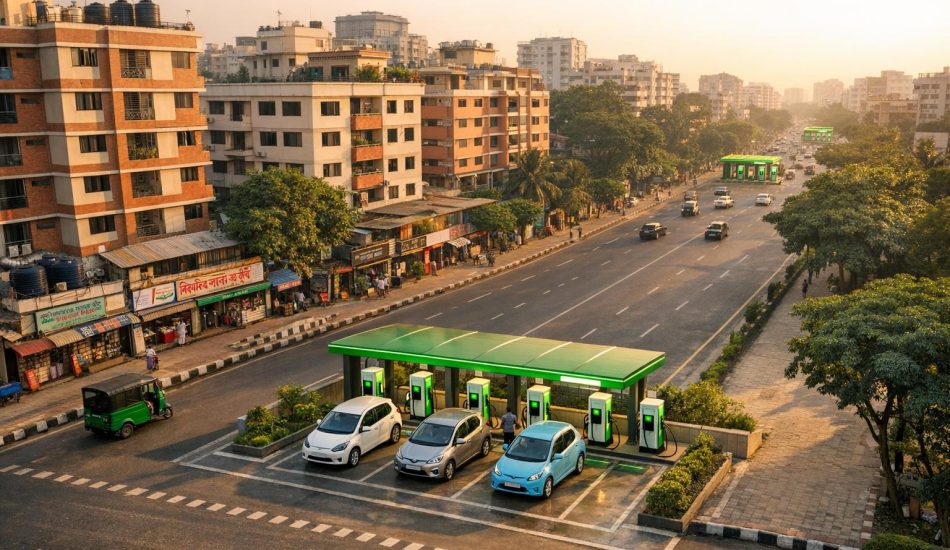
Bishkek, the capital, has the most developed charging infrastructure in Kyrgyzstan. Many new apartment complexes with underground parking make it easier for residents to install private charging points, encouraging a preference for home charging over public options for daily use.
In March 2026, Energy Minister Taalaibek Ibraev and Blue Networks CEO No Sun Yeon announced a plan to install 300 charging stations by July 2026. As part of this initiative, software access keys will be handed over to the Ministry of Energy for streamlined management. A joint venture, Revo KG LLC, has been set up to oversee the project, with an assembly plant for charging stations set to open in April 2026.
Rural Coverage and Expansion Plans
Outside urban areas, Kyrgyzstan is working to address the lack of charging options in rural regions. Historically, charging stations have been limited to major highways and tourist hotspots, leaving remote areas underserved. In February 2026, the state-owned Chakan GES OJSC announced plans to install 10 charging stations in the Issyk-Kul region, with operations expected to begin later in the year. Locations include Karakol (2 stations), Cholpon-Ata, Balykchy, Bokonbaevo, Kyzyl-Suu, and Tyup. These new stations aim to support the tourism industry and improve connectivity in rural areas.
Kyrgyzstan is also tapping into international partnerships to speed up infrastructure development. In June 2025, the Ministry of Economy and Commerce signed a memorandum of understanding with South Korean firms – EVSIS, NGS, and the Korea Automobile Environment Association – to expand charging networks and establish local manufacturing of EV charging stations. The plan also includes educational programmes, such as internships and technical training at Kyrgyz State Technical University, to build local expertise.
"The project opens up new prospects for the sustainable development of urban transport and could become a starting point for the wider introduction of green technologies in Kyrgyzstan." – Akchabar
With approximately 85% of Kyrgyzstan’s electricity generated from hydroelectric power, EV charging is both affordable and environmentally friendly. The government views charging infrastructure as a strategic priority to reduce dependence on imported hydrocarbons. As of early 2026, EVs make up about 0.8% of the country’s total vehicle fleet, amounting to roughly 15,200 vehicles.
EV Adoption Outlook for Kyrgyzstan
Kyrgyzstan’s electric vehicle (EV) market is set to grow steadily through 2026, thanks to low running costs, expanding infrastructure, and supportive government policies.
Cost Savings and Environmental Benefits
The financial appeal of EVs in Kyrgyzstan is hard to ignore, primarily due to the country’s extremely low electricity prices. Back in 2019, the average domestic electricity cost was just $0.036 per kWh (approximately Rs. 10) – a whopping 77% lower than the global median of $0.156 per kWh. EVs are also 3–4 times more energy-efficient than petrol vehicles, translating to significant savings on running costs. For instance, while a Nissan Leaf (priced at $29,990 or Rs. 8,357,200) consumes 18.6 kWh/100 km, a petrol alternative like the Kia Sportage (priced at $31,100 or Rs. 8,666,800) consumes 8.2 litres/100 km.
Over five years, EVs tend to have a lower total cost of ownership compared to petrol cars, especially for larger or more powerful models that typically come with a higher price tag. EVs also benefit from lower maintenance costs and tax exemptions, making them an even more attractive choice.
On the environmental front, EVs align with Kyrgyzstan’s Nationally Determined Contribution to cut emissions by 16% to 44% by 2030. With much of the country’s electricity coming from hydropower and solar energy, charging an EV results in far fewer carbon emissions than fuelling a petrol vehicle. Road transport, which accounts for about 12% of global greenhouse gas emissions, is a growing contributor to pollution in Kyrgyzstan. Shifting to EVs can help curb urban air pollution and support broader climate commitments.
These economic and environmental advantages are further bolstered by strong government initiatives.
Government Support and Tax Incentives
To make EVs even more appealing, Kyrgyzstan has introduced several supportive policies, including tariff exemptions and simplified customs processes. The Eurasian Economic Union (EAEU) has granted Kyrgyzstan a tariff exemption for importing up to 15,000 electric and series hybrid vehicles without customs duties until 2026. This special quota applies to "pure electric cars" and "series hybrid cars" imported by citizens with permanent residence in Kyrgyzstan. However, ownership restrictions prevent these vehicles from being transferred to residents of Russia or Kazakhstan. By late 2025, over 200 electric vehicles were being imported into Kyrgyzstan daily, highlighting the strong demand.
"This customs and tariff measure has already demonstrated positive effects in previous years. We expect it to continue supporting the formation of the electric vehicle market, the development of charging infrastructure, and an increase in the share of environmentally friendly transport." – Andrey Slepnev, EAEU Minister in charge of Trade
In addition to duty exemptions, the government has simplified customs procedures and is digitising them to boost transparency and efficiency. EVs have been exempt from annual registration taxes since 2019 and import duties since 2020. With international backing from organisations like the Korea International Cooperation Agency (KOICA), Kyrgyzstan is positioning itself as a regional leader in green mobility. To support the growing number of EVs, the country plans to add 4.6 GW of hydropower and 3.65 GW of solar power, ensuring the electrical grid can handle the increased demand while maintaining its low-carbon credentials.
Conclusion
Kyrgyzstan’s electric vehicle (EV) market in 2026 presents a lucrative opportunity. Thanks to the EAEU’s 15,000-unit duty-free quota, importing pure electric and series hybrid vehicles becomes a cost-effective option – but only for permanent residents. It’s important to note that vehicles imported under this quota cannot be sold or transferred to residents of Russia or Kazakhstan.
Chinese manufacturers lead the charge in the affordable EV segment. Brands like BYD, Geely, and Changan provide models that are not only budget-friendly but also well-suited to Kyrgyzstan’s rugged roads. When choosing an EV, focus on vehicles equipped with GB/T charging connectors, as this is the most widely used standard in the country. This consideration will help tackle the challenges posed by Kyrgyzstan’s limited charging infrastructure.
Currently, the country has only about 30 public charging stations. For most EV owners, having private parking with a home charging setup is crucial. With electricity priced at just $0.036 per kWh, home charging is incredibly economical. However, public charging options are sparse outside Bishkek. If you live in a multi-unit building in the capital, installing a dedicated AC charger can help you maximise savings.
For businesses interested in entering this market, patience is essential. Setting up charging stations involves navigating lengthy bureaucratic processes, with permits taking approximately 195 days to secure. That said, Kyrgyzstan’s electricity costs are 77% lower than the global median, reducing EV operating expenses by nearly half compared to petrol-powered vehicles. With over 200 EVs entering Kyrgyzstan daily by late 2025, the market is clearly gaining momentum. Combined with government support, these factors create a promising environment for EV growth.
Timing is critical. The 15,000-unit import quota for 2026, coupled with rising demand, means acting quickly is essential. Whether you’re a first-time EV buyer or a business aiming to tap into this growing market, success will depend on understanding the import process, selecting EVs suited to local conditions, and ensuring access to reliable charging solutions. Kyrgyzstan’s EV market is evolving rapidly – don’t miss your chance to be part of this transformation.
FAQs
Am I eligible for the 2026 duty-free EV import quota in Kyrgyzstan?
Yes, Pakistanis are eligible for Kyrgyzstan’s 2026 duty-free electric vehicle (EV) import quota. This programme permits the import of up to 15,000 EVs without tariffs, as part of the Eurasian Economic Union’s initiative. Be sure to carefully review the guidelines and requirements to take full advantage of this opportunity.
Which charging connector should I choose for Kyrgyzstan (GB/T or CCS2)?
The CCS2 connector is a practical choice for Kyrgyzstan since it’s the European standard and is compatible with a wide range of electric vehicles (EVs). On the other hand, GB/T, which is mainly used in China, might need adapters to work with certain EVs. Choosing CCS2 simplifies access to charging networks and helps sidestep potential compatibility problems.
What should I check on a used EV before importing it (battery, papers, resale rules)?
Before bringing in a used electric vehicle (EV), it’s crucial to examine the battery health and capacity to make sure it hasn’t suffered major degradation. Double-check all the legal documents, such as the purchase invoice, registration papers, and any necessary translations. Also, ensure the vehicle adheres to the import regulations in Kyrgyzstan, including left-hand drive requirements, age restrictions, and emission standards. Finally, verify that the EV is compatible with the local charging infrastructure to avoid operational issues.